
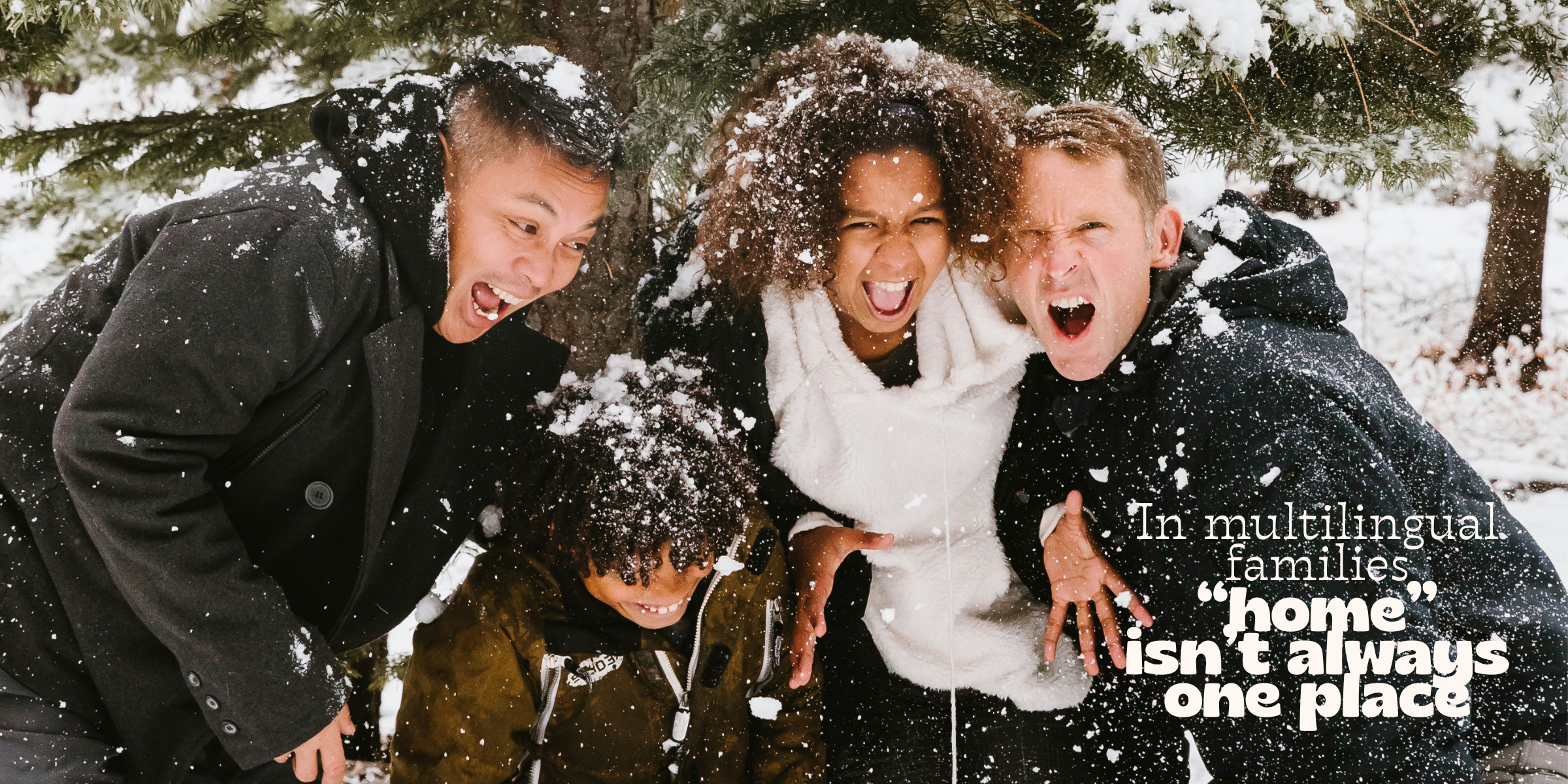
December has a way of amplifying everything in multilingual families. The joy feels bigger. The nostalgia feels sharper. And the tensions? They quietly grow in the spaces between airports, traditions, and languages.
As I pack my suitcase to fly home for Christmas, I can’t help thinking about how many songs are built around the same idea: finding your way back home in time for the holidays. But in multilingual families, “home” isn’t always one place. And “family” isn’t always one group. December becomes a month of choices — sometimes heart-breaking ones.
Because when your family spans countries, cultures, and languages, the question is rarely “Are we going home?”. It’s usually “Whose home?”. And that single question can create a surprising amount of tension.
The Pressure to Make December “Perfect”
What I notice in many multilingual families is this: the holidays carry an enormous pressure to be perfect. Perfectly cosy, perfectly traditional, perfectly nostalgic — yet also perfectly aligned with the traditions of your home country. Songs sung in your mother tongue, dishes prepared exactly as they “should be”, rituals recreated with total accuracy.
Parents worry their children might miss out on the traditions they grew up with. Suddenly December becomes a performance. But perfection is an impossible standard for families already balancing multiple worlds.
When “Both” Isn’t an Option
When extended family lives close by, it’s often easier to balance both parents’ traditions. Perhaps you celebrate Hanukkah with one side and Three Kings’ Day with the other. Perhaps Christmas with one family, and New Year’s Eve with the other. Spending the holidays with family who all celebrate the same way makes both parents feel supported in their traditions.
But the further apart families live, the more challenges begin to arise. Flights become painfully expensive, school and work calendars clash, travelling long distances with children becomes exhausting, and choosing one side over the other, even for perfectly logical reasons, often feels emotional.
Alternating years works in theory, but in practice, it can trigger something deeper. One parent suddenly feels wholly responsible for representing their traditions, their culture, their language, when it feels like it’s being drowned out by their partner’s. This can create additional tension, stress, and even resentment.
The Language Dilemma
Language usually complicates things even further. If one heritage language is stronger than the other, children may dread conversations where they feel insecure, and try to avoid them. This can lead them to prefer celebrating with one side of the family over the other.
And then parents feel guilty, grandparents feel sad, and children feel misunderstood. Everyone feels like they’re letting someone down. And suddenly a holiday meant to be joyful becomes bittersweet.
So How Do Multilingual Families Reduce December Tension?
There is, unfortunately, no one-size-fits-all solution. But there are ways to make the holidays feel more intentional, and less overwhelming.
1. Plan early and realistically
Think carefully about what is feasible, emotionally and financially. Try not to base your decisions on guilt, but on real parameters like flight prices and holiday schedules.
2. Identify which traditions matter the most
Discuss the traditions that matter most to each of you and try to implement them intentionally. Not every tradition needs equal time, but every culture deserves acknowledgment
3. Make use of digital tools
Video calls, recorded messages, shared playlists and photos can help distant relatives participate even without travel.
4. Use your heritage languages naturally
Read stories, play music, share traditions about the holidays in the lead up to these days in their language. This gives your children context.
5. Blend and adapt traditions
Let different cultures simply exist side by side when possible. Think about how you can honour multiple cultures in one meal or participate in multiple traditions side by side.
6. Involve the “other” side of the family
When you’re visiting one side, introduce them to some things from the other. Bake sweets together, share music, translate stories, or include small rituals that are easy to add.
7. Create your own family traditions
New, hybrid traditions can be just as meaningful as inherited ones. They portray your unique family identity and help children feel connected to all parts of their heritage.
8. Let go of perfectionism
It only creates guilt. The holidays aren’t a performance. You’re allowed to enjoy them without getting everything just right.
What December Teaches Us
December tends to be like a magnifying glass. Languages overlap, traditions collide, and the question “Where do I belong?” often feels louder than usual. Also, joy, curiosity and connection grow. December shows us the richness of having multiple cultures, the emotional weight and perceived responsibilities of heritage, and the creative ways families find to carve out their own identities.
There’s no “right” way to celebrate December when you come from more than one world. Messy, hybrid, unconventional holidays aren’t a failure — they’re authentic, unique, and most importantly, they’re yours. And that alone makes them meaningful.
If some of these December tensions feel familiar and you’d like support in navigating them, I offer personalised consulting for multilingual and multicultural families.
Together, we look at your specific challenges — whether that’s heritage language balance, competing traditions, identity concerns, or family expectations — and develop a plan that supports both your values and your wellbeing.
Leave a Reply