Every year, people set intentions about who they want to become. Resolutions are written down, goals are set, and intentions often centre on self-improvement: becoming more confident, communicating more clearly, learning something new. Learning a new language often appears somewhere on that list.
Many people associate personal growth with clear goals and visible progress. What’s rarely acknowledged is that language learning doesn’t just add a skill. It reshapes how we deal with uncertainty, imperfection, and persistence. Progress is rarely linear; it’s often frustrating, uneven, and at times discouraging. But it’s within this ongoing messy process that some of the most lasting lessons emerge.
Learning to stay with the process
Language learning offers a particularly honest version of personal growth. Improvement happens slowly, and not always visibly. Moments of confidence are followed by periods of doubt, and the sense of “having it” can disappear just as quickly as it appeared.
What this requires isn’t constant motivation, but commitment. Continuing to engage despite frustration teaches patience and resilience. Over time, this reshapes expectations around growth itself. Progress becomes less about measurable milestones and more about sustained effort.
For those who live with more than one language, this process isn’t tied to a single goal or time frame. It becomes part of their everyday life.
When language becomes noticeable
Language often remains invisible until it stops working effortlessly. This tends to happen during moments of transition: moving between countries, entering new education systems, navigating unfamiliar social environments, or stepping into professional spaces where the dominant language isn’t your own.
I first experienced this when moving to Spain and later to Germany, starting school in languages that I wasn’t yet fluent in. Communication suddenly required effort, and self-expression felt constrained. More than that, there was a growing awareness of being perceived differently because of how I spoke, hesitated, or searched for words.
These experiences highlighted how closely language and identity are intertwined, and how growth often begins in moments where fluency is interrupted.
Learning to speak without certainty
One of the quieter lessons multilingualism teaches is that communication never arrives fully formed. There are pauses, rephrasing, misunderstandings, and moments where meaning has to be negotiated rather than delivered.
Over time, this leads to a crucial realisation: imperfect communication is always better than no communication at all. Waiting for the right words can mean missing the moment entirely; waiting until everything feels correct can mean not speaking at all. Choosing to engage, even imperfectly, builds confidence and connection far more reliably than silence.
This principle extends well beyond language learning. Many of the goals people set for themselves each year require action before clarity arrives. Growth often follows engagement, not the other way around.
Identity across languages
Multilingualism also encourages reflection on identity. Many people notice that they express themselves differently depending on the language they’re using. Tone shifts, behaviour changes, and different aspects of personality come to the foreground.
In my own case, I’m louder and more expressive in Spanish, more chatty and reflective in English, and quieter and more reserved in German. These differences aren’t contradictions. They reflect context, cultural expectations, and emotional associations tied to each language.
Recognising this complexity can be deeply grounding. Rather than searching for a single, fixed version of the self, multilingualism makes space for adaptability and self-awareness.
Becoming aware of perception
Living in more than one language also sharpens awareness of how people are perceived. Accent, fluency, hesitation, and silence influence assumptions about competence, confidence, and belonging.
Experiencing this from multiple perspectives encourages careful listening and empathy. It becomes easier to recognise that communication isn’t only shaped by what’s said, but by how it’s received. This awareness often leads to greater patience, both with others and with oneself.
Growth beyond resolutions
As the year progresses, resolutions often shift or fade. What tends to remain isn’t the list itself, but the mindset behind it: openness to learning, willingness to adapt, and acceptance of imperfection.
For me, multilingualism has become a constant reminder of this process. What once felt complicated now feels integral. It’s a core part of my identity, my values, and my work. It may not promise ease or clarity, but it reflects how growth actually happens.
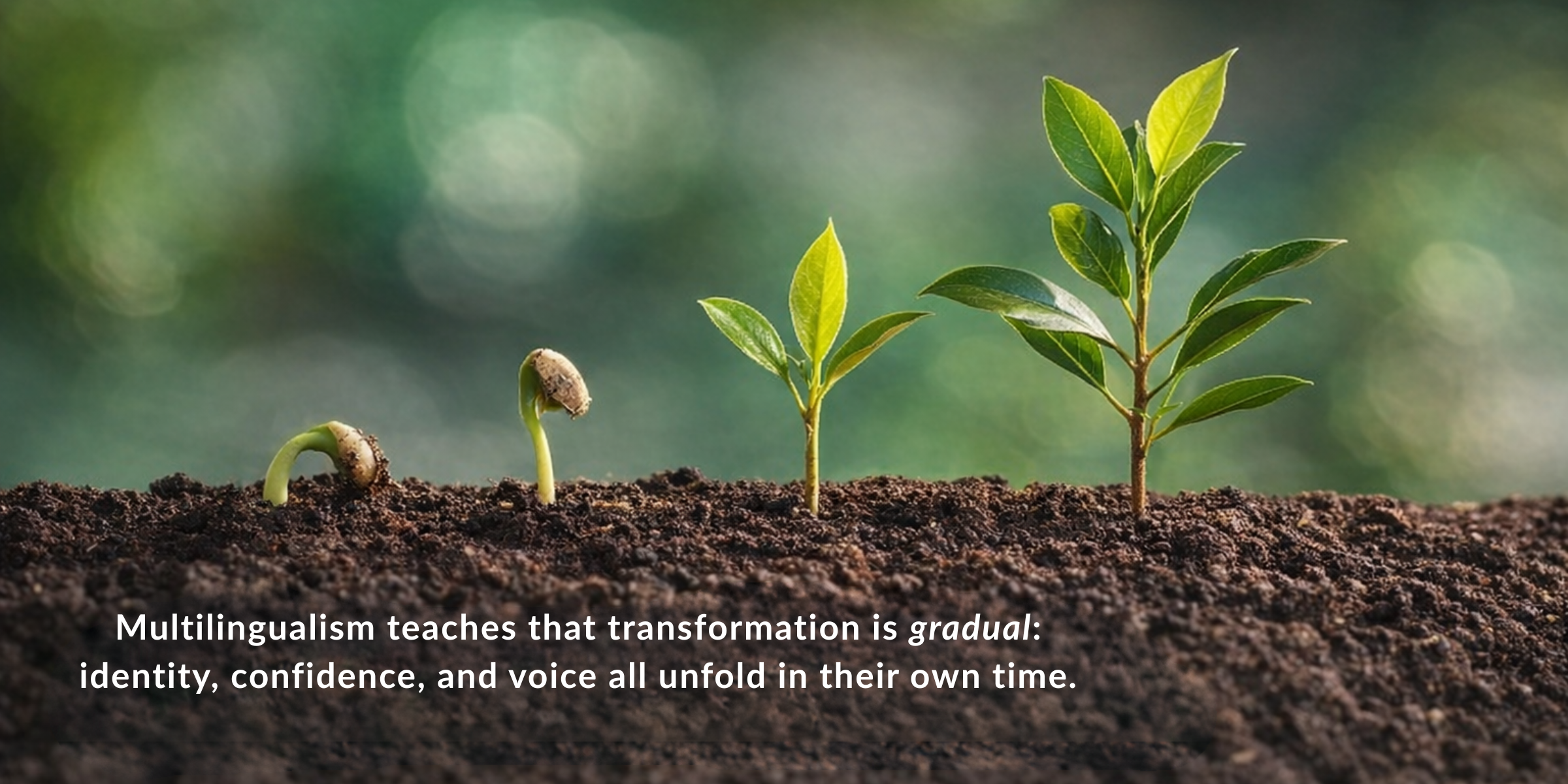
The quiet lessons of multilingualism are rarely dramatic. They unfold gradually, through repetition, adjustment, and continued engagement. And perhaps that’s what many yearly goals are really asking of us: not transformation overnight, but the courage to stay with the process, even when it feels uncertain.
Thanks for reading!
If you’re navigating questions, challenges, or personal goals around multilingualism — whether in your work, family life, education, or everyday experiences — I offer individual consulting sessions that focus on clarity, reflection, and practical support.
You can find more information about my work and current offers here. I also share ongoing insights and resources on Instagram, Facebook, and LinkedIn.
Leave a Reply