On intimacy, language, and the quiet work of understanding
Falling in love across languages is a curious blend of magic and challenge. Sometimes it looks like laughter over a word neither of you can quite pronounce. Sometimes it looks like silence, searching for the right one. Sometimes it’s shared understanding, and sometimes it’s one misunderstanding after another.
In multilingual relationships, communication doesn’t only happen between two people. It moves between languages, cultural expectations, emotional registers, and levels of linguistic comfort. Every conversation carries layers, some visible, some hidden beneath the surface.
Words can bridge hearts, but they can also reveal differences. They can create closeness, and they can expose the small gaps where meaning slips through.
Love, in this context, exists not only in shared laughter, small gestures, or quiet understanding, but also in the subtle choices of how we speak, what we leave unsaid, and which language we reach for when emotions run deep. Multilingual love isn’t romanticised ease. It’s effort, learning, patience, and growth.
Love Doesn’t Remove Language Barriers
It’s tempting to believe that love makes communication effortless. That if two people care deeply for each other, language differences will naturally fade into the background. Popular narratives often suggest that love is a universal language, capable of smoothing over any obstacle.
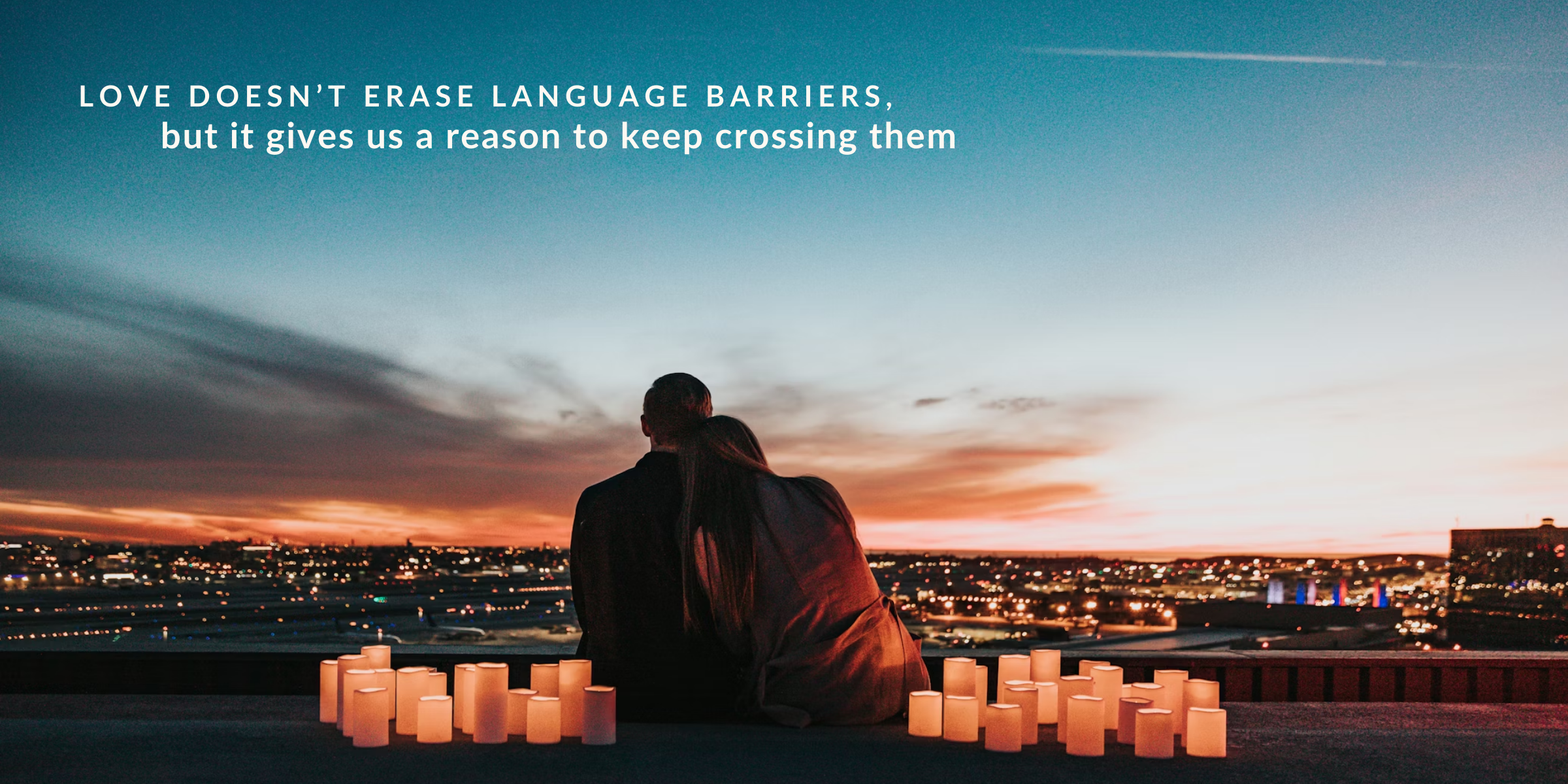
But love doesn’t erase language barriers. It gives us a reason to keep crossing them.
Even in relationships where both partners are multilingual, communication can be complex in ways that aren’t immediately visible. One of the first, often unspoken, decisions is which language to use. Partners may share more than one language, yet none of them is ever truly neutral.
A native language often carries intimacy, warmth, and emotional history. A second or third language may feel practical, structured, or emotionally distant. These differences shape how partners express affection, frustration, vulnerability, and care, and how safe they feel doing so.
Power Dynamics Shift with Language
Once a shared language settles into place, another layer emerges.
Language proficiency shapes relationships in subtle but powerful ways. The partner speaking their stronger language usually has easier access to nuance, humour, and emotional precision. They can choose words quickly, adjust tone instinctively, and express complexity without much conscious effort.
The partner using a weaker language may sound simpler, more hesitant, or less confident than they actually are. Their thoughts may be just as rich, but harder to access.
This can create quiet imbalances. A fluent speaker may unconsciously use complex vocabulary or cultural references, while the other struggles to keep pace. Even everyday conversations like planning a weekend, discussing a problem, or expressing a need can require extra mental energy.
Yet this careful navigation is also an act of love: slowing down, rephrasing, checking understanding, and celebrating moments of shared clarity.
The Emotional Labour of Translating Yourself
Imbalance doesn’t only show up in conversation. It shows up internally, in how we think, feel, and move through the relationship.
Translation in multilingual relationships is rarely just about words. It also involves translating tone, emotional weight, humour, values, and cultural expectations. It means constantly asking yourself not only what you want to say, but how to say it in a way that will land.
There are moments when explaining what you feel is manageable, but explaining why feels heavy, especially when the reasons are rooted in cultural experiences your partner hasn’t lived.
Over time, constantly translating yourself can be exhausting.
Some days, you don’t want to be understood better, you just want to be understood without working so hard for it.
Wanting that ease doesn’t mean communication has failed. It reflects the emotional cost of living between languages, and the quiet longing for rest inside a relationship.
How Language Shapes Identity
Living between languages doesn’t only shape communication. It shapes identity.
Language shapes who we are and how we show up in the world. Our humour, confidence, boundaries, and emotional expression often change depending on the language we’re using, sometimes so subtly we only notice in retrospect.
In one language, you may feel witty and assertive. In another, more cautious or vulnerable. You might tell different stories. You might soften or sharpen your edges.
Speaking multiple languages can mean inhabiting multiple versions of yourself within the same relationship. Partners witness these shifts and learn to adapt to each other’s evolving selves. Over time, this fosters a unique closeness: the knowledge that your partner not only loves you, but sees you across your different linguistic identities.
Loving someone across languages often means learning who they are in each one, and also accepting that identity is layered, not fixed.
A Quieter Kind of Connection
All of this adds up to a particular kind of intimacy.
Multilingual love may not always look effortless. But it offers something quietly profound: an awareness of difference, a respect for complexity, and an understanding that connection is something we actively build, again and again, in small, often invisible ways.
Love across languages isn’t about speaking perfectly. It’s about choosing, repeatedly, to meet each other where understanding is still in progress.
It’s about staying, trying, and finding your way back to each other. And that, perhaps, is love at its most honest.
A Small Glimpse into Reality
That honesty often lives in ordinary moments.
My husband and I both grew up trilingual. He grew up with German, Turkish, and Kurdish. I grew up with English and Spanish, and German later on.
He learned English and Spanish in school. I’m currently learning Turkish after struggling with Kurdish varieties and the lack of accessible learning materials.
We speak German most of the time. We live in Germany, and we’re both fluent, so it makes sense. But I notice that German still feels more difficult for me when I’m tired or overwhelmed. In those moments, it helps to be able to mix in an English or Spanish word when I can’t find the German one, or to switch languages entirely when needed. It also creates a sense of ease to share languages we can speak when we’re with family or friends who don’t speak German.
Recently, we’ve started incorporating a bit of Turkish into our daily life, allowing me to practise without judgement. These moments don’t solve everything. But they soften the space between us.
Belonging Beyond the Couple
What happens between two people inevitably ripples outward. Multilingual relationships extend into families, friendships, and social spaces where language differences become more visible.
Family gatherings where not everyone shares a common language can create moments of quiet isolation, even in loving environments. You may be surrounded by people and still feel slightly outside the circle.
Inclusion often depends on translation, repetition, and conscious effort. Many couples find themselves acting as bridges not only between languages, but between worlds. In these moments, multilingual love becomes intercultural love. Feeling welcomed isn’t just about being present. It’s about being able to participate meaningfully.
Love as a Shared Learning Space
Because of this, multilingual relationships aren’t about achieving perfect understanding. They’re about staying engaged in the process of learning about language, culture, and each other.
This learning is mutual. It requires curiosity and patience. It also involves accepting misunderstandings, fatigue, and limits. Love becomes an ongoing act of translation. Sometimes smooth, and sometimes messy, but always meaningful. And perhaps that’s the point.
Love Beyond Words
Maybe multilingual love isn’t defined by how well we translate each other at all.
Maybe it’s defined by how willing we are to stay in the spaces where translation is incomplete. Where sentences trail off, where we search for words together, and where meaning is built slowly through repetition, gesture, and shared history.
In those spaces, language becomes less about precision and more about presence. Words may stumble, and phrases may falter, but something steady remains. That steadiness is the knowledge that care can exist even when understanding is partial. It’s the willingness to remain present, to keep trying, and to keep learning about each other in every language you share.
Multilingual love asks us to accept imperfection and to embrace the work it takes to understand and be understood. It reminds us that intimacy isn’t measured in flawless communication but in the effort, patience, and attention we give one another day after day. In this way, love becomes both practice and discovery: a commitment to presence, curiosity, and shared humanity.
If you’re navigating a multilingual relationship and want guidance on how to communicate with empathy, bridge language gaps, or embrace the richness of multiple languages in your connection, I offer personalised consulting and support tailored to your unique situation. Together, we can make communication feel easier, more meaningful, and more joyful, in every language that matters to you.
You can find more information about my work and current offers on my website. I also share ongoing insights and resources on Instagram, Facebook, and LinkedIn.
Leave a Reply