Why Language Belongs at the Heart of Your Inclusion Strategy
Walk into almost any mid-sized company today and you’ll find a quietly multilingual workforce. Someone doing mental arithmetic in Polish before answering in German. A team meeting where three people are working hard to follow a fast-paced conversation in a language that isn’t their first. A new hire who is highly qualified, deeply motivated, and exhausted by the end of every working day because they’ve been thinking across two languages since nine in the morning.
Multilingual workplaces aren’t new. But truly inclusive ones are still relatively rare, and the gap between the two matters more than most organisations realise. Inclusion in the workplace has rightly become a priority for many companies, yet language — one of the most fundamental dimensions of human identity and experience — is often left out of the conversation altogether. Not out of bad intentions, but because it’s harder to measure than other forms of diversity, less visible, and it touches something so personal that naming it can feel genuinely uncomfortable.
This post is a practical one.
Here are five ways to build a workplace where multilingualism isn’t just present, but genuinely included.
1. Acknowledge Language Diversity Openly
The first and most underestimated step is simply to talk about it. Many workplaces operate under a quiet assumption that everyone is equally comfortable in the working language, and that assumption is almost never accurate. The silence around it leaves multilingual employees carrying an invisible weight: the pressure to appear fluent, to keep up without flagging, to ask for nothing.
When an organisation names language diversity openly, something shifts. Employees feel less pressured to mask their linguistic reality, and it becomes easier to ask for clarification, to flag when a document isn’t fully clear, or to admit that a meeting was hard to follow. None of that signals inadequacy. It signals honesty, and it only happens when the culture actively makes space for it.
As a manager or leader, you can model this yourself without needing a new policy or a formal initiative. Ask your team whether communications are genuinely accessible. Slow down. Check in. The conversation has to start somewhere, and it can start with you.
2. Make Key Materials Accessible in Multiple Languages
This one is practical, and it matters more than many organisations recognise. Onboarding documents, safety information, HR policies, contracts: these are materials that employees need to understand completely and confidently. When they exist only in a language someone is still developing fluency in, the consequences go beyond confusion. It signals, quietly but clearly, that their experience wasn’t fully thought about when the materials were written.
Where full translation isn’t feasible, plain language is always a meaningful first step. Short sentences, no jargon, clear structure. These changes benefit not only multilingual employees but everyone on the team, and they cost very little to implement. If your organisation is already international or growing in that direction, multilingual documentation isn’t a luxury but a basic act of care.
3. Design Meetings for Multilingual Participation
Team meetings can be one of the most excluding spaces for multilingual employees, and very often entirely unintentionally. Fast conversation, cultural idioms, overlapping turns, and humour that depends on linguistic nuance all put multilingual speakers at a significant disadvantage, even when their professional skills and knowledge are strong.
Small structural changes make a real difference here. Sharing a written agenda in advance gives people the chance to prepare. Visual summaries reinforce what’s being discussed and take some of the pressure off real-time processing. A slightly slower pace, and a genuine willingness to wait rather than filling every pause, creates space for people to formulate their thoughts properly.
It’s also worth noticing who tends to speak most in your meetings and who tends not to. Silence doesn’t always mean disengagement. Sometimes it means someone is working harder than anyone around them realises, just to follow the thread.
4. Challenge “Native Speaker” Bias
This is perhaps the most uncomfortable tip on the list, and probably the most important one. Native speaker bias is widespread, often unconscious, and has real consequences for the people on the receiving end of it over the course of a career.
It shows up in job descriptions that list “native-level fluency” as a requirement when what’s actually needed is clear, professional communication. It shows up in performance reviews where an accent or occasional grammatical difference gets read as a lack of polish or professionalism. And it shows up in decisions about leadership: in who gets put forward, who gets visibility, and who is quietly assumed to be less capable of representing the organisation in high-stakes situations.
Linguistic fluency in the working language isn’t the same as competence, intelligence, or leadership potential. Some of the most skilled and creative professionals in any given organisation may be working in their second or third language every single day. Auditing your hiring criteria, your promotion frameworks, and your feedback culture with this in mind is a genuinely important step.
5. Treat Multilingualism as the Asset It Actually Is
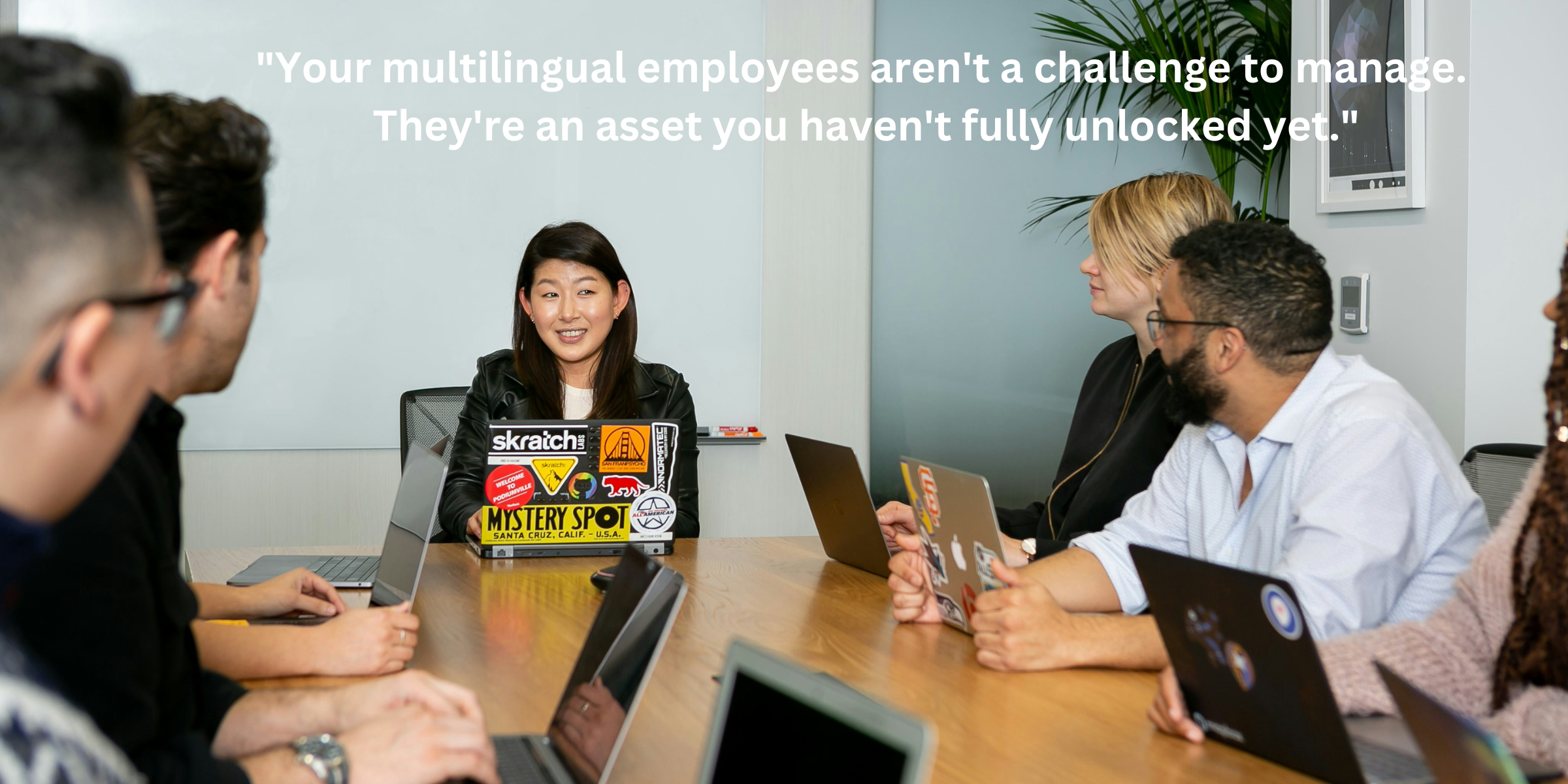
The final shift is also a reframe. Multilingualism isn’t a complication to be managed or a difference to be accommodated. It’s an asset, and one with real, measurable value that often goes unacknowledged.
Employees who speak multiple languages bring cultural insight, broader networks, and the ability to communicate across contexts that monolingual colleagues can’t access in the same way. Research supports what many multilingual professionals already know intuitively: linguistic flexibility tends to go hand in hand with cognitive flexibility, adaptability, and a capacity to hold multiple perspectives at once. Celebrating this genuinely and visibly, rather than just in a diversity statement, sends a message that multilingual employees hear and remember. You’re valued here because of who you are, not in spite of it.
Why This Matters Beyond the Working Day
Inclusive language practices aren’t just good for employees. They’re good for organisations. Teams that feel genuinely included tend to communicate more honestly, contribute more freely, and stay longer. The cost of exclusion, in turnover, in disengagement, in the ideas that never get voiced, is far higher than most companies account for.
The people in your multilingual team are bringing their whole selves to work every day, navigating complexity that most monolingual colleagues will never fully see. They deserve workplaces that meet that effort with genuine thought, not just tolerance.
Building an inclusive multilingual workplace isn’t a one-time project. It’s an ongoing practice of listening, adjusting, and choosing to do better when you notice a gap.
If you’re thinking about how to bring more inclusive language practices into your organisation, sometimes the clearest place to start is simply taking a step back to look at the whole picture: which structures are already working, which ones are quietly excluding people, and where a few intentional changes could make a real difference for the people on your team.
I offer a free 30-minute introductory call where we can look at your organisation’s language situation together and explore what next steps might look like for your specific context.
You can find out more about my work and current offers on my website, and I share regular reflections and practical insights on multilingualism on Instagram, Facebook, and LinkedIn. I’d love to have you there!
Leave a Reply