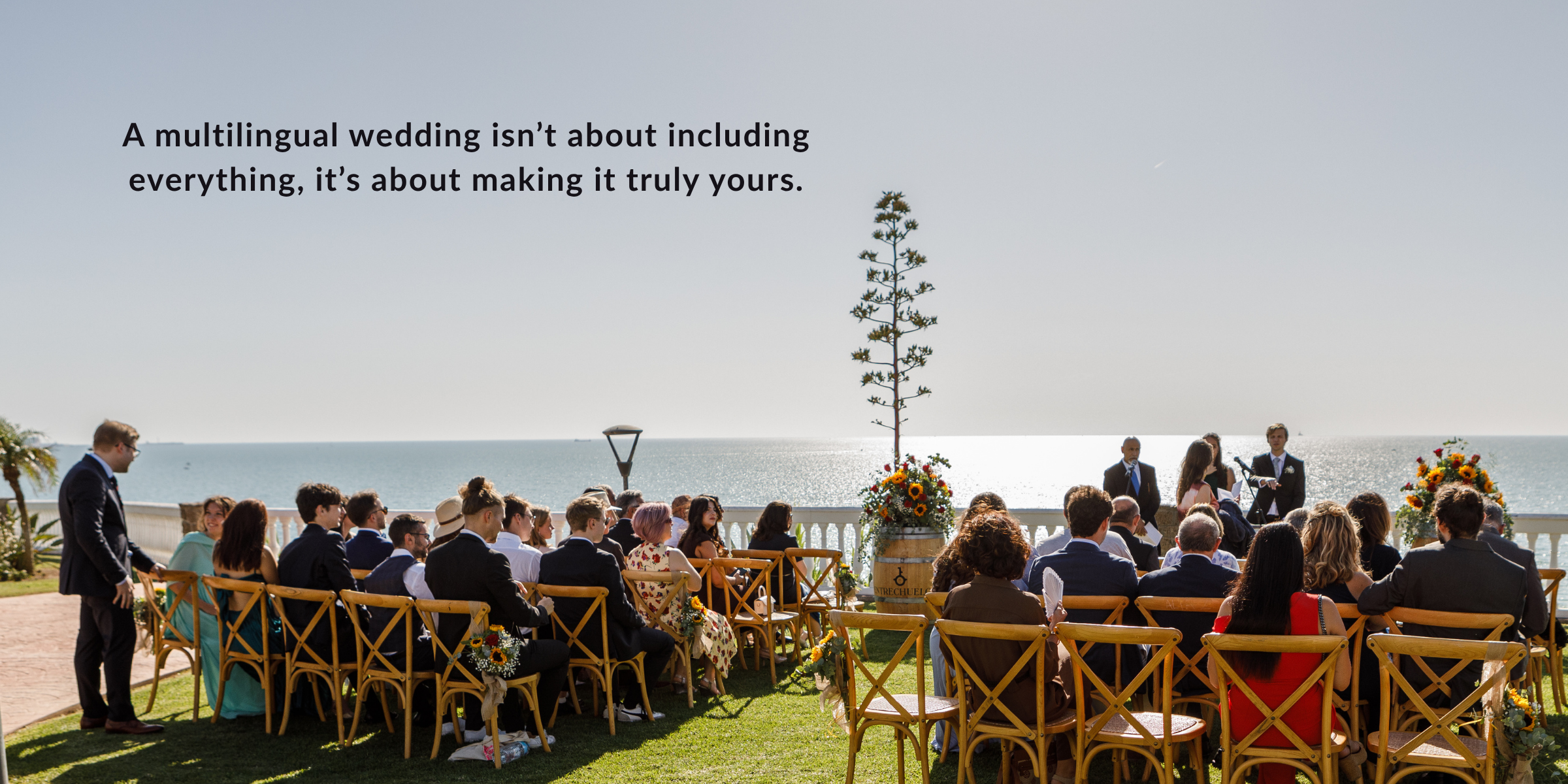
Eight countries. Five languages. Three officiants. One very carefully considered decision about where in the world to get married.
That’s a snapshot of our wedding, and behind every one of those numbers is a choice we had to make with care, sometimes against the grain of what felt easiest or most expected. This is the story of how it actually happened, including the parts that were harder than I’d anticipated, and what I’d do differently, or exactly the same, if I had the chance again.
Choosing Where to Get Married
Deciding where to get married when your guests come from eight different countries isn’t a simple logistical question. It’s a values question, and an emotional one, and honestly one of the harder conversations we had as a couple before we even started planning anything else.
There’s a temptation, when you’re in a multicultural relationship, to try and find the neutral option. The place that feels fair to everyone. What I’d tell you is that this place doesn’t really exist. Wherever you choose, someone will have a harder journey. Someone will pay more for flights. Someone will need a visa. Someone will have to take more time off work. The goal isn’t a perfectly equitable solution. The goal is a decision you can stand behind with a clear conscience, knowing you thought it through honestly.
We chose Spain. Not because it was the obvious answer, not because it was the easiest, but because my Spanish family are the ones who find travel most difficult. My husband’s family includes people from Turkey, and getting to Spain from Turkey isn’t straightforward either. We thought carefully about who would struggle most, what we could realistically ask of people, and what felt like the most generous choice we could make. Spain kept coming up as the answer.
We also knew from the start that we didn’t want a wedding that felt like it belonged to any one culture. Not a Turkish wedding, not a British one, not even a straightforwardly Spanish one. We wanted something that felt genuinely like us: rooted in the languages and places that actually make up our life together. Choosing Spain gave us that foundation. Even with everything it entailed.
And it entailed quite a lot.
Planning a Wedding in a Country You Don’t Live In
We were based in Germany. Planning a wedding in Spain, from Germany, is a particular kind of adventure. There were trips back and forth to visit the venue, meet vendors, and sort things in person that simply couldn’t be done over the phone. There were calls with florists, caterers, and coordinators, all happening in Spanish. There were decorations we wanted to bring from Germany that weren’t exactly easy to transport across an international border. And there was the constant low-level effort of coordinating everything remotely, without being able to simply pop in and deal with something when it went wrong.
My honest advice here: build in far more time than you think you need, and accept early on that not everything will move at the pace you’d like. Because one of the things that caught me most off guard was the difference in planning culture. My husband approached the whole process in quite a German way: let’s decide, confirm, and move forward quickly. Spanish vendors, understandably, operate on a different rhythm entirely. “You’ve still got loads of time. Come back next week.” Which is perfectly reasonable if you’re local and can simply come back next week. Slightly maddening when you’re calling from abroad and trying to get things pinned down months in advance.
Neither approach is wrong. They’re just different. And understanding that early, rather than taking it personally or letting it create friction, would’ve helped us both.
There was also the question of family involvement, which turned out to be more loaded than I’d expected. My husband’s family, coming from a Turkish and German background, expected my family to take a much more active role in the planning. To take over, really, in the way that might be more traditional in those cultural contexts. My family, being Spanish and English, simply weren’t built that way. They were supportive, and they cared deeply, but getting hands-on with their children’s wedding planning wasn’t really how they operated. And on top of that, my parents and sister had only just moved back to Spain a few months before the wedding. Everyone had a lot going on.
It took a while to understand where those different expectations were coming from. Once we talked about it openly, things became much easier. If you and your partner come from different cultural backgrounds, I’d encourage you to have that conversation early: what does “family involvement in wedding planning” look like in each of your families? Because the assumptions you’re both carrying might be very different, and neither of you will know that until you ask.
If you’re also the multilingual one in your partnership, the one who speaks the language of the country you’re marrying in, a lot will naturally fall to you. Not just vendor communication, but cultural navigation, translation, and being the person in the middle who holds it all together while also trying to be a person who’s planning their own wedding. That’s a lot. Name it with your partner early, and be specific about where you need support.
Sorting the Paperwork
This is the section nobody writes about in wedding blogs, but it’s one of the most practically important things to know. Getting married in a different country comes with its own administrative layer. There’s extra documentation required, beyond what you’d need if you were marrying at home. And afterwards, once you’re back in your country of residence, you’ll need to register the marriage there too. It’s all completely manageable, but it takes time, it requires research, and it’s absolutely worth looking into before you start planning anything else.
We actually considered signing the legal paperwork in Germany. It would’ve been simpler in some ways, logistically speaking. But the more we thought about it, the more wrong it felt. My parents and sister are in Spain, and doing something that significant without them there didn’t sit right with either of us. So we signed in Spain, on the morning of the wedding, with a small group of people we love. It was a bit hectic, with photos and a rather lively breakfast afterwards. Not the quiet, intimate moment people sometimes imagine. But it was exactly right, and I’m glad we didn’t let convenience talk us out of it.
The Invitations
Our invitations were in four languages: English, Spanish, German, and Turkish. Those are the four languages that live most centrally in our household and our families, and everyone on the guest list spoke at least one of them. It felt like a genuine reflection of who we are, rather than a gesture towards inclusion. There’s a difference between the two, and it’s worth sitting with that distinction when you’re making these decisions.
We also included a short overview of the ceremony on the invitations so guests arrived knowing roughly what to expect: which languages we’d be using, the broad shape of the day. We wanted people to feel oriented, not adrift. When you’re hosting guests across multiple languages and cultures, a little advance context goes a long way.
The Ceremony
We’d originally planned to include all four languages in the ceremony too. But as the guest list took shape, we realised that only one person attending, my husband’s aunt, wouldn’t speak any of the three main ceremony languages fluently. Even so, she understands a little English, and her son was there and could translate for her what she didn’t catch, which worked out beautifully. The ceremony became three languages: Spanish, German, and English. It felt right, and it meant that almost everyone could follow along directly rather than through someone else.
We had three officiants: my uncle, and our two witnesses. Each of us said our “I dos” in all three languages, and something about repeating those words in three different tongues made each one feel more weighted, more considered. It’s not just saying yes once. It’s saying it in every language that matters to your life. I’d highly recommend this, even if the logistics of it take a little more thought.
We chose not to use printed programmes on the day, beyond the overview already included on the invitations. Some couples create elaborate multilingual order-of-service booklets, and that can be a beautiful touch if it feels right to you. For us, keeping it simple meant guests were present in the moment rather than following along on paper. There’s no single right answer here. Think about what kind of ceremony you want people to experience, and let that guide the decision.
Seating by Language
We seated guests by language group for dinner, and I’d recommend this to almost anyone hosting a multilingual gathering, not just a wedding. It wasn’t about keeping people apart. It was about making sure that everyone started the evening feeling comfortable, able to turn to the person next to them and have a real conversation, rather than spending the first hour smiling politely and hoping for the best.
Connection across languages tends to happen more easily once people are relaxed and well-fed. And something lovely did happen: by the end of the night, people were crossing tables, finding each other, making connections we hadn’t planned for. You can’t engineer that kind of warmth. But you can create the conditions for it, and seating thoughtfully is one of the simplest ways to do that.
The Speeches
We kept speeches short and personal. Both of us said a few words in the same three languages as the ceremony. Our families aren’t naturally comfortable speaking in public, and we had no desire to put anyone in that position. When you’re at a multilingual wedding, there’s a particular pressure that can come with speeches: the fear of excluding guests, the temptation to over-explain or keep translating yourself mid-sentence. By keeping ours brief and heartfelt, we avoided all of that. It felt warm rather than performative.
Our officiants each gave a short personal speech in their own language, with no translation and no attempt to make them identical to each other. Each one was its own thing, from that person, in the language that was theirs. Guests who didn’t speak that language might not have understood every word, but they felt it. That’s something I’d encourage others to consider: not every moment needs to be universally comprehensible to be universally felt.
If you do want longer speeches, one approach is to assign each speaker a single language and make sure the key sentiments are covered across the languages between them. Another is to give speakers a short summary of their speech in each relevant language to read at the end. What doesn’t tend to work well is asking someone to translate themselves live and at length. It rarely flows naturally, and it can make an already nervous public speaker feel even more exposed.
What I’ll Always Remember
At some point during the day, it struck me that this was probably the only time in my life when every person who mattered to me would be gathered together in the same space, under the same sky. People who’d never met, from countries that don’t often share a table, finding each other. My friends from different countries got to know one another. My family met people they’d only heard stories about. For one day, all of those separate worlds overlapped.
It was magical. And I’d do every complicated, carefully considered bit of it again without hesitation.
That’s what a multilingual wedding can be, when you stop trying to make it perfect for everyone and start making it true to yourselves.
The One Thing I’d Tell Every Multilingual Couple
Be clear about what you want. Not what your family wants, not what makes the most logical sense geographically, not what feels like the polite thing to do. What do you want? Which languages and cultural elements feel genuinely yours? Which feel like you’re including them for someone else’s comfort?
A multilingual wedding isn’t a diplomatic exercise. You don’t have to represent every language spoken by every guest. You’re not running a United Nations summit. You’re celebrating a marriage, and that marriage belongs to the two of you first.
The most meaningful multilingual weddings aren’t the ones that tried to include everything. They’re the ones where every choice, linguistic and otherwise, felt like it came from the couple themselves.
A multilingual wedding is just one of the many moments in a multilingual life that deserves a little more thought and a lot more intention. If you’re in the middle of planning yours, or wondering how to navigate any big life event across languages and cultures, I’d love to think it through with you.
I offer a free 30-minute introductory call where we can look at your specific situation together and work out where to start.
You can find out more about my work on my website, and I share regular reflections and practical insights on multilingualism on Instagram, Facebook, and LinkedIn. I’d love to have you there!
Leave a Reply