
A multilingualism consultant reflects on her own rocky start in the German school system, and the teachers who made all the difference.
I was ten years old when my family moved to Germany. My parents had done what they could: they’d organised a private tutor, and I’d had four months of German lessons before we arrived. Enough to introduce myself and tell someone that I’d lost my pencil. Not enough to sit in a classroom and understand what anyone was saying.
What followed was six months of being moved from school to school, class to class. Three schools. Four classes. A trial period here, a transfer there, a slow institutional realisation that nobody quite knew what to do with me.
Part of the problem was structural. In Germany, the school you attend from age ten onwards depends on the grades you earned in primary school: the highest track is the Gymnasium, which leads to university; the middle track is the Realschule; and the Hauptschule is the more vocational path. The system works well enough for children who’ve been through German primary school. For a child arriving from Spain, where grades worked differently and the whole framework was unfamiliar, nobody knew where I belonged. And so the shuffling began.
I think about that period a lot now. Not with bitterness. But because I see the same dynamics playing out for the multilingual children I work with as a consultant, and because the difference between the teachers who helped me and the ones who didn’t had very little to do with talent or effort. It had to do with whether they had a way of thinking about what a multilingual child actually needs.
When Protection Becomes a Problem
Most German schools have a structure for children who arrive without the language: a transition class, known as an Übergangsklasse, where foreign-language learners are grouped together and taught basic German before joining the mainstream. In principle, it’s a thoughtful idea. In practice, it can go quite wrong.
My first transition class was at a primary school, where they placed me in the same class as my younger sister. It was lovely to be together, but the class was covering the very basics we’d already learned from our tutor back in Spain. I spent a week or two there before being moved on, which was the right call, even if the move itself was unsettling.
The second was a transition class at what would’ve been the vocational track school. The children there were learning to write. I was bored out of my mind. I made friends with a few Spanish-speaking kids, which was something, but academically I was completely unchallenged. The teachers were kind. The fit was wrong.
The problem with grouping multilingual children by language level alone is that language level is only one dimension of a child. I wasn’t a beginner learner who needed to start from scratch. I was a fluent reader in two languages, a motivated student, and someone who was going to acquire German fastest by being surrounded by it and stretched by it, not sheltered from it.
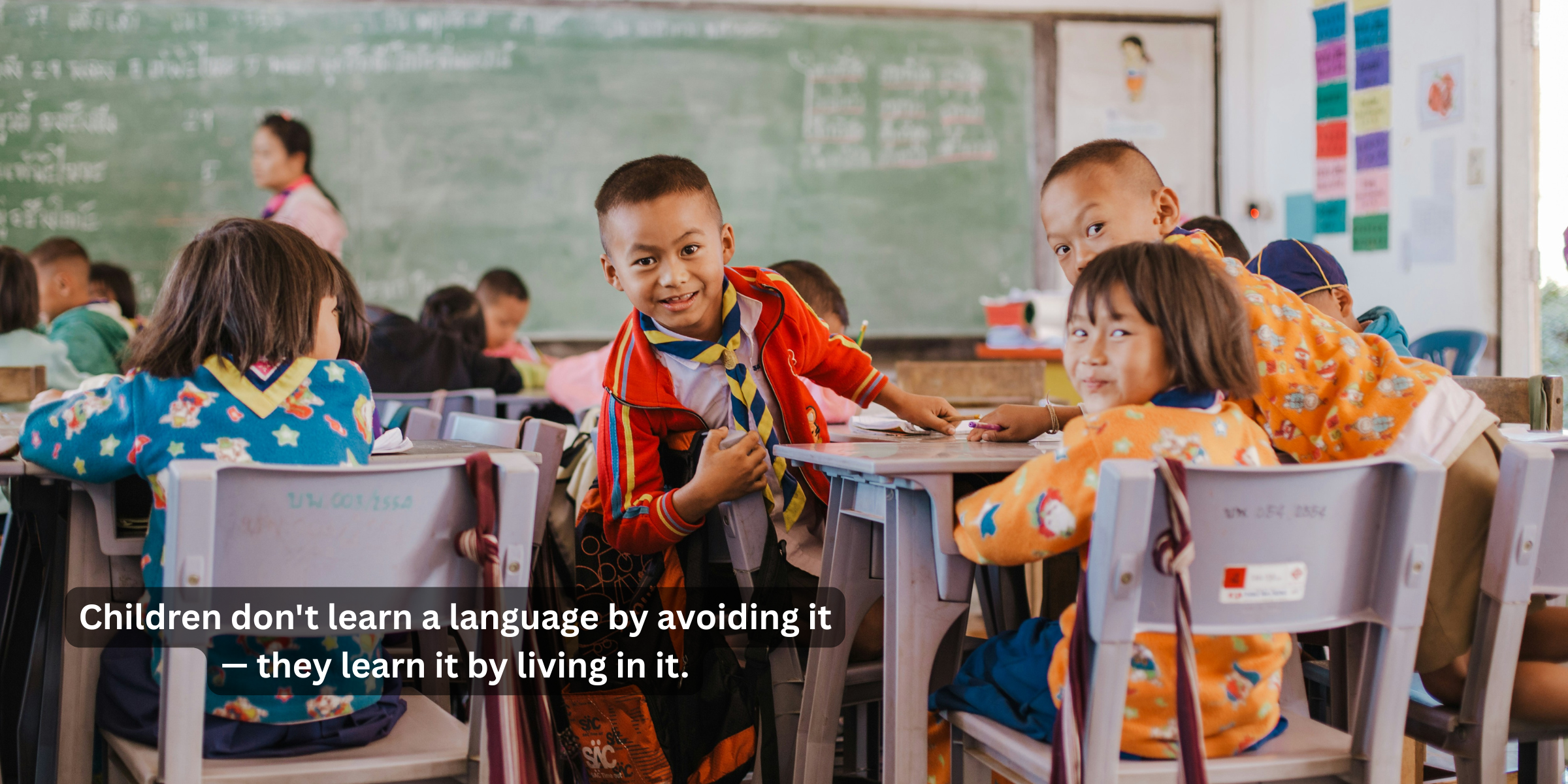
This is something the research on multilingual acquisition is consistent about: children don’t acquire a new language by being protected from it. They acquire it by having real reasons to use it, in contexts that are cognitively engaging. Boredom isn’t a language acquisition strategy.
The Two-Week Trial That Changed Everything
The turning point came at that second school. My parents and the teachers could all see I was in the wrong place, and they tried to move me to a more advanced transition class. Every one of them was full.
The solution nobody particularly wanted: put me in the regular class.
They gave me two weeks: a trial period. I was allowed to bring a dictionary, and that was it.
I stayed. And my German moved faster in those two weeks than it had in the months before combined.
What made it work wasn’t magic. It was that a few teachers made specific decisions that let me participate as a full member of the class rather than a problem to be managed. One spoke Spanish and let me ask her questions in my language when I was stuck. Another spoke English and did the same. A third told me, before a surprise exam on a day I’d forgotten my dictionary at home, to come to him with any word I didn’t understand. I only needed to ask once: Erdrotationsachse. We were both quietly proud about that.
Looking back, those teachers did something genuinely significant. They made a decision, in real time, to treat me as a capable learner who happened to be missing some vocabulary, rather than a foreign child who needed to be protected from difficulty. That reframe is everything. It determined how quickly I progressed, how I felt about school, and whether I believed my own intelligence was intact or somehow suspended until my German caught up.
What Happens When There’s No Framework
Eventually I made it to the academic-track school, the Gymnasium, where students are expected to go on to university. My parents and my head teacher from the previous school had fought hard to get me a place. There was another trial period, another year of all the teachers knowing who I was before I knew any of them. All eyes were on me, and the expectations were high: perform, or be moved out.
Within my first month there, the school had a week-long trip planned. The teachers debated whether it was too soon for me. A full week away from home, away from my own languages, nothing but German from morning to night. They let me go. By the end of each day I was so completely flattened by the non-stop immersion that I slept straight through my roommates talking so loudly they woke the teacher from three rooms away. Multiple times. I didn’t hear a thing. That kind of exhaustion is something no one really warns you about — the sheer cognitive weight of living in a language that isn’t yet yours.
Most of my teachers there were good. Some were exceptional. Two in particular have stayed with me, for entirely different reasons.
One was my German teacher. By the time I was in her class, I was speaking German almost fluently. I wasn’t struggling with participation or comprehension. What I was still working through was written German: spelling, grammar, the kind of precision that takes years even for native speakers. When my mother asked her what we could do to help me improve, her answer was: German can’t be learned this way. Either you know it or you don’t.
That sentence tells you everything about what was missing. It wasn’t just unkind. It was factually wrong, and it meant she had nothing practical to offer a child with a very specific, very addressable gap. She didn’t have a framework for thinking about multilingual learners, and rather than sit with that uncertainty, she turned it into a verdict about my limits.
The other teacher I think about often is my Spanish teacher, a few years later. When the class read novels, she ordered the simplified edition for everyone else and tracked down a more advanced version of the same text for me. She didn’t announce it or make a show of it. She just did it. That single act, treating my bilingualism as a strength to build on rather than an awkward exception to accommodate, is something I’ve thought about almost every week since I started working in this field.
She probably doesn’t know the effect that had on me. That’s the thing about teachers who get this right: they often don’t realise it. They’re just making sensible, thoughtful decisions, one child at a time. But for the child on the receiving end, it can genuinely change the shape of things.
What This Means for Your Classroom
I’m not sharing this to suggest that the teachers who didn’t help me were bad people. The ones who were unkind, I try not to dwell on. The ones who were simply underprepared are the more interesting case, because they’re the most common, and they’re the most fixable.
A multilingual child in your classroom isn’t a monolingual child who’s fallen behind. They’re operating across multiple linguistic systems at once, carrying cultural and cognitive resources that most of their peers don’t have, and doing all of this while also trying to learn fractions, or the causes of the First World War, or simply how to make a friend in a new country. The baseline ask is already enormous.
A few things that actually help, drawn from my own experience and from the families and schools I work with now:
Distinguish between language difference and language difficulty. A child who hesitates, makes grammatical errors, or avoids speaking may simply be in a normal phase of acquisition. These things can look like a learning difficulty on the surface. If you’re genuinely concerned, the key question is: has this child been assessed in their home language, by someone with specific experience in multilingual learners?
Treat the home language as an asset, not a complication. Whether or not you speak it, you can acknowledge it. Ask a child to teach the class a word. Order the more advanced version of the book. Express genuine curiosity about their linguistic background. The message that lands, that all of you belongs here, is worth more than most formal interventions.
Match challenge to ability, not language level alone. A transition class isn’t automatically the right placement for every child who arrives without the school language. A capable child placed in an under-challenging environment will stall, in German and in everything else. Ask what the child can do in their home language, not only what they can do in yours.
Seek out specific training. Multilingual education is a genuine specialism. The research exists, the frameworks exist, and the specialists exist. If your school doesn’t have access to any of these, that’s worth raising: not as a criticism, but as a gap with a real solution.
I made it, in the end. By the time I left school, my German was fluent, my grades were good, and I’d long since found my footing. But I also know that the six months of being moved from class to class, sitting in rooms where nothing was expected of me, were months I didn’t need to lose.
The teachers who helped me most did something that mattered. Maybe they didn’t think of it as anything more than a small decision, a practical adjustment, a moment of instinct. But those moments accumulate into something. They accumulate into a child who believes she can do this, who stops waiting to feel ready and starts actually learning.
If you’re a teacher with a multilingual child in your class right now, I want you to know: the small things you do aren’t small to them. The decision to let them use their language, to find them a harder book, to take thirty seconds at the start of a surprise exam to say “ask me if you’re stuck” is something they may still be thinking about twenty years from now.
I know, because I am.
If you’re a school or educator looking for guidance on supporting multilingual learners, or a family navigating a new school system, I’d love to help. I offer a free 30-minute introductory call where we can look at your specific situation together and work out where to start.
You can find out more about my work on my website, and I share regular reflections and practical insights on multilingualism on Instagram, Facebook, and LinkedIn. I’d love to have you there!
Not Sure Where to Start?
Book a free 30-minute intro call. No preparation needed, no strings attached.
Just a conversation about where you are and how I might be able to help.
Leave a Reply