What Seasonal Celebrations Do for Multilingual Children That Flashcards Can’t
This time of year, something quietly extraordinary happens in households across the world. Eggs are hidden in gardens. Pasos float through cobblestone streets under a canopy of incense smoke. A flame passes from candle to candle in a darkened church until the whole building is glowing. Families sit down together over foods that only appear once a year, and children hear words that belong entirely to this moment.
For those who celebrate Easter in any of its many forms, religious or secular, Catholic, Orthodox, Protestant, or simply cultural, it’s one of the richest language experiences in the family calendar. But the broader truth this post is really about isn’t specific to Easter. It applies to every seasonal celebration, every family ritual, every tradition that returns year after year in a particular language. The principle is the same whether you’re hiding eggs, lighting candles for Hanukkah, preparing food for Newroz, or sitting down for an Eid gathering. Traditions carry language in a way that nothing else quite can.
What Traditions Do That Textbooks Can’t
Language acquisition research has long shown us that emotion and memory are among the most powerful anchors for new vocabulary. When a child learns a word in the context of a meaningful, repeated, emotionally charged experience, that word is stored differently in the brain. It’s connected to smell, to touch, to the feeling of being surrounded by family, to the particular light of a spring afternoon.
The word “procesión” means something different to a child who has stood on a pavement in Seville watching the float of a Virgin pass by in silence than it does to a child who encountered it in a vocabulary list. One is a lived word. The other is a borrowed one. The brain holds them in completely different ways: one rooted in experience, one waiting to be lost.
This is true of any word that belongs to a tradition. The Hebrew word “seder.” The Persian “haft-sin.” The Turkish “bayram.” The German “Osterfeuer.” These words don’t need to be taught. They need to be experienced.
Easter Around the World — and the Language That Comes With It
For families who do celebrate Easter, consider what it actually sounds like in different linguistic traditions.
In Spain, Semana Santa transforms entire cities. The air fills with incense and the sound of saetas: raw, impromptu flamenco laments sung from balconies as the processions pass beneath. Children learn the names of the brotherhoods, the hermandades, the difference between a paso de misterio and a paso de palio. They eat torrijas, the sweet fried bread dusted in cinnamon and sugar that appears only at this time of year, and in Catalonia and Valencia, godparents give their godchildren a mona de Pascua, an elaborately decorated Easter cake. The greeting “Felices Pascuas!” is heard everywhere, and children absorb it not as a vocabulary item but as a feeling.
In Greece, Easter is the most important celebration of the Orthodox calendar. On Saturday night, families make their way to church in the dark, each holding an unlit candle. When the priest announces “Christos Anesti” (Christ is risen), the flame spreads from person to person through the crowd, and the response “Alithos Anesti” (Indeed He is risen) ripples back. Children learn these phrases not from a teacher but from standing in the dark beside their grandparents, watching the light grow. At home, red-dyed eggs called kokkina avga are cracked against each other in a game everyone looks forward to, and the rich, sweet bread tsoureki appears on every table.
In Poland, the Easter basket called swieconka is carried to church to be blessed, filled with bread, eggs, sausage, and a lamb-shaped cake. Easter Monday brings Smigus-dyngus, the tradition of splashing water on unsuspecting family members, accompanied by laughter and shrieks that need no translation at all.
In Germany, the Osterhase hides the Ostereier, similarly to the Easter Bunny hiding Easter eggs, and Osterfeuer, great bonfires, are lit across the countryside to mark the arrival of spring. “Frohe Ostern!” is exchanged between neighbours. In Britain, hot cross buns appear in every bakery window, Easter egg hunts draw children into gardens, and “Happy Easter!” is written on cards in curling script.
Each of these traditions carries with it a vocabulary that belongs entirely to that culture. Words that can’t be translated without losing something. Moments that lodge themselves in memory precisely because they’re so specific and seasonal, and because they’re felt.
The Same Principle Applies to Every Tradition
If your family’s seasonal celebrations are different — if the important annual gathering in your household belongs to another faith, another culture, another set of dates — everything above still applies to you. In fact, it applies even more directly.
Multilingual families who move between cultural worlds often worry that their children aren’t getting enough exposure to the minority language. The rituals and traditions that belong to that language are some of the most powerful natural exposure you have. The specific foods, the particular greetings, the stories told in a certain way, the songs that only get sung at this time of year; all of it is linguistic immersion, delivered in the warmest possible context.
Don’t underestimate it. These moments are doing real linguistic work, even when they feel like simply being a family together.
How to Be Intentional About It
None of this requires a lesson plan. But there are small ways to be more deliberate about making the most of these moments linguistically. If your family celebrates a seasonal occasion across more than one tradition, consider reading a short story connected to the celebration in each of your family languages. Make a habit of teaching children the seasonal greeting in every language they’re growing up with. Cook a traditional dish from each language background and name everything in the language it belongs to.
These aren’t chores. They’re invitations. They tell children that each of their languages belongs to something real, something warm, something worth carrying. And they create the kind of memory that anchors vocabulary in a way no flashcard ever will.
What This Means for Multilingual Families
If you’re raising children across more than one language, you don’t need to invent additional language lessons around your family’s celebrations. You just need to be present in the language. Name the things. Sing the song you remember from your own childhood. Tell the story in the language it belongs to. Let your children hear the greeting in each of your languages.
You might be surprised how much they carry with them. Not just the vocabulary, but the feeling that their languages belong to something real, something warm, something worth passing on.
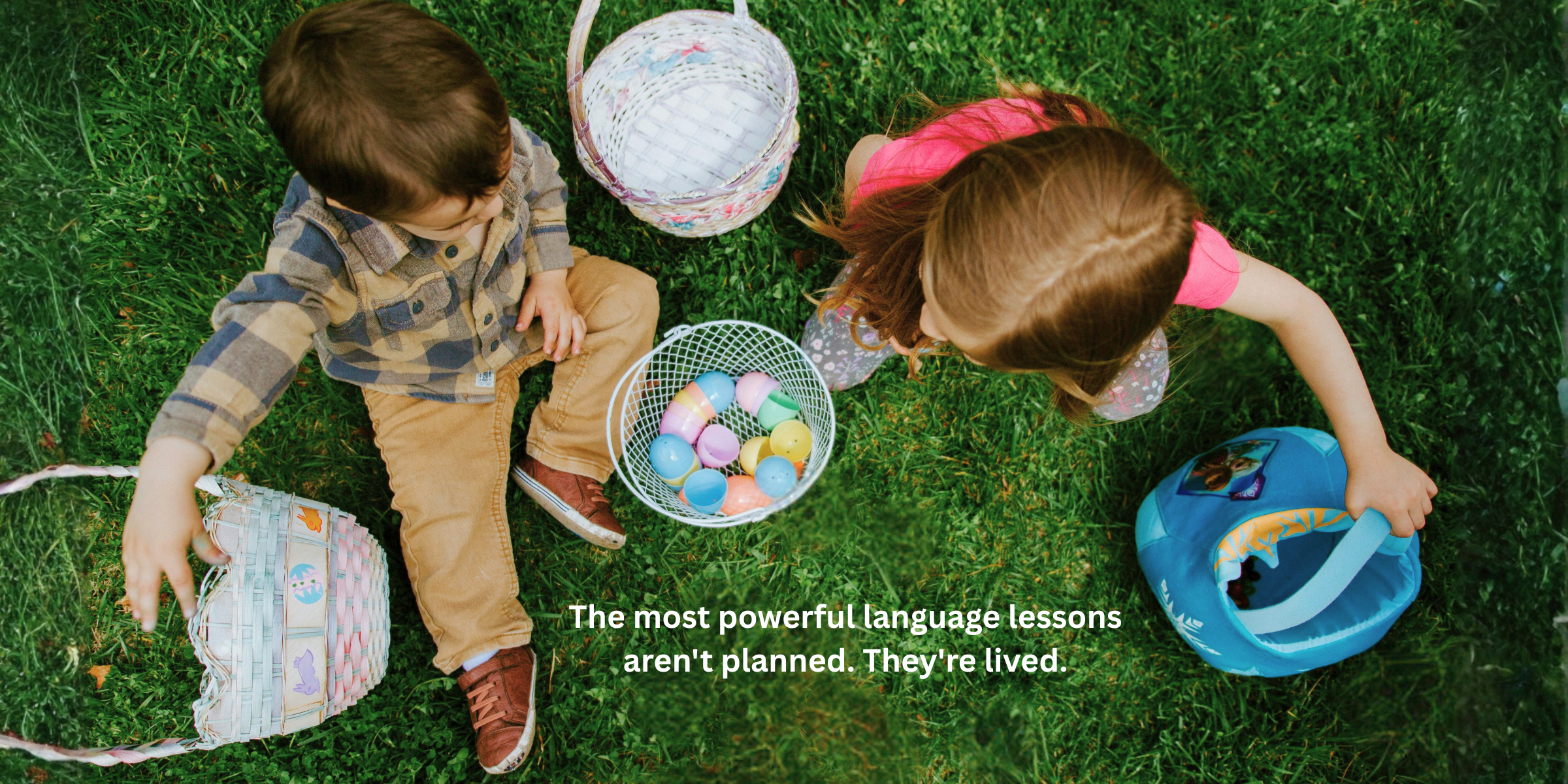
The most powerful language lessons aren’t planned. They’re lived.
If you’d like to explore how to weave your family’s languages more naturally into everyday life, I’d love to talk. I offer a free 30-minute introductory call where we can look at your specific situation together and work out where to start.
You can find out more about my work on my website, and I share regular reflections and practical insights on multilingualism on Instagram, Facebook, and LinkedIn. I’d love to have you there!
Leave a Reply