
On returning to a place where part of you has always lived
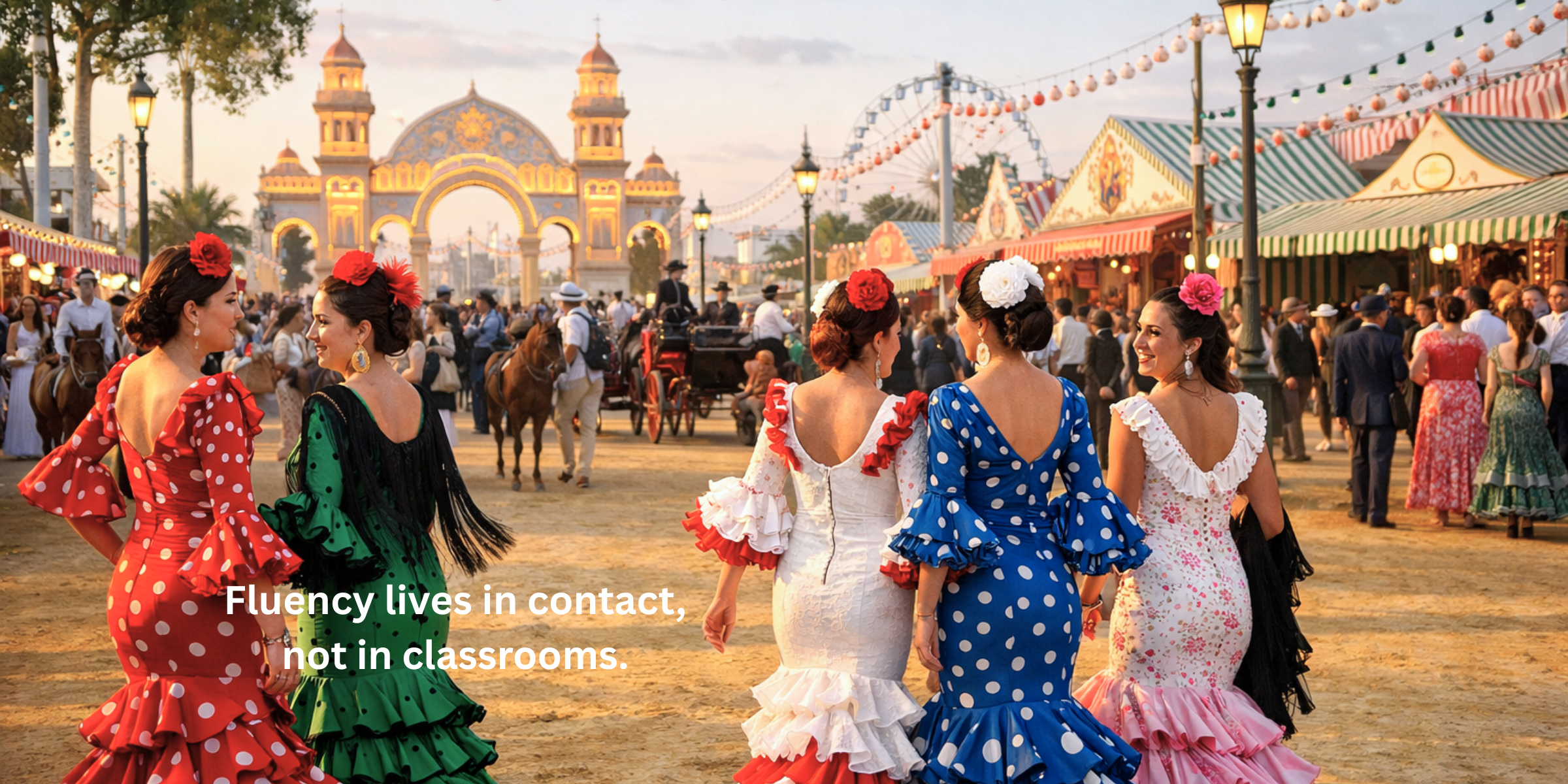
This year I’m going to the feria in Andalucía, the week-long spring festival of flamenco, food, and celebration that defines the social calendar of the south, and I’ve completely forgotten how to dance sevillanas. I remember the shape of it: the turns, the arms, the particular held quality of the posture. But the muscle memory that used to carry me through has gone quiet from disuse. What’s interesting to me, both personally and professionally, is that this feels exactly like what happens to a language when you step away from it for long enough. The structure is still there. The deep knowledge holds. But the living, embodied fluency, the part that moves without thinking, needs the environment to wake it back up.
That parallel isn’t accidental. Language and culture aren’t separate things that happen to travel together; they’re woven from the same thread. And coming back to a place where both live in you, however loosely, is an experience that returns them to you in ways that nothing else quite manages.
The Language You Carry Without Knowing It
I spent part of my childhood in the south of Spain, and Spanish didn’t arrive for me the way it does for adult learners, through lessons, through deliberate study, through the slow accumulation of grammar rules. It arrived the way childhood things do: through the street, through play, through being surrounded by it before I had any framework to understand what was happening. It settled in, along with everything else that settles into you when you’re young and fully inside a place.
I’ve been going back every year since we moved to Germany, and more frequently lately. What I’ve noticed with each visit is that returning doesn’t feel like practising a language. It feels like finding one again, and finding it a little more completely each time.
The foundation laid in childhood is remarkably durable, and this surprises people, including people who work professionally with language as I do. What loosens isn’t the core. It’s the periphery: the idiomatic expressions, the sayings, the particular flavour of informal speech that you only absorb through regular contact. Sayings are the first to go quiet, not because you forget them exactly, but because they stop arriving at the right moment, the way they would for a native speaker, before you’ve had time to think about them. The same happens with the softer edges of colloquial speech: the filler words, the diminutives, the expressions that exist mostly in the mouth, passed between people in conversation.
When you come back, those things start returning too. They surface again not because you studied them but because you heard them, in a shop, at a table, in passing on the street, and the language recognised them before you consciously did. The more often you return, the shorter the distance between arrival and that feeling of being fully inside it again.
Language and Culture Are the Same Thing
Here’s the argument I want to make clearly, because I think it gets lost in most conversations about language learning: you can’t fully separate a language from the culture it lives in, and trying to do so produces a version of fluency that’s technically functional but somehow hollow.
The sevillanas example is a useful one precisely because it seems unrelated to language on the surface. Dancing isn’t speaking. But the feria, the particular social choreography of it, the way conversations happen across glasses of manzanilla, the songs, the dress, the specific humour of the south, is a context in which Andalusian Spanish doesn’t just occur but belongs. The language makes more sense inside that world. Expressions that seemed merely colloquial become culturally rooted. The rhythm of speech starts to feel connected to something larger than vocabulary.
This is true of every language in every place. The German of a Bavarian Christmas market carries different weight than the German of a Berlin office. The Spanish of a flamenco peña in Seville isn’t the Spanish of a business meeting in Madrid, and not only because the words differ. The social context shapes what the language means, how it moves, what it signals about who you are when you use it. To learn a language without any contact with its cultural life is to learn the map without the territory.
What immersion travel gives you, and what even a long weekend in the right place can begin to give you, is time inside the territory. You’re not just hearing the language; you’re hearing it in the situations that give it meaning. The joke that’s funny because of where you are. The phrase that lands differently in this context than it would anywhere else. These aren’t decorative extras. They’re the language being fully itself.
Andalusian and Castellano: Two Registers, One Language
Something I find genuinely interesting about my relationship with Spanish is that it’s always existed in two forms, and the way I navigate them has changed over the years in ways I didn’t entirely plan.
Growing up in Andalucía, I was surrounded by the particular sounds of the south: the dropped consonants, the aspirated s, the warmth and speed of Andalusian speech. Then I had Spanish in school, in a more formal Castellano-taught context, and what followed was a kind of linguistic whiplash that was funny in retrospect and slightly disorienting at the time. I’d arrive in Andalucía speaking only Castellano, having been shaped by the classroom, and leave speaking only Andaluz, having been reshaped by the environment. The two kept pulling me in different directions, and it would take a while after each transition to feel settled in either.
With enough time and enough return visits, the two separated into distinct registers rather than competing for the same space. I can pull from either now depending on where I am and who I’m speaking with. In Andalucía, the southern sounds come naturally; in other contexts, Castellano is there without effort. It doesn’t feel like switching between two things so much as having a richer single instrument with a wider range.
This captures something important about regional variation that most language learning doesn’t prepare you for. The standard version of a language that courses teach is a starting point, not the whole picture, and when you encounter regional variation in the wild it can feel like an obstacle. But with enough exposure it becomes an expansion, and it’s worth noting that regional variation is always culturally loaded, too. Andalusian Spanish doesn’t just sound different; it carries a distinct cultural identity, a set of references and values and ways of being that Castellano doesn’t carry in the same way. Learning to hold both isn’t just a linguistic achievement. It’s a cultural one.
Confidence Isn’t the Same as Fluency
Something shifts when you spend time in a country where your language is spoken, and it’s not primarily a vocabulary shift or even a grammatical one. It’s a confidence shift.
The internal monologue, the constant checking, the is that right?, the hesitation before producing a word you’re not quite sure about, quietens. Not because you’ve suddenly become more accurate, but because you’re no longer performing the language for an imaginary evaluator. You’re using it. There are real people on the other side, and the conversation has somewhere to go.
This is what I mean when I say that coming back makes you feel more like yourself in a language. When you’re studying at a distance, even very successfully, you can remain slightly outside it; a learner in relation to the language, rather than a speaker of it. When you’re inside the country, that relationship shifts. The language is no longer something you’re working towards; it’s something you’re inside. And crucially, so is the culture that the language belongs to, which means the confidence isn’t only linguistic. It’s a fuller kind of belonging.
For anyone who’s ever felt that their spoken language doesn’t match their written language, or that their confidence doesn’t match their knowledge, immersion travel is often the piece that closes that gap. Not because the trip teaches you things you didn’t know, but because it gives you access to things you already knew and couldn’t quite reach.
When You Can’t Get Back: Bringing the Language to You
I’m aware that what I’ve described so far assumes a certain freedom, the ability to travel regularly, to take time away, to return to a place with some consistency. That’s not everyone’s reality, and it’s worth saying clearly: the kind of frequent return I’ve been talking about is a privilege, and not a small one. Annual leave is finite, flights aren’t free, and for many people with family or caring responsibilities, disappearing for even a long weekend isn’t straightforward.
So what do you do when you can’t get back, or can only get back rarely?
The honest answer is that nothing fully replicates being inside the place, but there’s quite a lot that approximates the quality of contact that makes immersion useful, and the key word is quality. What immersion gives you isn’t simply more hours of exposure; it’s exposure that’s alive, contextualised, and emotionally present. You can create versions of that at home if you’re intentional about it.
Consuming media in the language, films, television, radio, podcasts, in conditions where you’re genuinely paying attention rather than half-listening as background noise, gets you closer to that quality of contact than many learners realise. The goal isn’t comprehension of every word; it’s the experience of the language in full flow, with all its rhythm and informality intact. Andalusian Spanish on a television series set in Seville will do things for your ear that a language app simply won’t, partly because the language is there and partly because the cultural context is, too.
The cultural dimension matters here as much as the linguistic one. Watching a film set in the place, cooking recipes from that region, reading about the history and social life that shaped the language: these aren’t peripheral activities. They’re building the territory that the language belongs to, and that territory is part of what you’re trying to inhabit. A language learned in cultural context sticks differently than a language learned as an abstract system.
Finding native speakers to talk with regularly matters enormously, whether through language exchange platforms, local community groups, or online conversation practice. The crucial thing is that these conversations have genuine communicative stakes; you’re trying to say something real to someone who cares what it is, rather than producing the low-stakes performance of a rehearsed exercise. And if you have access to a community connected to the language, a cultural association, events tied to the diaspora, spaces where the language is genuinely the operating language of the room, spending time there puts you in the presence of the language being lived rather than studied. That’s closer to immersion than it might sound.
None of this replaces the trip. But it keeps the language warm in the meantime, and it means that when you do get back, the re-entry is shorter; which is, in the end, what you’re always working towards.
What to Pay Attention To When You Do Go Back
If you’re travelling to a country where you have an existing connection to the language, here are the things worth noticing.
The expressions that return without being summoned: these are the ones most deeply embedded, and they’ll surprise you when they arrive. The saying that surfaces before you’ve consciously reached for it, the phrase that comes out right the first time.
The moments when you stop translating. They might be brief, and they might not happen on the first day, but they’ll come: a short exchange where the language moves through you rather than being produced by you.
The cultural moments that make the language suddenly make more sense. A gesture that explains an expression. A social ritual that puts a phrase in its place. The joke that only works because you’re there and you understand what it’s referring to. These are the moments where language and culture snap together, and they’re among the most valuable things a trip can give you.
And the things you reach for but can’t quite find, the saying that’s on the tip of your tongue, the expression you know exists but won’t come, because these gaps are useful information. They’re telling you exactly what regular return and consistent exposure would give back to you.
The Language Keeps Your Place
A language you have a deep relationship with doesn’t abandon you when you’re not using it. It waits. The foundation holds. What loosens are the living elements: the sayings, the humour, the instinctive rhythm of response, the cultural fluency that sits alongside the linguistic. But those come back with contact, often faster than you expect, and faster still with each return.
That’s what I’ve found, coming back more frequently these past few years. The re-entry gets shorter. The point at which the language feels fully available again comes sooner, and so does the feeling of being culturally present rather than culturally adjacent. It’s not that the language or the place is different; it’s that the accumulated contact has shortened the distance between arriving and belonging.
As for the sevillanas, I’m not worried. The steps will come back. They always do.
If you’re thinking about your own language journey, whether you’re returning to a language from your past or trying to find more of it in your daily life, I’d love to talk. I offer a free 30-minute introductory call where we can look at your specific situation together and work out where to start.
You can find out more about my work on my website, and I share regular reflections and practical insights on multilingualism on Instagram, Facebook, and LinkedIn. I’d love to have you there!
Not Sure Where to Start?
Book a free 30-minute intro call. No preparation needed, no strings attached.
Just a conversation about where you are and how I might be able to help.
Leave a Reply