
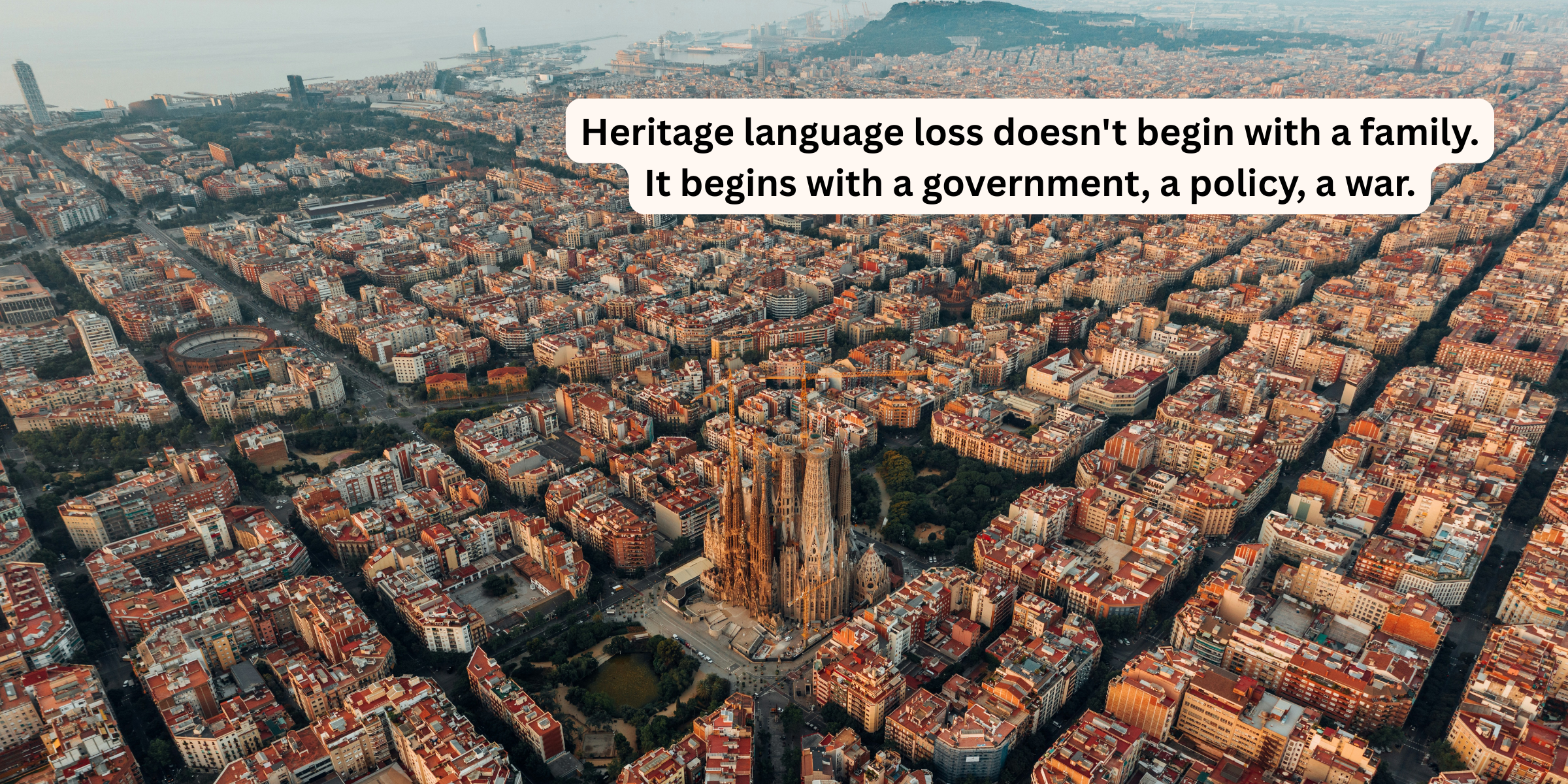
Heritage language loss rarely happens all at once. It happens in steps — each one entirely reasonable, each one quietly reshaping what the next generation inherits.
A client of mine grew up hearing Catalan. She learned it with her grandparents — weekend visits, summer stays, the particular intimacy of a language that belongs to a specific kitchen, a specific pair of hands, a specific quality of afternoon light. When her grandparents died, the language went with them, or most of it did.
Her parents never spoke it with much ease. That wasn’t an accident. It was politics.
For decades under the Franco dictatorship, Catalan was suppressed — banned from schools, from public life, from anything official. Between 1939 and the late 1970s, speaking Catalan in public was not just discouraged; it was punishable. An entire generation of children grew up without it in the classroom. Their Spanish became dominant not by preference but by force, and Catalan retreated into the home, into private spaces, into the speech of grandparents who remembered a different Catalonia. My client’s parents are part of that generation — people who understand Catalan, who feel it somewhere deep, but who were never given the chance to become fluent in it the way their own parents were. The language skipped a rung on the ladder. And once a rung is missing, the climb looks different for everyone who comes after.
She later married someone from a completely different linguistic background. They speak English together — the language they share, the one that sits between their two worlds. They live in a country that is neither of theirs. And they’re raising a son who is already navigating four languages. She has decided, quietly and without drama, that Catalan won’t be the fifth.
She told me this not with guilt, exactly, but with something adjacent to it. A recognition that a thread was being allowed to go slack. “I know what I’m doing,” she said. “I’m just not sure how to feel about it.”
I think about this conversation often.
What a Heritage Language Actually Carries
A heritage language is more than vocabulary and grammar. It carries the way a specific set of people understood the world — their humour, their particular tenderness, the things they said when they were worried and the things they said when they were happy. When a language is spoken primarily with grandparents, it becomes intertwined with everything those grandparents represented: safety, belonging, a version of the self that exists only in that relationship.
When the grandparents are gone and the language goes quiet, what people grieve is rarely the language itself. It’s the loss of the channel. The way certain things could only be said in that language, to those people, in that kitchen.
The Decision Belongs to the Parents, Too
This is something I want to say plainly, because it often gets lost in the conversation about raising multilingual children: the parents are doing the work.
Language transmission doesn’t happen passively. It requires consistent effort, intentional exposure, emotional investment, and often a willingness to speak a language you yourself feel uncertain in. For my client, introducing Catalan to her son would mean attempting something she isn’t fully equipped to do — her own Catalan is partial, her relationship to it complicated by grief, and the fluent speakers who could have helped her are gone. Her husband doesn’t speak it at all. There’s no community around them to fill that gap.
There’s also the question of what adding a fifth language would cost the others. Her son is already navigating four. Catalan and Spanish, while related, are distinct enough that they’d compete for the same cognitive and emotional bandwidth. Spanish — which has a living community around them, which his family uses, which has global reach — would likely be the one that suffered most. That’s not a reason to dismiss Catalan entirely. It’s a reason to be honest about what maintaining it would require, and what it might take from everything else.
Raising a multilingual child is extraordinary. It is also genuinely hard, and parents who are already managing multiple languages, multiple cultures, and the emotional weight of living far from home aren’t failing anyone by recognising their own limits. That realism is itself a form of care.
When Politics Decide Which Languages Survive
Catalan’s story isn’t unusual. Across history — and across the world today — minority and regional languages have been suppressed, marginalised, or simply crowded out by the languages of power. The logic is always the same: one dominant language for administration, for education, for economic opportunity. Everything else becomes private, quaint, regional — tolerated until it becomes inconvenient.
The consequences play out across generations. Children who were never taught their grandparents’ language grow up with a passive relationship to it at best. When those grandparents die, the transmission chain breaks. And by the time their own children are grown, the language exists mainly in collective memory and cultural longing — real, but hard to act on.
This is happening with hundreds of languages right now. Irish. Welsh. Occitan. Breton. Aragonese. Languages that were once the daily speech of entire communities, now held alive through dedicated revival efforts and the collective will of people who understand what’s at stake.
The Catalan revival is, in this context, genuinely remarkable. Since the restoration of democracy, Catalonia has invested heavily in language policy — Catalan is now co-official, taught in schools, present in media and public life. A generation of children in Catalonia is growing up bilingual in a way their grandparents were never allowed to be. The language is coming back, and that matters enormously.
But it’s coming back in Catalonia. For families in the diaspora — in Germany, in the UK, in the United States — that infrastructure doesn’t reach them. There are no immersion schools, no Catalan-language playgroups, no casual exposure on the street. A revival requires a community to carry it, and for families far from that community, the conditions simply aren’t there. Heritage language loss in diaspora families isn’t a failure of commitment. It’s often the predictable result of political decisions made a generation or two earlier, compounded by the reality of building a life somewhere new.
How Languages Disappear, One Reasonable Decision at a Time
Heritage language loss across generations follows a recognisable pattern. The first generation migrates and speaks the heritage language at home. The second generation understands it but feels more comfortable in the majority language. The third generation may have heard it spoken but never acquired it. By the fourth, it’s gone.
What makes this so hard to interrupt is that each step looks reasonable from the inside. The second generation isn’t failing their heritage by preferring the language of their school and social life. The third generation isn’t failing theirs by not passing on a language they themselves speak haltingly. Each choice makes sense. The cumulative effect is erasure — and it’s an erasure that often began not with the family, but with a government, a policy, a war.
Some families decide the effort of maintaining a heritage language is worth making. Others decide, as my client has, that it’s not the right moment, or not the right conditions, or simply not possible given everything else. Both decisions deserve to be made with clear eyes, not guilt.
The Door Left Open
Deciding not to teach a language now isn’t the same as deciding never.
My client’s son is young. He’s building foundations in four languages, and those foundations matter. Spanish, given space to grow, will become something solid — a language he genuinely inhabits, not just navigates. And it gives him something Catalan, at this stage, couldn’t: a living community, a global reach, a language he can use with family right now.
Catalan can come later. It won’t be the same as growing up with it — early acquisition produces a different kind of fluency, and it’s worth being honest about that. But it isn’t lost to him. If he grows up and finds himself drawn to that part of his heritage, the language is learnable. The revival in Catalonia means there are resources, communities, courses, and media waiting. The thread, even if it goes slack in childhood, needn’t be cut.
Some things are better attempted when the conditions are right. That’s not giving up. That’s planning.
What Remains
Even when a language isn’t actively maintained, traces of it persist in unexpected ways. A particular word that surfaces in moments of emotion. A phrase that comes naturally in a situation no other language quite covers. A sensitivity to sounds that means recognition arrives faster than it should.
Languages leave deposits. They shape how we hear, how we process, sometimes how we feel. My client’s son may never speak Catalan. He may, twenty years from now, hear it on a street in Barcelona and feel something he can’t quite name — a familiarity, a pull toward something he didn’t know he’d carried.
Each family gets to decide what they’re holding on to and what they’re releasing. There’s no version of that decision that doesn’t involve some loss. What I’d hope for is that it’s made consciously — with an understanding of what the language carried, what politics took from it, and what goes quiet now.
If you’re navigating a decision like this — about a heritage language, about how much to maintain, about what you want your children to carry — it’s worth talking through. A free 30-minute introductory call is a good place to start.
You can find out more about my work on my website, and I share regular reflections and practical insights on multilingualism on Instagram, Facebook, and LinkedIn. I’d love to have you there!
Not Sure Where to Start?
Book a free 30-minute intro call. No preparation needed, no strings attached.
Just a conversation about where you are and how I might be able to help.
Leave a Reply