
When “We All Speak English” Isn’t Actually Working
There’s a meeting that happens in organisations all over the world, several times a week, where someone is struggling and nobody says so.
The room — or the video call — contains people from two or three different countries. Everyone speaks English, to varying degrees, with varying levels of ease. The meeting runs in English because that’s what organisations do when they need a common language, and English is the default answer to that problem. The agenda gets covered, decisions are recorded, and somewhere in the room, at least two or three people have been tracking about sixty percent of what was said, nodding along through the remaining forty.
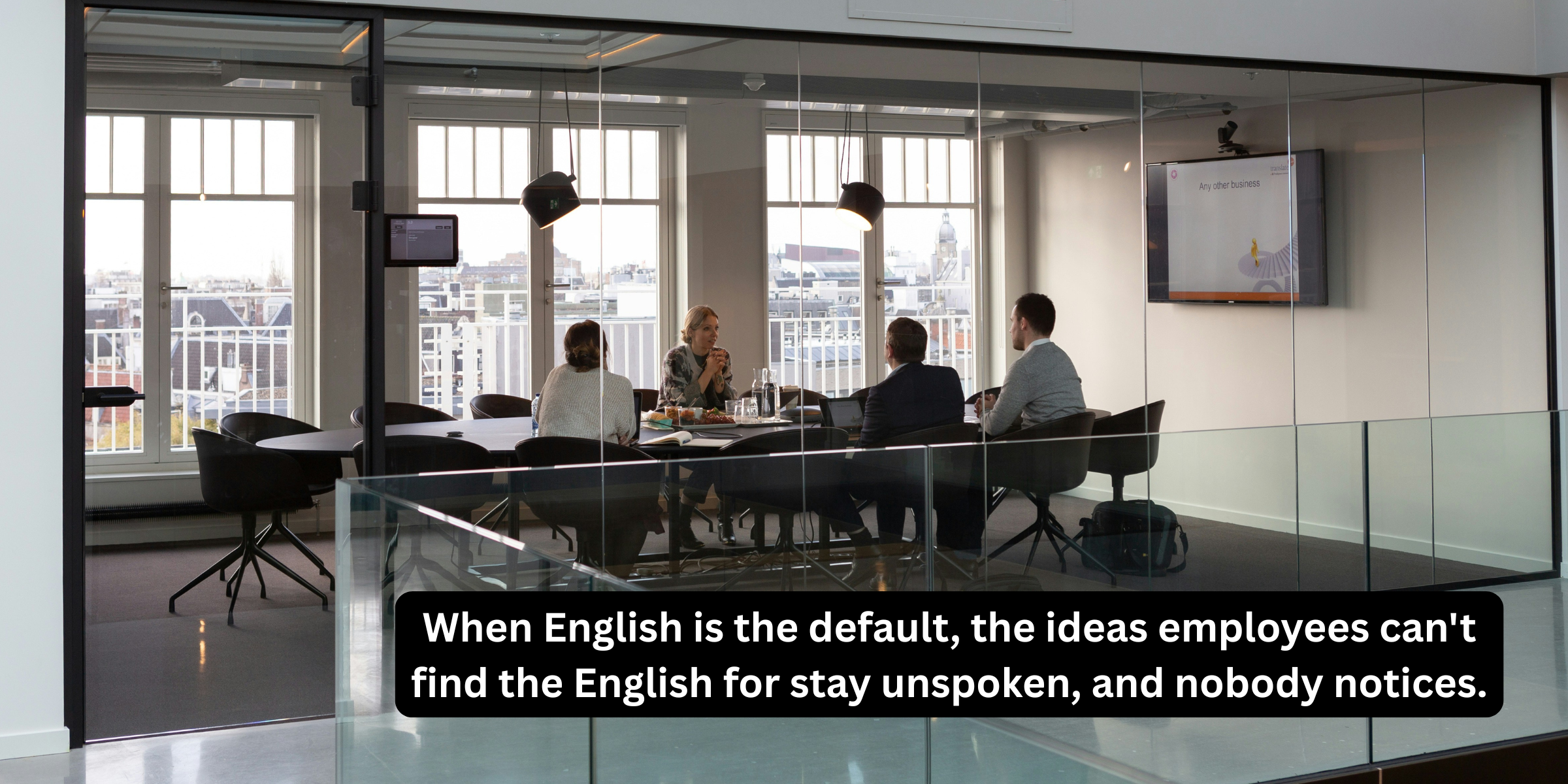
Nobody lies in this meeting, and nobody performs understanding they don’t have. What they do is something subtler: they participate at the level their English allows, which isn’t the same as the level their thinking allows. The ideas they can’t find the English for stay unspoken. The objection that would’ve come quickly in their first language gets abandoned halfway through formulation. The nuance gets lost. And the meeting ends, looking entirely functional, having quietly shed a portion of the thinking it was supposed to surface.
This is lingua franca culture in practice. And most organisations running it have no idea how much it’s costing them.
The False Floor of Comprehension
One of the most underappreciated dynamics of lingua franca workplace communication is what I think of as the false floor. Meetings feel functional because they proceed. Questions get asked and answered. There aren’t visible communication breakdowns. What’s invisible is the floor just below that surface: the layer where partial comprehension looks like full comprehension, where silence reads as agreement, where “yes” means “I heard you” rather than “I’m committed to this course of action.”
This dynamic has been well-documented in workplace communication research. Studies consistently show that non-native English speakers in English-dominated meetings not only contribute less frequently — they also self-censor more, second-guess their own positions, and feel less confident asserting disagreement. The more senior and experienced the person, paradoxically, the more painful this can be: having spent decades developing professional judgement, they find themselves unable to deploy it at full capacity because the linguistic container for it is operating at two-thirds speed.
It’s worth sitting with that for a moment. The colleague who goes quiet during the cross-border call may not be disengaged. They may be holding an objection they can’t quite construct in real time, in a second language, under the implicit pressure to be fluent, concise, and confident simultaneously. That objection doesn’t go away when the meeting ends. It tends to resurface as resistance, disengagement, or quiet withdrawal — none of which get attributed to the meeting format that created them.
The false floor has a particular geography. It appears most often at the edges of conversations: the final ten minutes of a meeting, when fatigue sets in and language becomes harder; the fast-moving debate between two confident English speakers that everyone else watches rather than joins; the moment when an unexpected question is asked and non-native speakers have no preparation time to bridge the gap between their thinking and their English. Understanding this geography matters, because the solutions aren’t uniform. Different parts of the false floor require different structural responses.
What Lingua Franca Culture Actually Costs
This false floor costs organisations in concrete, measurable ways — even when it’s invisible on the balance sheet.
Decisions made in English by the people most comfortable in English get implemented by teams whose real response to those decisions was never captured. When implementation stumbles, the diagnosis is usually strategic misalignment, poor communication, or cultural difference. Language is almost never on the list, even when it’s the primary driver.
Projects fail not because of technical problems or insufficient talent, but because the people closest to the work never felt the conditions to say what they actually thought. The window for raising concerns passed — quickly, in fast-paced English — and nobody noticed it close.
Talent leaves. Being consistently underestimated in meetings, for linguistic rather than professional reasons, produces a specific kind of demoralisation that’s difficult to name and easy to misattribute. High performers who can’t perform in the shared language eventually find environments where they can. When they leave, their departure gets coded as cultural fit or career ambition, not as a structural failure of the organisation’s communication environment.
I worked with a team in this situation — different offices, different countries, one assumed solution. English as the lingua franca for anything cross-office. On paper, functional. In practice, a quiet asymmetry had developed: one team was more comfortable in English than the other, which meant one team consistently shaped cross-office decisions, not because their ideas were stronger, but because they had easier access to the shared language. The other team’s most experienced members had become progressively less visible in joint decision-making — not through any design, but through the slow gravitational pull of structural disadvantage. When I started asking those team members what they actually thought about recent decisions, the gap between their private assessments and the recorded outcomes was significant. That gap represented lost institutional knowledge, unacted-on risk awareness, and missed opportunities for course correction.
Nobody had designed this. Nobody intended it. The system had simply settled into its natural shape.
What Actually Helps: Structural Changes That Work
The first thing that helps is naming it. Organisations that acknowledge the asymmetry of lingua franca communication — that English fluency isn’t evenly distributed, that this unevenness has predictable effects on participation and decision-making, and that those effects are structural rather than personal — are already ahead of most. Naming it doesn’t solve it, but it shifts the frame from “why aren’t these people contributing?” to something more useful: “what would need to be different for their contribution to be possible?”
That reframe matters more than it might seem. When language difference is treated as a personnel problem, the solution is always placed on the individual: work on your English, speak up more, be more confident. When it’s treated as a design problem, the responsibility moves to the system — which is where it more accurately belongs.
The second category of solutions is structural, and this is where I see the most consistent gains. Written pre-reads circulated before key meetings give non-native English speakers preparation time that real-time conversation doesn’t allow. Structured contribution formats — formats that build in explicit space for each participant to respond, rather than defaulting to whoever is most verbally fluent — reduce the dominance of fluency over substance. Asynchronous input channels, particularly for complex or high-stakes decisions, create space for the kind of careful formulation that real-time English rarely permits. Slightly slower meeting pacing, with more deliberate check-ins, costs almost nothing in time and gains a great deal in participation.
None of these require abandoning English as a working language. They require holding lingua franca practices with slightly more care: recognising that the format has winners and losers built in, and making deliberate structural choices to compensate.
The third category is cultural, and it operates at the level of leadership behaviour. When senior leaders model comfort with language difference — when they explicitly invite non-native speakers into conversations, when they normalise the request for more time to think, when they treat fluency and intelligence as the separate things they are — the whole organisation takes a cue. Culture in organisations tends to follow what leadership consistently does, not what policy documents say. A single manager who actively creates the conditions for non-native English speakers to contribute at full capacity can shift the experience of an entire team.
The fourth — and perhaps least practised — is measurement. Most organisations have no mechanism for detecting the false floor. They don’t track who speaks in meetings, who initiates positions, whose objections get recorded. Without some form of participatory data, the problem remains invisible even to people who sincerely want to address it. This doesn’t need to be elaborate: even a brief post-meeting reflection — “who didn’t we hear from today, and why?” — can begin to surface what the meeting itself concealed.
The Individual Side: Cognitive Load in a Second Language
Everything above addresses the organisational picture. But there’s an equally important individual dimension that often goes unnamed.
Working in a second language all day — even a second language you’re highly fluent in — takes a specific cognitive toll. Researchers call it the cognitive load of dual-language processing: the brain is running two systems simultaneously, translating, monitoring for accuracy, and managing the social performance of appearing effortlessly fluent, all while also trying to think clearly about the actual substance of the conversation. The more demanding the communication — negotiation, conflict resolution, presenting under pressure, handling unexpected questions — the more significant the gap between first- and second-language performance.
Most people who experience this don’t name it as a language issue. They call it cognitive load, or stress, or just the general difficulty of a demanding job. Language doesn’t make the list, because naming it feels like an admission of inadequacy. It isn’t. It’s an accurate description of a real physiological process that affects even the most capable, most multilingual professionals.
Knowing this is useful in two directions: for individuals, because naming the source of the drain is the first step toward working with it rather than against it; and for organisations, because the structural conditions they create around language will either compound that load or relieve it.
Where to Start
If you’re reading this from an organisational perspective and recognising the dynamics described here, the most useful starting point isn’t a policy overhaul — it’s an honest audit of where the false floor appears in your current communication environment. Which meetings consistently produce the same voices? Which decisions look agreed but leave some teams quietly unpersuaded? Where does the gap between official outcomes and actual team sentiment tend to be largest?
If you’re reading this as an individual working in your second language and recognising the cognitive reality it describes: the experience you’re having is real, it has a name, and it’s workable.
I do this work with both organisations and individuals. A free 30-minute introductory call is a good place to start — you can book one directly at multi-lingua-consulting.com
You can also find out more about my work on my website, and I share regular reflections and practical insights on multilingualism on Instagram, Facebook, and LinkedIn. I’d love to have you there!

Not Sure Where to Start?
Book a free 30-minute intro call. No preparation needed, no strings attached.
Just a conversation about where you are and how I might be able to help.
Leave a Reply