
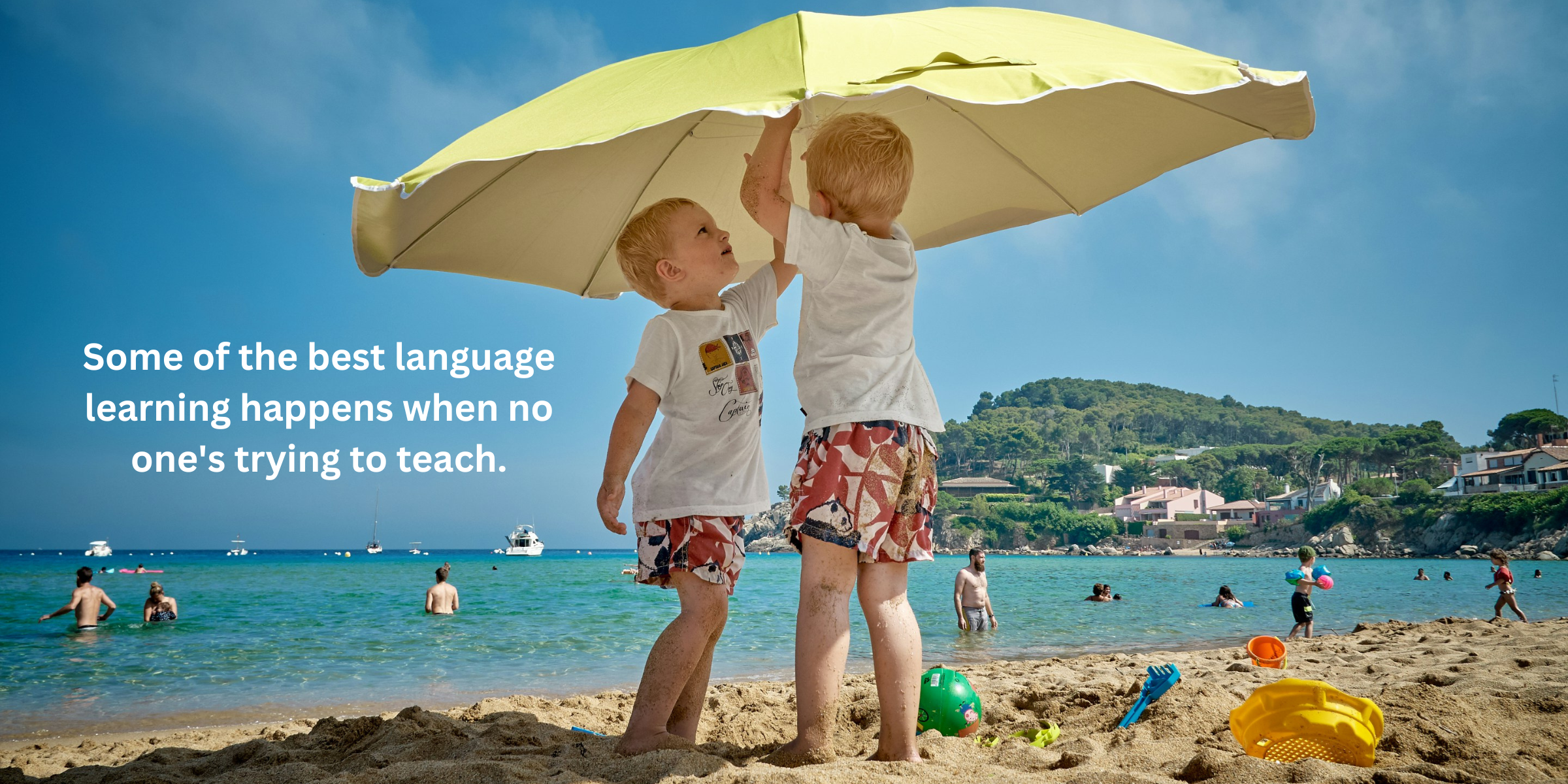
I had Spanish lessons in Germany throughout my childhood. Regular, dutiful lessons in a classroom where Spanish existed as an academic subject rather than a living thing. My Spanish was competent. It was also, as my relatives in Andalucía made abundantly clear every summer, extremely proper.
Two or three weeks in the south of Spain and something would shift. The careful Castilian I’d been maintaining all year would start to dissolve somewhere between the airport and my grandparent’s kitchen. The vocabulary changed, the rhythm changed, the sounds changed. By the time I had to go back to Germany, I’d stop halfway through a word and produce something that definitely hadn’t been in the syllabus. What I brought home was always more alive than what I’d taken there.
I think about those summers whenever parents ask me what the school holidays will do to their child’s languages, specifically, whether they’re about to lose what they’ve spent all year building. The honest answer about what happens to a child’s language over the summer holidays depends entirely on which language you’re asking about, and it’s almost never as bad as the worry suggests. Let me go through each scenario properly.
Does Summer Actually Cause Language Attrition in Children?
Yes — but with important caveats that most of the worry skips straight over.
Language attrition during school breaks is real. Children who have a weaker language — a minority language, a recently acquired language, a language spoken primarily at school — do show some reduction in active use when the main source of input disappears for six to eight weeks. Vocabulary retrieval slows slightly. Some idiomatic expressions become less fluent. The language doesn’t disappear; its edges become slightly less sharp.
What the research is also consistently clear about is that this attrition is almost entirely reversible. Two to three weeks of renewed contact with a language is typically sufficient to restore what was lost over a longer break. The language hasn’t gone; it’s been stored rather than used. Re-exposure activates it. Children, in particular, re-activate languages with a speed that tends to surprise most adults.
The reason for this is worth understanding. Languages that have been properly acquired — meaning a child has developed genuine communicative competence, not just surface familiarity — are stored in long-term memory in ways that are highly resistant to loss. What attrition affects is retrieval fluency: the ease and speed with which vocabulary and structures can be accessed. This is different from the underlying competence itself.
What researchers call the savings effect means that re-learning is dramatically faster than initial learning, because the neural pathways already exist. The language is there. It just needs waking up.
Which Language Are We Actually Talking About?
This is where most of the confusion comes in. The summer trajectory looks completely different depending on which language you’re thinking about. Conflating them is the source of most parental anxiety and a lot of unnecessary worry.
The Heritage or Minority Language
For heritage languages, the language spoken at home or with family, often connected to another country, summer is genuinely one of the best opportunities of the year.
The school term is dominated by the majority language: the language of learning, of friends, of tests, of social life. The minority language gets squeezed into whatever margins remain. Summer removes that pressure entirely. A trip to the heritage language country, even just a week, provides the kind of dense, unscripted language contact that a year of carefully maintained input at home can’t replicate. The ice cream has to be ordered in one language. The cousins won’t switch. The television is only comprehensible if the language is actually engaged with. Motivation — that elusive force that makes language work — turns up when it’s genuinely needed.
Children who spend summer immersed in their heritage language frequently return more fluent, not less. Richer vocabulary, better idiom, a more natural and relaxed relationship with the language. My Spanish came back from Andalucía every August doing things it absolutely hadn’t been doing in May.
Even without travel, summer creates real space: more frequent video calls with family, films and books in the heritage language as actual leisure rather than educational obligation, and potentially a short language camp for peer exposure in the minority language — something that’s nearly impossible to arrange during term time.
The School Language or Majority Language
Parents sometimes worry in the opposite direction: that time immersed in the heritage language will cost their child ground in the school language. This concern is almost always unfounded.
School languages are dominant for a reason. They have the most environmental support, the most social currency, and they return to full intensity the moment September begins. For a child with well-established schooling in the majority language, six weeks of reduced input won’t create any lasting reduction in fluency. Some light engagement — a few books, occasional time with friends in the language — is sufficient, and often happens naturally anyway.
The Recently Acquired Language — the One Exception Worth Knowing About
If your family moved country less than a year ago, or your child arrived in a new school system recently, the calculation is genuinely different, and it’s worth naming this clearly.
When the school language is still fragile — still being actively acquired rather than maintained — a long break without meaningful contact can create a more significant setback at re-entry in September. The roots aren’t yet deep enough for the language to sustain itself through an eight-week absence. This doesn’t mean the progress disappears, but re-entry can feel harder than it needs to.
For recently arrived families, some intentional engagement over summer is worth building in. It doesn’t need to be intensive or structured. A book or two in the new language, chosen for pleasure rather than educational value. Some time with friends from school. Light, low-pressure contact that keeps the language present without making summer feel like an extension of the school year. The goal here is maintenance, not acceleration.
A Practical Summer Guide by Situation
If You Can Travel to the Heritage Language Country
Even one week counts, and it counts substantially. Prioritise density of real-world contact over duration where you can — the language your child is using with cousins, at the market, in front of the television is doing more work than any planned activity. Let it be natural. Let them lead socially.
If Travel to the Heritage Language Country Isn’t Possible
Daily or near-daily video calls with native-speaking family members make a real difference, as does defaulting to films, audiobooks, and podcasts in the minority language as leisure rather than educational supplement. If there’s a short summer language camp in your area, it’s worth prioritising — peer exposure in the minority language is genuinely rare during term time. For older children, a pen pal, an online language exchange, or even voice messages back and forth with grandparents and cousins can keep the language alive and social.
If You’re a Recently Arrived Family
The goal over summer is gentle maintenance, not measurable progress, so keep expectations realistic. One or two books in the new language, chosen by the child where possible, is enough to keep things ticking over, alongside whatever time with school friends happens naturally. A brief check-in with the class teacher at the start of September is also worth doing — just flagging that there may be a re-entry period, and asking that it be treated as normal rather than as a regression.
What to Do If September Feels Like a Setback
If your child’s minority language sounds rustier at the start of term than it did in June: wait two weeks before worrying. The language is there; it needs activating, not rebuilding. Most parents who check in at the three-week mark find it has returned to where it was, and often beyond — particularly if summer included any meaningful immersion.
For recently arrived children, a brief word with the class teacher or support staff at the start of term is worthwhile — simply flagging that there may be a re-entry period, and asking that it be treated as normal rather than as a regression.
If you’d like to think through a language plan for your family’s summer — whether that means making the most of time with heritage language family, supporting a recently arrived child through the break, or simply understanding what’s realistic to expect — a free 30-minute introductory call is the easiest starting point.
You can book a call or find out more about my work on my website, and I share regular reflections and practical insights on multilingualism on Instagram, Facebook, and LinkedIn. I’d love to have you there!
Not Sure Where to Start?
Book a free 30-minute intro call. No preparation needed, no strings attached.
Just a conversation about where you are and how I might be able to help.
Leave a Reply