A family told me, some time after the event, about a conversation they’d had with their child’s kindergarten. Their daughter had been flagged. She wasn’t using enough words, and there might be a delay. They should consider moving her to a different nursery, one better equipped to support her.
Their daughter was being raised bilingually: German at nursery, Italian at home. She didn’t speak Italian at kindergarten at all, and by any observable measure she was a quiet, watchful child in a German-speaking environment. The assessment that flagged her had looked only at her German vocabulary.
When you count across both languages, the picture is entirely different. She knew more words than most of her monolingual peers. The delay was a measurement problem, not a developmental one — the assessment had simply missed half her vocabulary because it wasn’t looking for it.
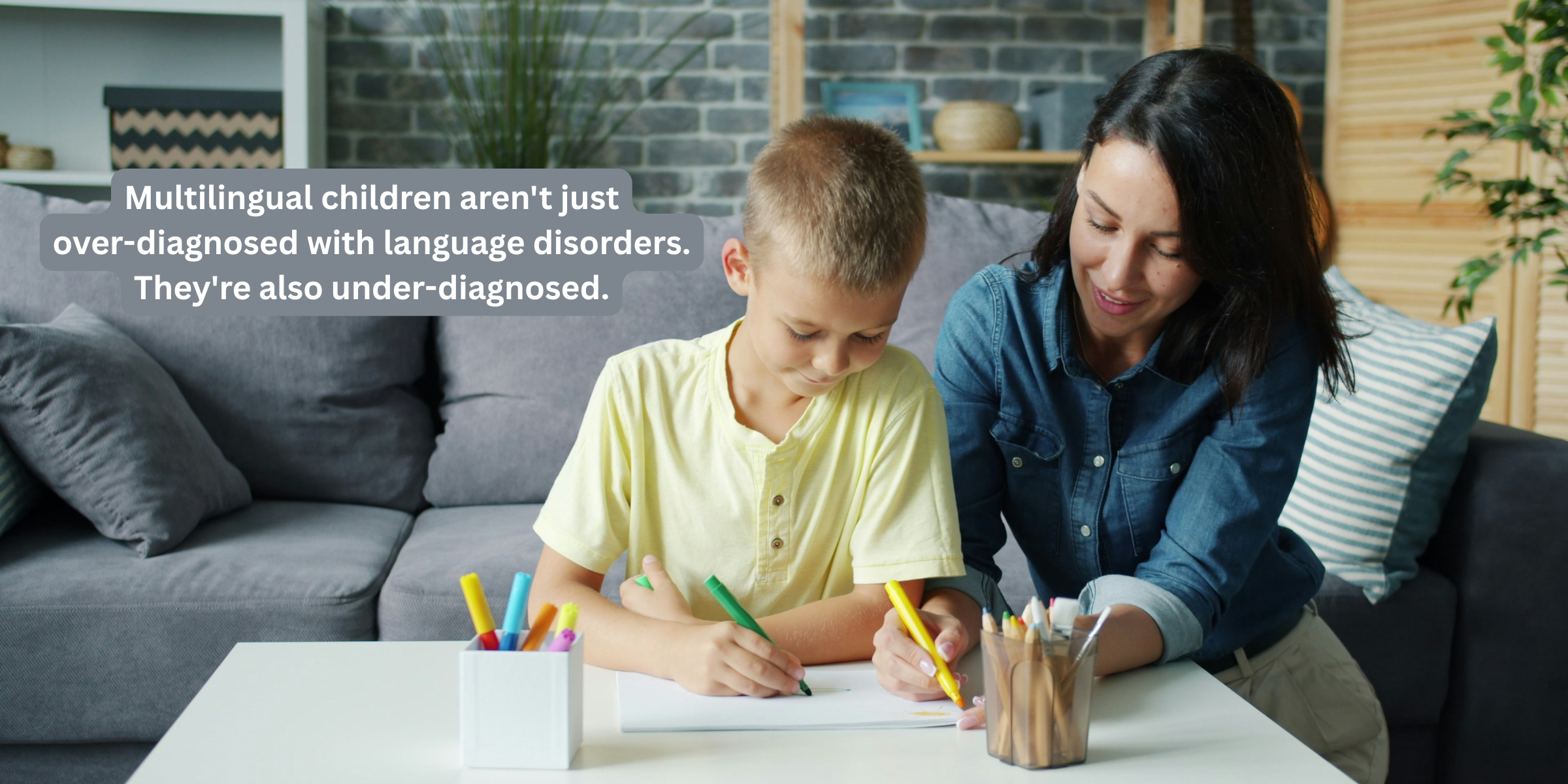
This family’s story isn’t unusual. But it’s also not the whole picture, because the assessment problem with multilingual children doesn’t only run in one direction. Multilingual children aren’t just over-diagnosed; they’re also under-diagnosed. And both happen for the same underlying reason: the tools we’re using weren’t built for them.
The Assessment Problem Runs Both Ways
Most people, when they hear about multilingual children and language assessments, assume the risk is being flagged when there’s nothing wrong. And that does happen, regularly. A child who speaks two languages will almost always score below average on a single-language assessment, because their vocabulary and exposure is distributed across both languages rather than concentrated in one. Compared against monolingual norms, they look like they’re behind, and often they’re not.
But there’s a second pattern that gets less attention. Some multilingual children who do have a genuine language disorder go unidentified, not because the assessor is too quick to flag, but because they’re too cautious. A child who’s quiet or who switches between languages might be assumed to simply be “still settling in” or “adjusting to a second language,” and their difficulties get attributed to multilingualism itself. The waiting continues and support doesn’t arrive.
Research published in 2026 in Research in Special Education (Ortiz & Chow) examined identification rates for bilingual children across elementary school and found evidence of both patterns: emergent bilingual children were overrepresented in language-related disorder categories relative to monolinguals, while English-proficient bilinguals were consistently underrepresented in the same categories. The problem, in other words, isn’t that assessors are systematically biased in one direction. It’s that the tools don’t give them reliable information, so outcomes vary, sometimes dramatically, depending on the assessor’s training, assumptions, and the specific child in front of them.
Why Standard Assessments Fail Multilingual Children
Most language assessments used in early childhood settings were developed using monolingual child populations. They were normed against children who speak one language. When they ask how many words a child knows, they ask in one language. When they assess comprehension, they assess in one language. When they produce a score, they compare it against a monolingual average.
For a child who speaks two languages, this will almost always produce an artificially low result. Multilingual children distribute their vocabulary across their languages depending on context: they learn school words in the school language, home words in the home language, food words in the language of the kitchen, garden words in the language they hear outside. Their total vocabulary, counted across all their languages, is typically in line with or ahead of monolingual peers, though their vocabulary in any single language, counted alone, often isn’t.
A 2022 study in Frontiers in Education (Armon-Lotem et al.) found that applying monolingual norms to bilingual children produces over-diagnosis of developmental language disorder at rates of between 15% and 72%. That’s an enormous range, and it reflects how inconsistent the outcomes are when the wrong tool is used.
The under-diagnosis problem comes from a different mechanism. When an assessor knows a child is multilingual, they may hesitate to diagnose, correctly recognising that normal multilingual development can look like delay, but then over-correcting by assuming everything they see is explainable by bilingualism. A child who’s genuinely struggling can go years without support because their difficulties have been quietly attributed to the language situation at home.
What Happened After the Assessment
The family I mentioned earlier had, before I spoke with them, already acted on the nursery’s advice. They’d stopped speaking Italian at home. The reasoning was understandable: if German wasn’t yet established, introducing a competing language was making things worse, so it seemed better to focus, consolidate the German, and reintroduce Italian later.
By the time I spoke with them, the Italian had faded significantly. What had been a living, functioning home language — the language of one parent’s entire childhood, of extended family, of cultural identity — had been put on pause on the basis of an assessment that had never actually found a problem.
I want to be careful here: I’m not assigning blame to the nursery staff, who were working with the tools they had, within a system that hadn’t given them better ones. But the outcome illustrates why this matters so concretely. Language assessment errors in early childhood aren’t abstract; they have real consequences, and those consequences can be surprisingly difficult to undo. What tends to go on pause in early childhood, even for a few months, doesn’t always come back at the same level.
The consequences of under-diagnosis are just as real, if less visible. A child who isn’t identified early doesn’t receive support during the period when intervention is most effective, and by the time a genuine disorder becomes undeniable — when it starts affecting reading, classroom participation, and confidence — the window for early support has already passed.
What a Genuine Language Disorder Actually Looks Like in a Multilingual Child
True language disorders, conditions like developmental language disorder, do exist in multilingual children at roughly the same rates as in monolingual children. They’re real, they’re worth identifying correctly, and identifying them correctly is the whole point.
The Key Markers That Cross Language Boundaries
The distinguishing features aren’t what a child scores in a single language but what happens across all their languages. A child with a genuine language disorder will typically show difficulties in both languages, not just one. They’ll struggle with language structure — grammar, sentence formation, sequencing — rather than only with vocabulary counts, which are the most context-dependent indicator there is. They’ll also show particular difficulty with sentence repetition tasks, which research has identified as a reliable clinical marker that works across multilingual contexts.
A child who simply has less vocabulary in one language because that language has fewer daily use opportunities is showing a different pattern entirely. Vocabulary gaps follow the logic of exposure, whereas structural difficulties don’t.
Why Parent Input Is Essential
One of the most consistent findings in recent multilingual assessment research is that parent questionnaires dramatically improve diagnostic accuracy. The 2022 Frontiers study found that asking parents structured questions about their child’s home language abilities, developmental history, and sentence complexity in the home language significantly distinguished children who had developmental language disorder from those who’d simply been flagged on the basis of monolingual norms. Parents know things about their child’s language that no single-session assessment can capture, and a good assessor will treat that knowledge as essential information rather than background noise.
What a Good Multilingual Assessment Should Include
A proper multilingual language assessment starts by mapping the child’s complete linguistic environment: which languages are spoken, by whom, in which contexts, and how much. This information changes what every subsequent finding means, and without it the assessment is working in the dark.
It should assess across all languages the child is exposed to, ideally with a native-speaking assessor for each language or at minimum with structured parent input about language development and use at home. It should compare the child’s performance against multilingual norms rather than monolingual ones, and it should look at language structure and processing rather than treating vocabulary as the primary indicator. And crucially, it should never recommend removing or reducing a language unless there’s genuine, independently confirmed evidence of a disorder — and even then, that decision should be made carefully and in close collaboration with the family.
What to Ask If Your Child Has Been Flagged
If your child has been flagged for a language assessment, or has already received one that you’re uncertain about, these are questions you’re entirely within your rights to ask:
- Was this assessment designed for multilingual children?
- Was vocabulary counted across all of my child’s languages, or only one?
- Were they compared against multilingual norms or monolingual ones?
- Did the assessor ask about language use and development in the home language?
- Does the professional involved have specific training in multilingual language development?
These aren’t hostile questions — they’re the right questions, and a good professional will welcome them. If the answers suggest the assessment was monolingual in scope, a second opinion is worth seeking, ideally from a speech and language therapist or educational psychologist with specific training in multilingual assessment.
The goal isn’t to dismiss concerns. It’s to make sure the picture being used to make decisions about your child is the full picture, not just the part that’s visible through a monolingual lens.
If you’d like to talk through an assessment your child has received, or if you’re not sure whether their multilingual development is on track, a free 30-minute introductory call is a good place to start. You can book a call or find out more about my work on my website, and I share regular reflections and practical insights on multilingualism on Instagram, Facebook, and LinkedIn. I’d love to have you there!
Not Sure Where to Start?
Book a free 30-minute intro call. No preparation needed, no strings attached.
Just a conversation about where you are and how I might be able to help.
Leave a Reply