
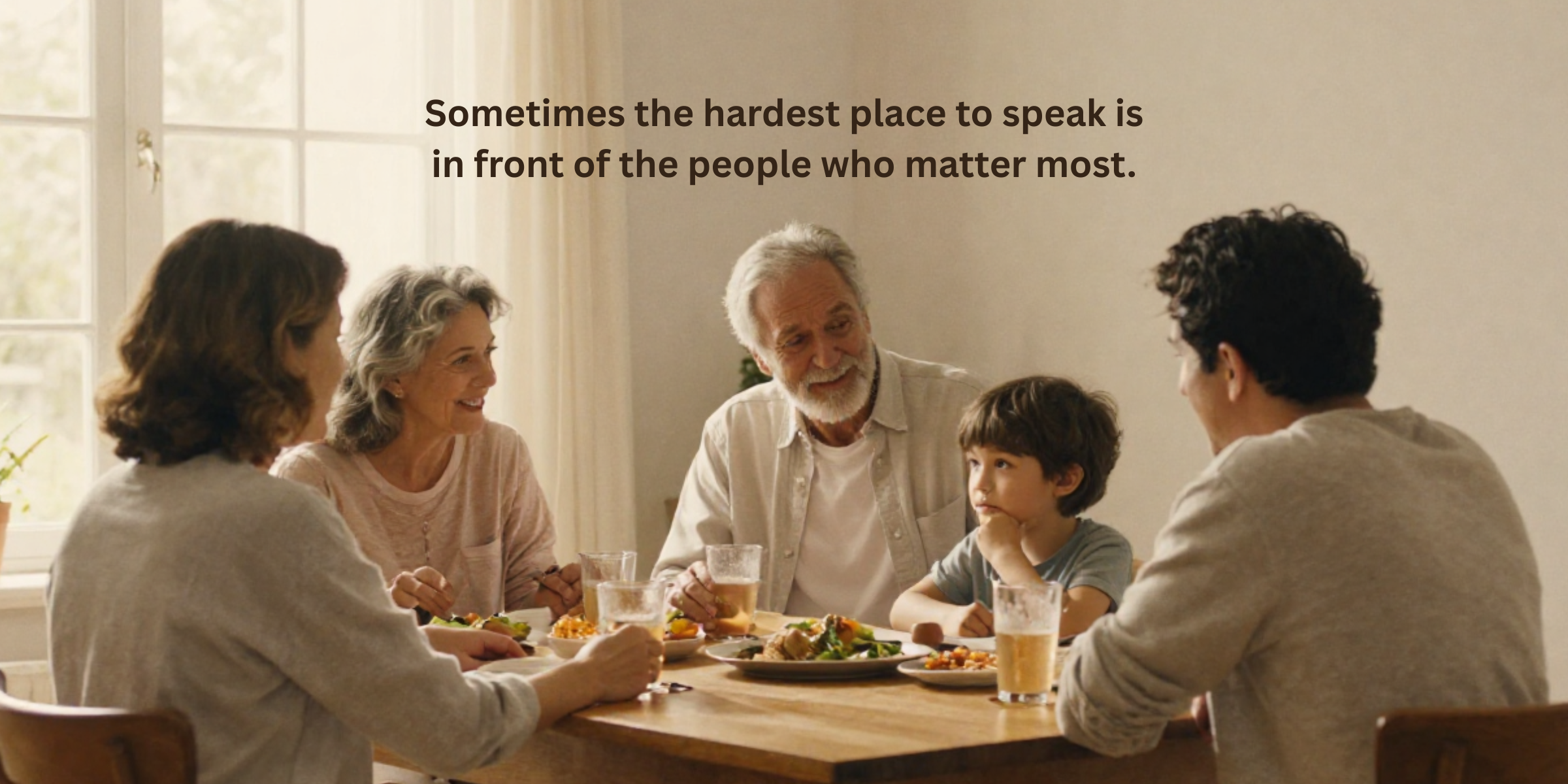
It isn’t regression, and it isn’t forgetting. Here’s what’s really going on when a multilingual child clams up around extended family.
A mother I spoke with recently told me her son hadn’t said a single word of French in three days. Not to his grandmother, not to his cousins, not even to answer a direct question. At home, he chatted away in French constantly. At his grandmother’s table, he went completely silent.
She was mortified. She assumed he’d forgotten the language, or worse, that he was rejecting it.
This is one of the most common worries I hear from multilingual families, and it’s almost never about vocabulary. Why bilingual children go quiet around family has far less to do with what they can say and far more to do with how safe they feel saying it.
It’s Performance Pressure, Not Language Loss
When a child feels like they’re being tested, watched, or silently compared to monolingual cousins, the safest option is silence. Not because they can’t produce the words, but because speaking suddenly feels risky. There’s an audience. There are expectations. There’s a grandmother beaming at them, waiting.
I see this constantly in my work, and it usually looks the same way. A child will be happily chatting away in Spanish with their parents, full sentences, no hesitation, and then someone unfamiliar leans in and says “Hola!” and the same child goes shy, looks at the floor, and refuses to say a word. Nothing about their Spanish has changed in that moment. What’s changed is the audience.
This kind of multilingual child speaking anxiety tends to spike in exactly the situations where parents most want their child to shine: family gatherings, video calls with grandparents, visits to the home country. The stakes feel highest precisely when the child is least likely to perform.
Why Heritage Language Use Drops in High-Stakes Moments
Heritage language use in children isn’t static. It flexes depending on context, audience, and emotional safety. A child who’s fluent and confident in one setting, chatting with a parent in the kitchen, say, can genuinely struggle to access the same language in a setting that feels evaluative.
This isn’t unique to bilingual children. Any child asked to perform a skill in front of an audience, whether it’s reciting a poem or playing an instrument, can freeze. Language is no different. The difference is that when a monolingual child goes quiet, nobody assumes they’ve forgotten how to talk. When a bilingual child goes quiet, the assumption often jumps straight to language loss.
That assumption is usually wrong, and it can do real damage if it shapes how the family responds.
The Identity Layer Nobody Talks About
There’s another layer to this that rarely gets named directly: heritage language often carries an emotional weight that goes far beyond communication. It’s tied up with belonging, with being seen as a proper member of the family, with living up to a grandparent’s hopes. That’s a lot of pressure to place on a sentence about what someone had for lunch.
Children pick up on this weight even when nobody says it out loud. The more a language is treated as proof of identity or loyalty, the higher the stakes feel every time the child opens their mouth. Paradoxically, the families who care most about passing on the heritage language are sometimes the ones whose children feel the most pressure around it, simply because the caring is so visible.
Loosening that pressure, even slightly, tends to do more for long-term language use than any amount of encouragement to just try.
It Happens to Adults Too (Yes, Including Me)
This isn’t only a childhood thing. Ask any adult who’s tried to hold a conversation in a language they’re not fully fluent in, meeting a partner’s family for the first time, moving somewhere new, sitting through a call in a second language, and the same pattern shows up. Linguists call this willingness to communicate, and it isn’t fixed. It rises and falls depending on who’s listening, how well you know them, and how confident you feel in that specific moment.
Accents make it harder still. An unfamiliar way of pronouncing familiar words, a relative’s regional turn of phrase, a new expression nobody warned you about, all of it adds real-time decoding on top of the usual effort of speaking a non-dominant language. Adults usually have the vocabulary to explain why they’ve gone quiet in that moment: I couldn’t quite catch what she said, I didn’t want to guess and get it wrong. Children have the same experience without the words to name it. They just go quiet.
I feel this myself with Turkish. I can hold a conversation comfortably with my husband at home, then sit at a table with his extended family in Türkiye and freeze slightly, not because I’ve forgotten the words, but because the accent is different, the pace is faster, and getting it wrong in front of people I want to impress feels higher stakes than getting it wrong in my own kitchen. If it happens to an adult who chose to learn this language, it’s not surprising it happens to a seven-year-old who didn’t get a say in the matter.
What Doesn’t Help (Even Though It Feels Natural)
A few instinctive parental reactions tend to make things worse:
- Prompting repeatedly. “Say hello in Italian. Go on, say hello to grandma.” Each prompt raises the stakes further and confirms to the child that this is, in fact, a test.
- Translating on their behalf. It’s tempting to jump in and smooth things over, but this confirms the child’s fear that they can’t manage the interaction alone. It also removes their chance to try.
- Apologising for them. “Sorry, he’s shy, he doesn’t really speak much French.” This sentence, said in front of the child, becomes a label they may start to believe about themselves.
- Comparing them to a sibling or cousin. Even a light, joking comparison sharpens the sense that this is a competition with a winner and a loser.
What Actually Helps Raising Bilingual Children with Confidence
- Give them a job, not a test. “Tell your cousin what the dog’s name is” works far better than “say something in Portuguese.” A task has a clear, low-stakes goal. A test has an audience and a verdict.
- Model imperfection yourself. If you code-switch, mix languages, or make mistakes out loud, it signals that the language is a working tool rather than something to get right or wrong. Children pick up on this far more than we expect.
- Create low-pressure contact before the high-pressure moment. If minority language exposure at family gatherings is rare, even short, playful exchanges beforehand, a video call, a voice note, a family WhatsApp thread, can lower the stakes before the actual visit.
- Let silence be an option without becoming the story. Sometimes a child genuinely won’t speak on a given day, and that’s fine. The goal isn’t forcing output. It’s protecting their relationship with the language so they want to use it later, on their own terms.
What Grandparents and Relatives Can Do
Parents can only carry half of this. The other half sits with the relatives in the room, often without them realising it.
- Skip the direct language test. “Say something in Polish for grandma” puts a child on the spot in front of an audience. A shared activity, cooking, a game, looking at photos together, gives language a reason to happen naturally.
- Respond to attempts, not just fluency. A child who tries a single word and gets a warm reaction is more likely to try a second one. A child who’s corrected or laughed at gently, even affectionately, often shuts down.
- Let the parent take the lead. If a parent redirects or steps in, that’s usually a signal to ease off, not a cue to try harder from another angle.
Frequently Asked Questions
Is this a sign my child is losing the language? Rarely. Most children who go quiet in specific settings can still understand everything and often continue using the language normally at home. Watch for whether the silence is situational or constant, that distinction matters far more than the silence itself.
How long does this phase usually last? It varies, but for most families it eases as the child has more low-pressure contact with the same relatives over time, rather than through any single conversation or intervention.
Should I stop bringing it up entirely? Not necessarily, but shift from prompting the child to speak toward creating situations where speaking happens as a side effect of doing something else together.
Could this ever be something more serious? In a small number of cases, silence that happens everywhere, including at home, and lasts more than a few months, can point to selective mutism, an anxiety condition distinct from situational silence. If that sounds like your child, it’s worth a conversation with a paediatrician or speech-language therapist rather than waiting it out.
The Bigger Picture
The silence isn’t the child failing the language. It’s the child protecting themselves from getting it wrong in front of an audience that matters to them. Reframing it this way changes how the whole family responds, and that response matters more than any single conversation at a wedding table.
I work with a lot of families navigating exactly this tension between wanting their child to shine in front of relatives and understanding that pressure often backfires. If this is playing out in your own household, a short conversation can usually surface one or two concrete adjustments that make a real difference by the next family gathering.
If you’d like to talk through your own family’s language situation, I offer a free 30-minute introductory call. You can find details and book directly on my website, or find me on Instagram, Facebook, and LinkedIn for more on raising confident multilingual children.

Not Sure Where to Start?
Book a free 30-minute intro call. No preparation needed, no strings attached.
Just a conversation about where you are and how I might be able to help.
Leave a Reply