On confidence, competence, and the gap between them
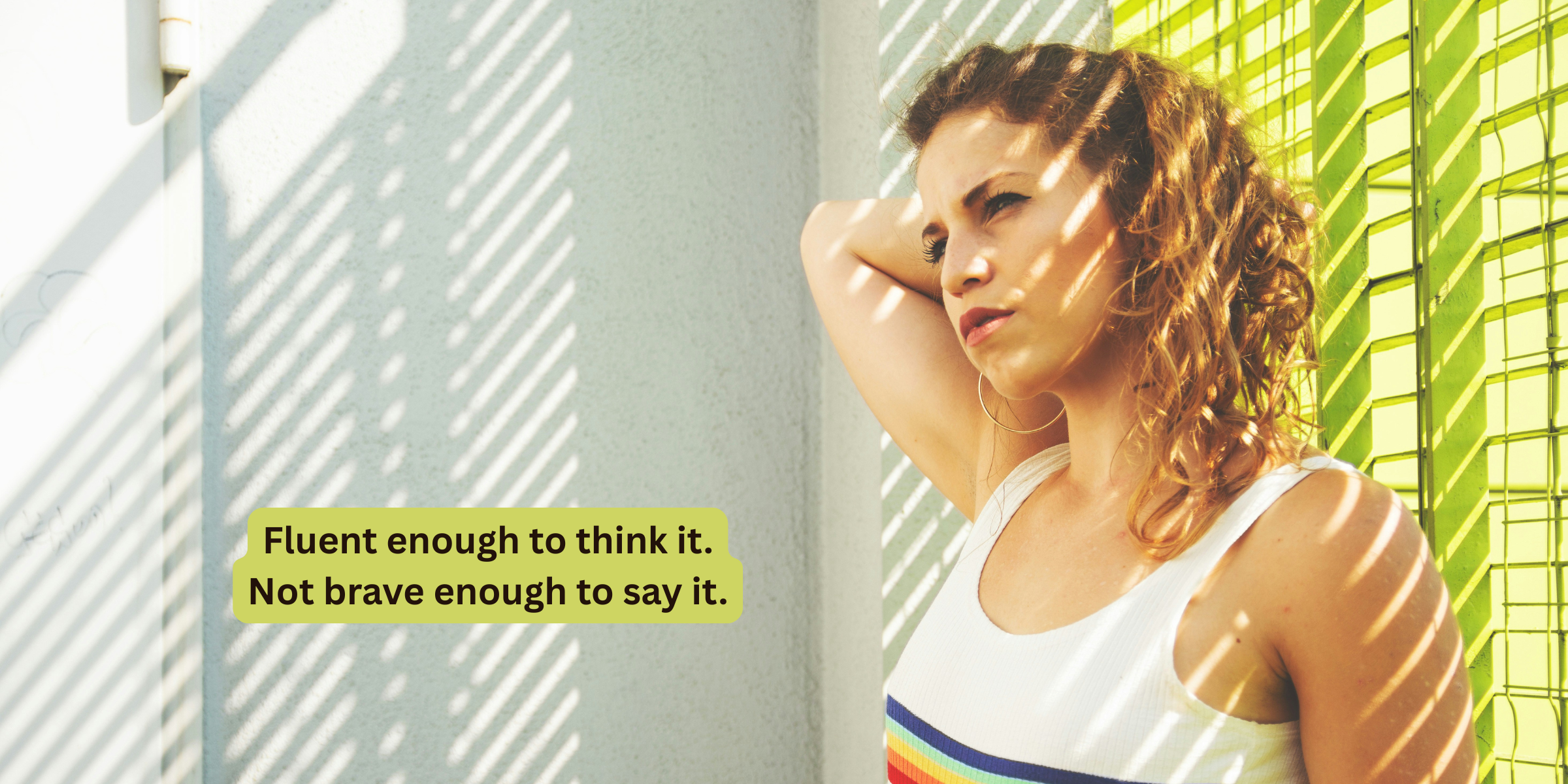
Plenty of people who speak two, three, even four languages still won’t call themselves bilingual. Ask them why, and the ability isn’t usually the problem. It’s a nagging sense that they don’t quite qualify, that a “real” bilingual wouldn’t hesitate, wouldn’t mix up a preposition, wouldn’t need to double-check a word before saying it out loud.
I know this feeling first-hand. I run a multilingualism consultancy and speak three languages fluently: English, Spanish and German. I’ve also learnt French and Italian, and I’m currently learning Turkish. I can hold a conversation in Turkish, and still, the other day, when someone asked how many languages I speak, I answered five, and added that while I’m also learning Turkish, I probably don’t speak it well enough for it to count yet. If you’ve never heard of bilingual imposter syndrome, that gap between what you actually know and how entitled you feel to claim it, this is exactly what it looks like from the inside.
That gap is more common than people realise, and it points to a strange quirk in how we think about bilingualism generally. Somewhere along the way, a lot of people picked up the idea that being bilingual, or multilingual, means every language is spoken flawlessly, every one used constantly, every one indistinguishable from a native speaker’s. Anything short of that gets quietly downgraded to “I know some,” or “it isn’t good enough,” or “it doesn’t really count yet.”
What is bilingual imposter syndrome?
Bilingual imposter syndrome is the gap between what you actually know and how entitled you feel to claim it. It’s the quiet conviction that your fluency doesn’t count, that a native speaker would see through you in seconds, or that being a beginner in one new language somehow undoes your fluency in all the others, as if the weakest one drags the rest down with it. It has nothing to do with actual ability, and almost everything to do with a handful of past moments that taught you to doubt yourself.
There isn’t just one kind of bilingual
Researchers who study bilingualism describe it as a spectrum rather than a single fixed state. There are simultaneous bilinguals, who grew up with two languages from birth. There are people who learned a second language later and use it daily for work. There are receptive bilinguals, who understand a language fluently but speak it rarely or hesitantly. There are people whose stronger language has shifted more than once across a lifetime, depending on where they’ve lived and who they’ve spoken with.
All of these are forms of bilingualism. None of them is the “real” one that the others fall short of.
The trouble is that most people only have one mental picture of what bilingual is supposed to look like, and it’s usually the most fluent, most balanced, most effortless version. When someone’s own experience doesn’t match that picture, the instinct isn’t to widen the definition. It’s to disqualify themselves.
This isn’t about lowering the bar to nothing
None of this means any amount of exposure counts as fluency. If you can say hello and count to ten in a language, you don’t speak it, not yet, and no reasonable definition of bilingualism pretends otherwise. That was never the point being made here.
The point is where people draw the line once they’re well past hello and counting to ten. Once they can hold a conversation, read a menu, follow the news, get through a work meeting, understand every word someone else says to them, and still insist it doesn’t count because it isn’t flawless. That’s not a modest, accurate self-assessment. It’s the same perfection standard as before, just quietly moved a few steps further down the road, so it still catches almost everyone in its net. The useful line isn’t “can you do it perfectly.” It’s “can you actually do it.” Those are very different questions, and most people who doubt themselves have already answered the second one without noticing.
It looks different depending on how you got there
Bilingual imposter syndrome doesn’t show up the same way for everyone, because the route into a language shapes the doubt that follows it.
Heritage speakers, people who grew up hearing a language at home without necessarily being taught it formally, often carry a specific kind of guilt on top of the doubt. Their fluency was never “earned” through a classroom, so it can feel less legitimate, even when it’s the language they’ve heard the longest. Adult learners tend to carry the opposite problem: every mistake is visible and recent, which makes it easy to mistake a normal part of learning for proof they’re not cut out for it. Receptive bilinguals, who understand fluently but speak rarely, often assume the imbalance between the two skills means neither one counts, rather than recognising comprehension as a real, substantial skill on its own.
Knowing which version of this you’re dealing with matters, because the fix looks slightly different for each. A heritage speaker usually needs permission more than practice. An adult learner usually needs a longer runway before judging the results. A receptive bilingual usually needs a reason and a safe context to start producing the language, not more time spent understanding it.
Where bilingual imposter syndrome actually comes from
It rarely starts with the person themselves. It starts with a comment. A laugh at a mispronounced word. A relative who switches to the stronger language the moment a sentence gets bumpy, meaning well, but confirming without meaning to that the attempt wasn’t good enough to sit with. A teacher, a colleague, a stranger, correcting an accent in a tone that says more than the correction itself.
Enough of those moments, and people stop trying in the language altogether. Not because they lost the ability, but because they lost the willingness to be imperfect in public. The understanding usually stays completely intact. It’s the speaking, the part other people can hear and judge, that quietly goes into hiding.
Signs you might have bilingual imposter syndrome
A few common patterns, if you want to check your own list against them:
- You apologise before speaking a language, even when nobody’s asked you to
- You round your language count down when someone asks how many you speak
- You wait to feel “ready” before using a language out loud, a point that keeps moving further away
- You describe strong comprehension as “not really” knowing a language
- You let other people switch languages for you rather than push through a stumble
- You downplay language skills on a CV or LinkedIn profile despite using them regularly
None of these are character flaws. They’re learned habits, usually picked up from a handful of early moments, and habits can be unlearned in the same way they were picked up.
Why the question is worth answering differently
The more useful question isn’t “am I bilingual enough to claim it.” It’s “what kind of bilingual am I, and is that where I want to stay.” A receptive bilingual who wishes they could speak more isn’t starting from zero. They’re building on a level of comprehension most language learners spend years trying to reach. An adult learner who still makes mistakes isn’t failing at fluency. They’re using a second language, in real situations, which is the entire point of learning one.
Proficiency isn’t determined by when a language was learned or how clean it sounds. It’s determined by how it gets used. A person who understands their grandmother’s every word, who follows the news, who can read a menu and order confidently, isn’t “not really” anything. They’re a bilingual whose speaking confidence has taken a knock, which is a very different, and much more fixable, problem.
What actually helps
A few reframes that tend to make more difference than more study ever does:
- Count what you can already do, not what’s still missing. Comprehension, reading, following a conversation, all of it counts before speaking catches up.
- Treat a mistake as data rather than a verdict. It tells you what to work on next, not what you fundamentally lack.
- Practise in low-stakes settings before high-stakes ones, a language exchange rather than a work presentation, so confidence has somewhere to build before it’s tested.
- Notice who’s actually doing the judging. Most of the time, it’s a memory of one moment, not the room you’re currently standing in.
For some people, working through this alone is enough. For others, especially when the doubt is tangled up with family, work, or a specific bad memory, it helps to talk it through with someone who isn’t inside the situation.
By any reasonable definition, I’m already multilingual, Turkish included. What I’m missing isn’t the language. It’s the permission to be imperfect out loud in it, the same permission I’d give anyone else learning a sixth language while already speaking five. That’s bilingual imposter syndrome in a sentence: mistaking a confidence problem for a competence one.
If you’re rebuilding confidence in a language you understand but rarely speak, or recognise your own bilingual imposter syndrome in this post, this is exactly the kind of thing I work through in 1:1 consultations. Book a call if you’d like to talk it through.
For weekly language tips, strategies, and the kind of honest advice I’ve shared here, come and find me on my website, Instagram, Facebook, and LinkedIn. I’d love to have you there!
Frequently Asked Questions
How many languages do you need to speak to be considered bilingual?
Two, technically, but proficiency in each doesn’t need to be identical or perfect. Bilingualism is a spectrum, not a single fixed bar, and most researchers now define it by function rather than flawlessness.
Does understanding a language without speaking it count as being bilingual?
Yes. This is called receptive bilingualism, and it’s a recognised, well-studied form of bilingualism, common among heritage speakers in particular.
Can you lose your bilingual status if you stop practising?
Skills can weaken without regular use, a process called language attrition, but that’s different from never having had them. A rusty language is still a language you know.
Is imposter syndrome common among multilingual people?
Very common, particularly among heritage speakers and adult learners who measure themselves against native-speaker fluency rather than their own actual, functional ability.
Okay, I recognise myself in this. Now what?
Talk to someone who isn’t inside your own head about it. I offer a free call for exactly this reason, no pitch, no pressure, just an actual conversation about where you are and whether there’s anything worth doing about it.
Not Sure Where to Start?
Book a free 30-minute intro call. No preparation needed, no strings attached.
Just a conversation about where you are and how I might be able to help.
Leave a Reply