
A mother I spoke with recently described it with real frustration in her voice. She and her husband had done everything they thought they were supposed to do: one parent, one language, consistently, for years, with books, songs, and cartoons all carefully split between German and Turkish. And yet her two children, aged five and seven, spoke to each other almost exclusively in German, the language of school and the playground, a language that had nothing to do with either parent’s careful plan.
“I feel like all that effort is undoing itself,” she told me, and I understood exactly why it felt that way, even though I didn’t think it was true.
The Pattern Is Extremely Common
If you’re raising more than one bilingual child and have noticed them defaulting to a single language between themselves, usually the majority or community language, you’re not doing anything wrong, and you’re in very good company. This is one of the most consistently reported patterns among multilingual families, and it has surprisingly little to do with how carefully parents structure language exposure at home.
Here’s roughly how it tends to unfold. The older child starts nursery or school and spends the bulk of their waking hours immersed in the community language, building their peer relationships, their play vocabulary, and their jokes entirely in that language. By the time a younger sibling comes along, the older one has already constructed an entire social world in one language, so talking to a little brother or sister in that same language becomes simply the path of least resistance, requiring no real decision at all.
Research into bilingual households backs this up. Studies looking at how older siblings shape younger children’s language environments have found that once an older child starts spending most of their day in the community language, that language tends to become the default for interactions with younger siblings too, regardless of how much minority-language input parents continue to provide directly at home. Older siblings, in other words, don’t simply receive language from their parents and pass it along unchanged. They actively shape the linguistic environment for whoever comes after them, for better and for worse, in ways that often surprise even attentive parents.
Why Parents Can’t Fully Control This
Here’s the part that can be hard to hear, though it’s genuinely useful to know: you can’t decide which language your children speak to each other. You can shape the environment around them with real care and consistency, but you can’t dictate the outcome of their relationship with one another, because that relationship, like any relationship between children, develops according to its own logic.
Children, from a very young age, are remarkably good at reading the room. They speak whichever language feels most natural, efficient, and socially theirs in a given context, and by the time an older sibling has spent a full day at school, the community language often simply feels more theirs, at least for talking to another child their own age.
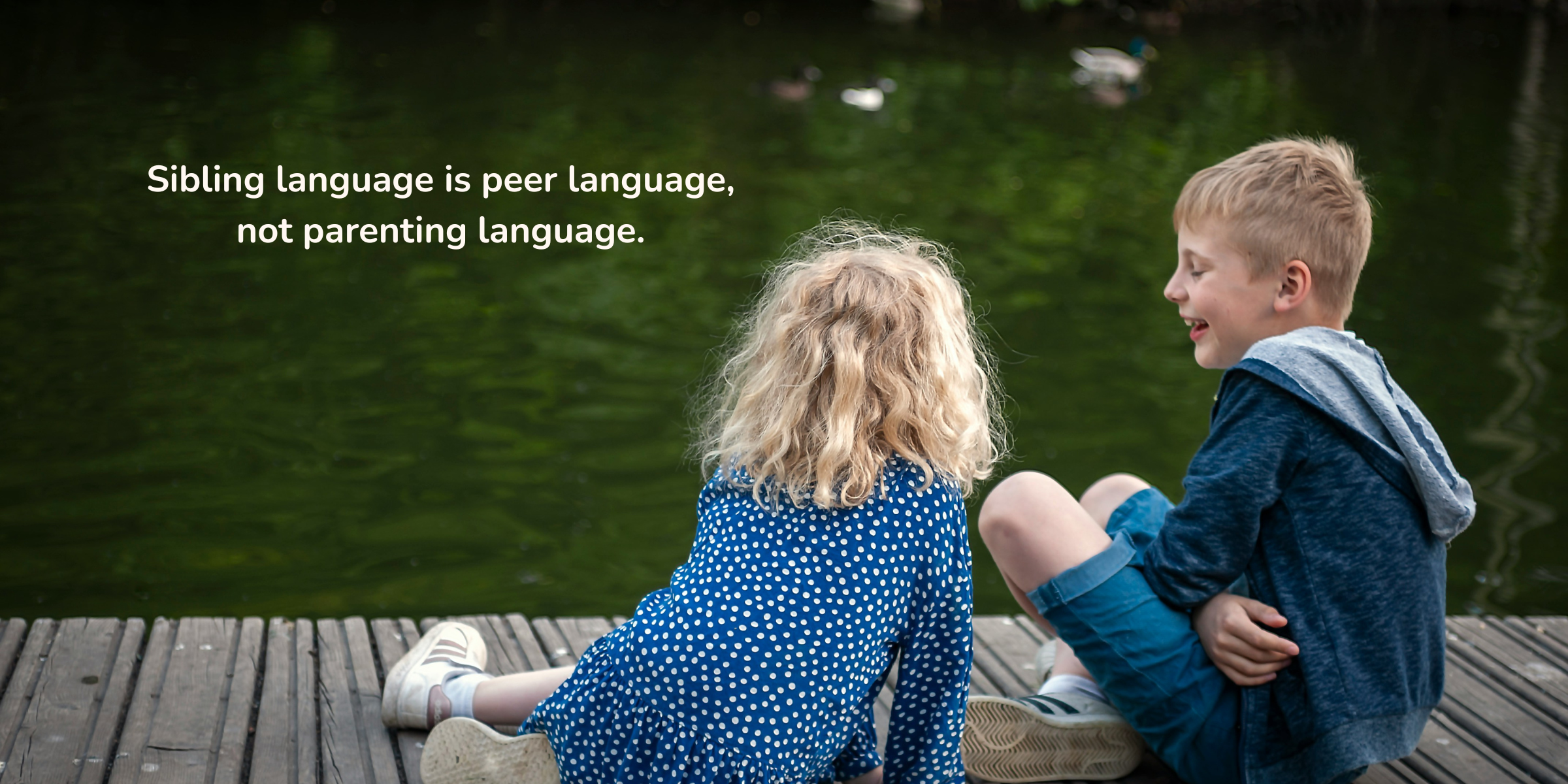
This differs from a parent-child dynamic, where you’re the one setting the linguistic tone of an interaction for years before school enters the picture at all. Sibling language is peer language, and peer language tends to follow peer norms rather than household rules, however consistently those rules have been applied at the dinner table or during bedtime stories.
This isn’t only something I see in client families, either. My mum always spoke to my sister and me in Spanish, but we’d answer her in English, and English was what we spoke to each other too, for years. It was only once we moved to Spain and started at primary school there that Spanish took over as the language between us. Nothing had changed about what our mum did at home, she’d been consistent the whole way through. What changed was our social world, our friends, our school day, the language we were building our shared childhood in, and that’s what flipped the switch. Spanish is still what we default to together now, as adults, wherever in the world we each happen to be living. Whatever language becomes “ours” as siblings often has more to do with where we build that shared world than with any plan a parent puts in place, however carefully considered.
This Isn’t the Same as Losing the Language
It’s worth separating two things that feel identical in the moment but aren’t: which language your children choose to speak to each other, and whether they’re retaining the minority language overall.
A child can answer their sibling in the community language while still being a fully competent, active speaker of the minority language with you, with grandparents, and in specific contexts and activities that matter to them. Passive competence, understanding everything even when responding in another language, is still real competence, and it’s often the quiet foundation that later turns into active use, particularly during trips, visits, or periods of more intensive exposure such as a summer spent with extended family.
What actually determines whether a minority language survives in the long run isn’t sibling dynamics at all. It’s the total quality and quantity of exposure across a child’s whole world, sustained over years, not the specific language two children happen to use when arguing about whose turn it is on the tablet.
What Actually Helps
If you’d like to gently shift the balance without turning it into a battle, since forcing a child to speak a specific language on command rarely works and often backfires, a few things do genuinely make a difference, and none of them require a formal rule.
Shared activities that live entirely in the minority language tend to work far better than a blanket house rule. Cooking together, a specific game that’s always played in that language, a weekly video call with family abroad: context-specific use is more effective than a general instruction to speak one language with a sibling, because it gives the language a concrete reason to exist in that moment rather than asking children to police themselves in the middle of play.
It also helps to increase the language’s presence around your children rather than policing how they talk to each other directly. More books, more shows, more real-world situations where the minority language is simply the only option on the table, especially ones your children already enjoy, tend to do more over time than any rule about sibling conversation ever could.
Resisting the urge to correct sibling-to-sibling language in the moment is harder than it sounds, but it’s worth it. It rarely changes the underlying pattern, and it tends to add tension both to the sibling relationship and to each child’s relationship with the language itself, which is the opposite of what most parents are hoping for.
Perhaps most usefully, it helps to look for situations where the minority language has a genuine social payoff of its own: cousins who only speak that language, a summer with grandparents, a community group of peers who use it naturally. When a language becomes useful for connecting with people children actually want to talk to, they tend to re-engage with it far more willingly than when it’s simply something being asked of them by a parent. That’s exactly what happened with Spanish and my sister, in reverse: it became the language of a whole world of friendships and memories, and that’s why it never left.
When to Actually Pay Attention
The sibling dynamic on its own isn’t usually a red flag. What’s worth watching more closely is a broader drop in comprehension, not just production, of the minority language over time. If a child stops understanding things you say to them in that language, rather than simply choosing not to answer in it, that’s a different conversation, and one worth having with a bilingual-aware speech and language professional if it persists for more than a few months.
For most families, though, this is simply one of the more visible, more emotionally loud parts of raising multilingual children, and one that tends to look far more permanent at age six than it turns out to be at sixteen, once school pressures ease and children start choosing their own relationship with the languages they grew up around.
If you’re navigating this in your own family and recognise the pattern described here, this is exactly the kind of thing I work through in 1:1 family consultations. A free 30-minute introductory call is a good place to start, or find out more about my work on my website, and I share regular reflections and practical insights on multilingualism on Instagram, Facebook, and LinkedIn. I’d love to have you there!
Frequently Asked Questions
Is it normal for bilingual siblings to speak to each other in the majority language?
Yes, this is extremely common and well documented. Children tend to default to whichever language feels most natural in a peer context, which is often the community or school language, regardless of how carefully parents manage their own language input at home.
Does this mean my child is losing the minority language?
Not necessarily. Sibling language choice is separate from overall language retention. A child can respond to a sibling in one language while remaining a fully competent speaker or understander of another, particularly with parents, grandparents, and in specific contexts that matter to them.
At what age do bilingual siblings usually start defaulting to one language?
It varies, but the shift often becomes noticeable once the older sibling starts nursery or primary school and begins spending most of their waking hours immersed in the community language. Once that happens, sibling interactions frequently follow, sometimes within a matter of months.
Can I make my children speak the minority language to each other?
You can shape the environment through shared activities, exposure, and social contexts where the language has real value, but you generally can’t dictate the outcome of what language children choose between themselves. Forcing it in the moment tends to create tension without changing the underlying pattern.
Not Sure Where to Start?
Book a free 30-minute intro call. No preparation needed, no strings attached.
Just a conversation about where you are and how I might be able to help.
Leave a Reply