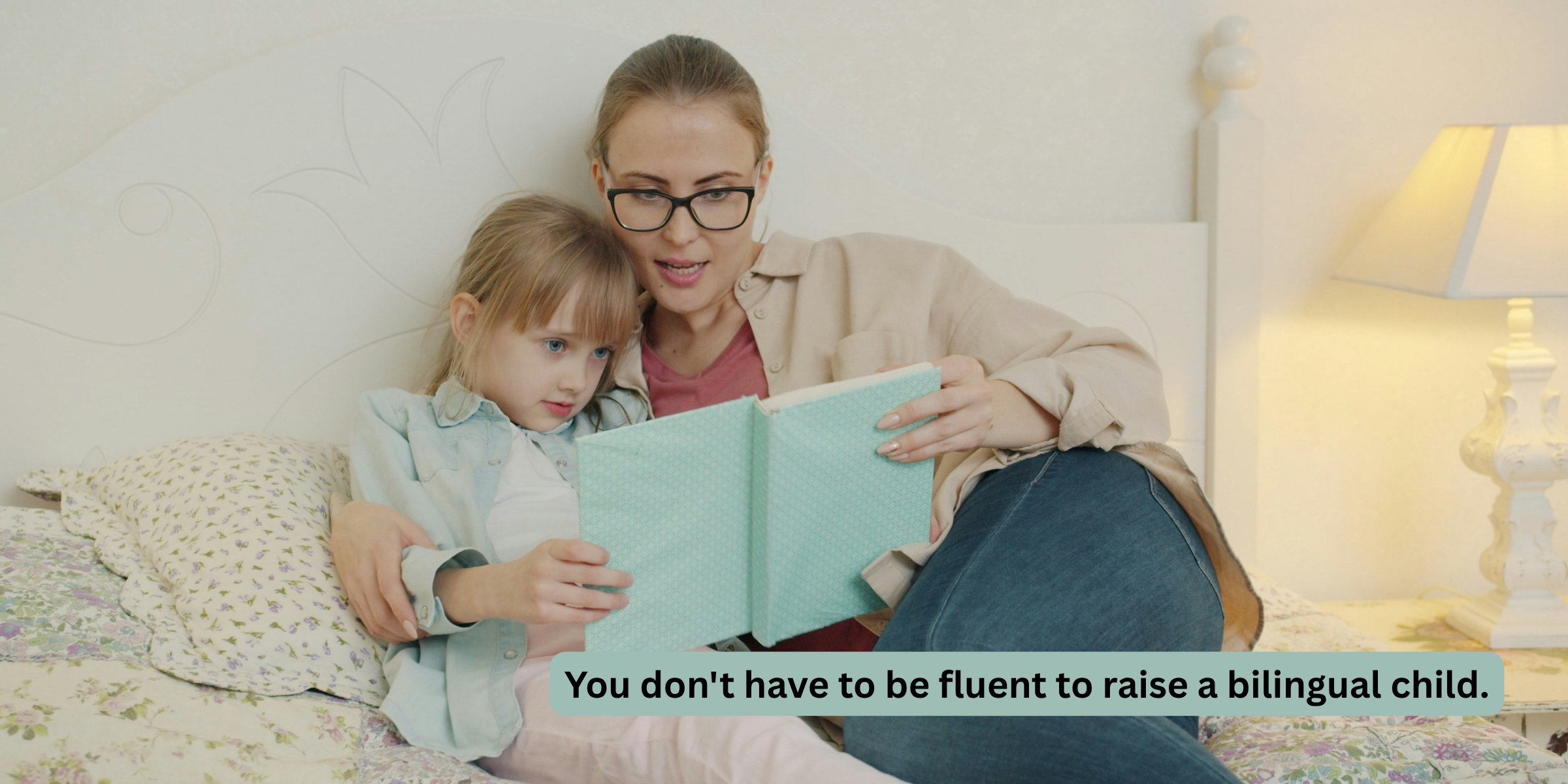
Why cumulative exposure, not fluency, decides whether a child grows up bilingual.
A client told me something recently that I hear in some form almost every week: “How can I teach my daughter English when my own English still isn’t perfect?” She’d learned English at school in her twenties, uses it daily at work, reads in it, thinks in it half the time. And she still didn’t feel she’d earned the right to be her daughter’s source for it.
That question, “Who am I to pass on a language I had to learn myself?”, comes up more than any other in my consultations, and it’s the one I most want to put to rest. Not because it’s a silly worry, but because it rests on an assumption that simply isn’t true. Native speakers aren’t the only ones who get to hand a language down.
Parents who learned a language as adults, even imperfectly, even with an accent, give their children something completely real. What decides whether a child grows up genuinely bilingual isn’t whether a parent was born speaking that language. It’s whether the language shows up consistently, in a warm and ordinary way.
The Belief That Stops Non-Native Parents Before They Start
There’s a quiet assumption running through a lot of parenting advice: that a language is only “yours” to give if you grew up inside it. Anything short of that, the thinking goes, risks passing on something broken. The wrong accent, the wrong grammar, the wrong idioms, a garbled half-version of the real thing. It’s an understandable worry, but it’s also not how children actually learn language.
Kids build their sense of a language from every source they’re exposed to, not from one parent in isolation. A parent’s accented, occasionally-wrong English is one input among several (books, shows, other speakers, school, eventually the wider world). Children are remarkably good at sorting through all of that and converging on the standard forms over time. A parent’s imperfect English isn’t a ceiling on a child’s eventual fluency. It’s a starting point, and a generous one.
What Actually Predicts a Bilingual Outcome
Research on family language input, including decades of work from linguists studying bilingual development, points to the same conclusion again and again: total, cumulative exposure across a child’s whole environment predicts outcomes better than the skill level of any single speaker in that environment. In plain terms, consistency and warmth do more work than fluency ever will.
A parent who speaks confident-but-imperfect English every day, without apologising for it, tends to raise a stronger English speaker than a parent who waits for fluency that never quite arrives before saying anything at all. The language that gets used, gets learned. The language that gets postponed until it’s “good enough” usually doesn’t get passed on at all.
Why a Learned Language Still Counts
There’s a version of this worry that’s specific to non-native parents: if I didn’t grow up with it, is what I’m giving my child even the real thing? The answer is yes. A language a parent learned deliberately, as an adult, often comes with something a native-speaking parent doesn’t automatically have: an awareness of how the language actually works, because they had to study it consciously rather than absorb it unconsciously. That’s not a lesser version of the language, just a different, equally legitimate way of holding it.
There’s another benefit here, too. A child who watches a parent visibly learning, correcting themselves, looking up a word, or laughing at a mistake, absorbs something beyond vocabulary. Learning a language is a normal, ongoing, not-embarrassing thing to do. That’s a harder lesson to teach a fluent native speaker’s child, who rarely sees their parent struggle with the language at all.
Practical Ways to Pass On a Language You’re Still Learning Yourself
A few things consistently help the parents I work with who are in exactly this position:
- Learn alongside your child rather than ahead of them. You don’t need to master a topic before introducing it. Working out the word for something together turns a gap into an activity rather than a failure.
- Lean on books and media as backup, not replacement. They fill vocabulary you don’t have yet, but they don’t replace your own daily use of the language, which is what actually builds the habit.
- Mix languages when you need to, rather than stalling. Say the sentence in your target language, drop in the word you don’t know from your stronger language, and keep moving. A dropped-in word doesn’t undo the sentence around it.
- Let your child see you make mistakes. A shrug and a correction models exactly the right relationship to a language you’re still growing into.
- Build a network beyond yourself. A tutor, a playgroup, a relative, media in the language. None of this needs to come from you alone, and it shouldn’t have to.
Common Worries, Answered Honestly
Will my accent become my child’s accent?
Possibly, in the early years, though children exposed to multiple sources (media, teachers, other speakers) tend to develop their own pronunciation over time rather than permanently copying a parent’s. An accent isn’t a flaw to correct out of yourself before you start; it shouldn’t be a barrier at all.
Am I “allowed” to raise my child in a language that isn’t native to me?
Yes, without qualification. There’s no ownership test on a language. What matters is exposure, consistency, and warmth, not your birth certificate.
What if I run out of vocabulary mid-conversation?
This happens to every parent in this position, usually around anything technical or unfamiliar. Say what you can, drop in the missing word from whichever language you do have it in, and keep the conversation moving. Momentum matters more than precision.
Is it too late if I haven’t started yet, or if my own level is still basic?
Almost never. Children build real language skills well into primary school, and consistent exposure at any level, even a modest one, adds something a fully absent language never could. Your own English doesn’t need to be finished for your child’s to begin.
The Real Question to Ask Instead
The question isn’t “am I fluent enough to be my child’s only source for this language.” It never was, for anyone, native speaker or not. The better question is: “what can I offer consistently, and who else can I bring in around me, so this language reaches my child from more than one direction?” That’s a far more achievable goal than fluency ever was, and it’s the one that actually determines whether a language takes root.
If you’re weighing how to approach a language you didn’t grow up with, working out what’s realistic for your family, or just want to hear that you’re doing better than it feels like some days, I offer 1:1 consultations built around exactly this. You can book a free 30-minute introductory call or find more information about my work and current offers on my website. I also share ongoing insights and resources on Instagram, Facebook, and LinkedIn. I’d love to have you there!
FAQs
Do I need to be a native speaker to raise a bilingual child?
No. Consistency, warmth, and total exposure across every source combined matter more than whether the parent grew up speaking the language natively.
Will speaking with an accent affect my child’s language?
Not in any lasting way for most children, who draw pronunciation from multiple sources over time rather than fixing permanently on one parent’s accent.
What if my own level in the language is still basic?
It still counts. A modest, consistent level of exposure builds real skills over time; it doesn’t need to wait until the parent’s own fluency is “finished.”
What do I do when I don’t know a word in the language I’m teaching?
Say what you can, substitute the missing word from your stronger language, and keep going. Stopping the conversation costs more than one borrowed word ever will.
Not Sure Where to Start?
Book a free 30-minute intro call. No preparation needed, no strings attached.
Just a conversation about where you are and how I might be able to help.
Leave a Reply