What actually transfers when a child, or an adult, learns to read across two or more scripts
Привет. If you don’t read Cyrillic, that’s just a shape on the page, not a word yet. It reads “hello,” and it took me a few weeks in a university class about Russian grammar to sound it out without stopping to think. I never got much further into Russian itself, a handful of words and phrases stuck, no more, but the alphabet did, and so did the reminder of how foreign an unfamiliar script feels, even to an adult who already reads confidently in two or more other languages.
A few of the families I work with are climbing a version of that same wall, usually much younger and with far higher stakes than a grammar module. A mother I’ve spoken with has a son growing up between German, English, and Japanese, and he’s now learning to read in four scripts at once, Latin for German and English, plus hiragana, katakana, and kanji for Japanese. Another family I know moved their daughter from an Arabic-medium nursery into an English-language primary school, alphabet and all. Their question is almost always the same. Are we asking too much of them?
The honest answer is more reassuring than most parents expect, with one real caveat. Learning to read in two or more languages asks genuine effort of a child, though nowhere near as much repeated effort as parents fear. What actually happens sits somewhere between those two ideas, and which side of that line a child lands on depends heavily on which scripts are involved.
What Transfers When You’re Learning to Read in Two Languages
If both of a child’s languages use the same kind of writing system, an alphabet where letters roughly correspond to sounds, a lot of what they’ve already learned genuinely carries over. Phonological awareness, the ability to hear and pull apart the individual sounds in words, is one of the most useful skills a young reader can have, and it travels remarkably well between alphabetic languages. A child who’s strong at sounding out words in German has a real head start when they come to sound out words in English, because the underlying skill, breaking speech into its component sounds, is the same skill wearing a different outfit.
There’s a second layer worth knowing about, something researchers call orthographic depth. Some alphabetic languages spell almost exactly the way they sound. Spanish, Finnish, and largely German fall into this category. English doesn’t. English is what linguists call a “deep” orthography, full of exceptions, silent letters, and words that simply have to be memorised rather than sounded out. One well-known comparison of European languages found that children learning shallow, consistent orthographies were reading with near-full accuracy by the end of their first school year, while children learning English’s far more irregular spelling system had only reached about a third of the way there in the same amount of time. That gap comes from the language itself, not from any child’s ability.
In practice, this means that if a child’s two languages are both alphabetic, the skills they build in one meaningfully support the other, even though English, or another deep orthography, will visibly take longer to click into place. That slower pace has nothing to do with ability, since deep orthographies simply take longer for everyone who learns them, monolingual children included.
When the Script Itself Changes
The picture shifts once a child is dealing with two genuinely different writing systems, not just two alphabets, but two entirely different ways of representing language on the page. This is where the Japanese example comes in. Japanese doesn’t use one script but three, layered together in the same sentence. Hiragana carries native Japanese words and grammatical particles. Katakana marks foreign loanwords. Kanji, borrowed from Chinese, carries whole units of meaning rather than individual sounds.
It’s worth saying plainly that even monolingual Japanese children face this same layered task. They learn hiragana and katakana first, usually before starting school, and build up their knowledge of kanji gradually, often across their entire school career. A bilingual or trilingual child learning Japanese alongside German, English, or any other language isn’t facing something uniquely difficult. They’re facing what every Japanese-reading child faces, on top of an unrelated alphabet.
Then there’s reading direction, which surprises a lot of parents. Japanese can be written vertically, top to bottom, in columns running right to left, still common in novels and newspapers. It’s just as often written horizontally, left to right, the way English is, particularly online and in textbooks. A child growing up reading Japanese and English isn’t just learning new letterforms. They’re learning that the direction of reading itself can change depending on context, and switching between the two as needed.
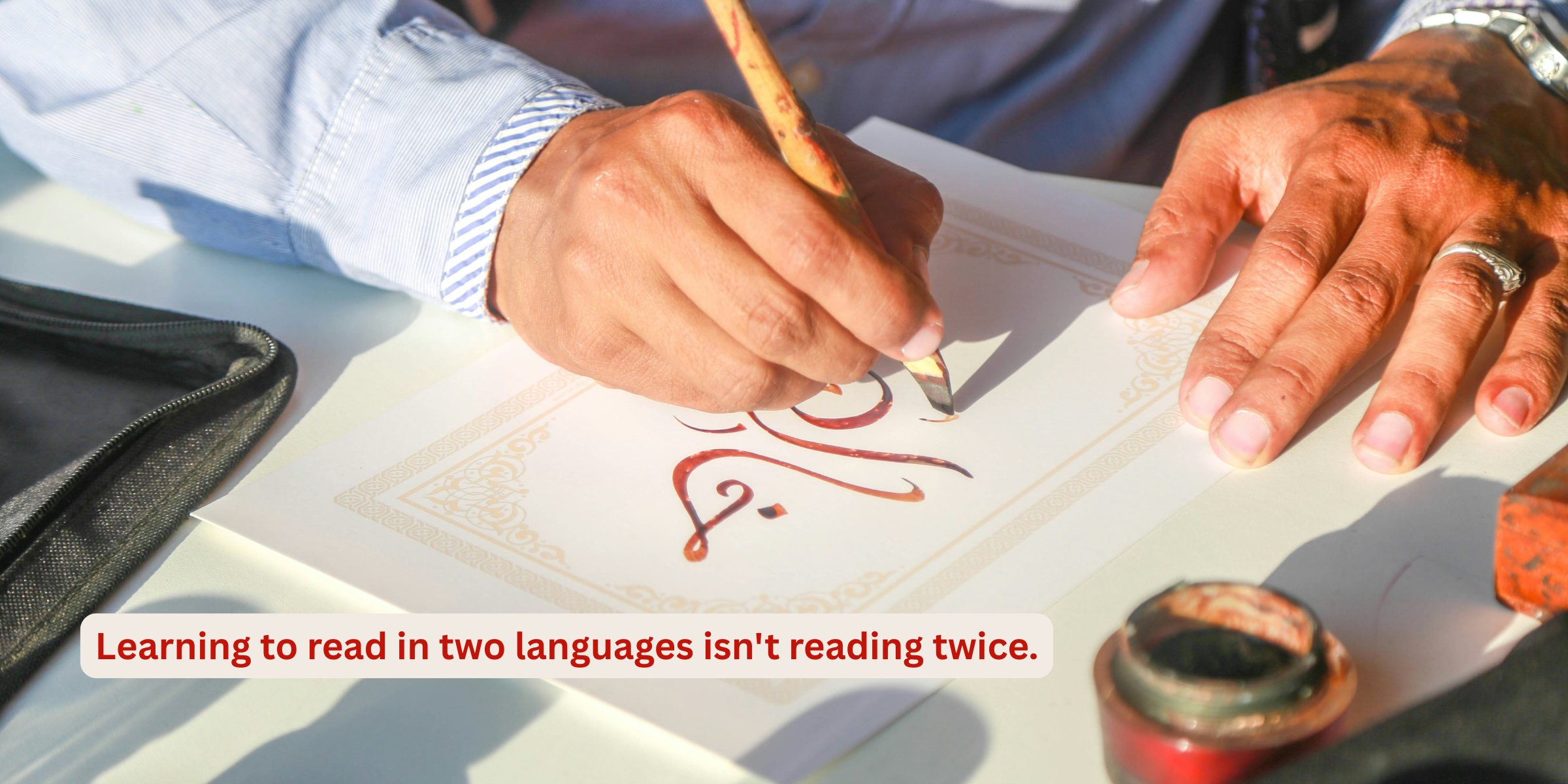
Research on this kind of cross-script transfer is fairly consistent. An alphabetic script and a very different system, such as Japanese kanji, Chinese characters, Arabic’s connected script, or Hindi’s Devanagari, don’t hand skills back and forth the way two alphabets do. Each requires a genuinely different approach to decoding, and transfer between them is selective rather than automatic. What does carry over is something more fundamental. The child already understands that marks on a page represent sounds and meaning, that reading has rules, and that persistence pays off. That underlying reading readiness holds up even when the letterforms themselves are entirely unfamiliar.
Grown-Ups Aren’t Starting from Scratch Either
I still think about that Russian class more often than I expected to. It wasn’t really about becoming a Russian speaker, more about understanding how the language was built, its grammar and structure, and reading Cyrillic came along as part of that. I never ended up with much more Russian than a handful of words and set phrases, but every other language I know uses the Latin alphabet, so learning an entirely new way of reading felt genuinely foreign. I enjoyed it more than I expected to.
There’s a persistent idea that children are simply better at this than adults, and it doesn’t hold up as well as people assume. Research on second-language and script acquisition has found that adults are often faster than children in the early stages of learning something new, partly because they can apply deliberate strategy in a way a five-year-old can’t yet. I’ve written before about why learning a language as an adult feels so hard, and the same pattern shows up here. Children tend to catch up and often surpass adults in long-term, native-like fluency, but the early, most disorienting phase tends to move faster for adults than for children learning the same script.
Reading Russian came with its own kind of trap. Some Cyrillic letters look exactly like Latin ones without behaving like them at all, a “Р” that’s actually an “R”, a “Н” that’s actually an “N”. My eye kept defaulting to the Latin reading before I’d properly retrained it, and unlearning that habit turned out to be slower than learning the genuinely unfamiliar letters from scratch.
Typing turned out to be its own skill again. For class, I had to work out how to type in Cyrillic on an ordinary keyboard, hunting for keys that didn’t match what was printed on them. A friend of mine who’s learning Japanese showed me something even further removed than that. His phone’s Japanese keyboard has one key per consonant sound, and holding a key down brings up the different vowel options for that syllable, so several sounds share a single key rather than each having its own letter. Reading a character, typing it, and writing it by hand are three different skills that just happen to end up looking like the same letter.
Handwriting is the piece I never actually tackled. I learned to read Cyrillic and to type it, but writing it by hand never came up in that class, and I’ve never properly practised it since. It’s worth knowing about anyway, because Cyrillic handwriting isn’t simply a joined-up version of the printed letters, the way English cursive mostly is. Russian schoolchildren learn a separate cursive alphabet, propis, where some letters change shape quite dramatically from their printed form, a printed “т” becomes something that looks closer to a Latin “m” in cursive, and a few other letters shift just as much. Someone who can read and type Cyrillic confidently might still find handwritten Cyrillic close to unreadable, which is a good reminder that “learning a script” is really several separate skills bundled under one name, and nobody has to pick all of them up at once, or at all.
What This Means for the Families I Work With
None of this adds up to a simple checklist, and I’d be wary of anyone who tells you there’s a single correct order to introduce two scripts in. What I can say, from the families I’ve worked with across different language combinations, is that the shape of the challenge is predictable even when the specific scripts aren’t. If both languages are alphabetic, expect real transfer, particularly in phonological skills, and expect the language with the more irregular spelling to simply take longer, not because something’s wrong, but because that’s what irregular spelling does to every child who learns it. If the two scripts are genuinely different systems, expect each one to need its own dedicated time and patience, and don’t mistake a child’s slower progress in the second script for a lack of aptitude.
I’ve written elsewhere about what these children need most from the adults teaching them, and expectations around timeline come up there, too. It matters enormously when the grown-ups around a child, at school as well as at home, understand this timeline rather than reading it as a problem to be fixed quickly.
This lines up with what Jim Cummins, whose BICS/CALP framework underpins much of what we understand about bilingual education, described as the difference between conversational fluency and academic language proficiency. Chatting fluently at the dinner table can happen within a couple of years of exposure to a language. Reading and writing at full academic level in that same language, particularly one with a different or more irregular script, can reasonably take five to seven years to fully mature. That’s the normal timeline for something genuinely difficult, done well, not a sign that anything has gone wrong.
Ready to Make Sense of Your Family’s Reading Journey?
What changes when parents understand this is the meaning they attach to the work, not the amount of work itself. A child who’s slower to read fluently in their second script isn’t behind, they’re partway through building something that, once it’s there, gives them access to an entire additional way of understanding the world, one script at a time.
If you’re navigating questions about how to support your child, or yourself, through learning to read across two or more languages and scripts, whether that’s choosing which language to introduce reading in first, understanding why progress looks uneven, or simply wanting a second opinion on what’s normal, this is exactly the kind of thing I help families and individuals work through in 1:1 consultations.
You can book a free 30-minute call or find more information about my work and current offers on my website. I also share ongoing insights and resources on Instagram, Facebook, and LinkedIn. I’d love to have you there!
FAQs
Does learning two alphabets confuse a child, or slow them down?
Not if both languages use an alphabet. Phonological awareness (the ability to hear and break apart sounds in words) transfers well between alphabetic languages, so a child who’s strong at sounding out German words has a real head start in English too.
Why does English take longer to read fluently than Spanish or German?
English has a “deep” orthography, full of exceptions and silent letters, while Spanish and German spell almost exactly as they sound. Children learning English simply need more time to reach the same accuracy: that’s true for monolingual English readers too, not just bilingual children.
Is it harder to learn two completely different writing systems, like Japanese and English, than two alphabets?
Each system needs its own dedicated learning time, since skills like kanji recognition don’t transfer to an alphabet the way skills between two alphabets do. What does transfer is the child’s basic understanding that marks on a page carry meaning, a foundation that supports learning any script.
Can adults learn a new script as easily as children?
Often more easily, at least at first. Adults can apply deliberate strategy in a way young children can’t yet, so they tend to move faster through the early, disorienting stage of learning an unfamiliar script, though children usually catch up in long-term fluency.
How long does it realistically take to reach full reading fluency in a second language?
Conversational fluency can develop within a couple of years, but full academic reading and writing fluency, especially in a language with a different or irregular script, typically takes five to seven years. That’s a normal timeline for something genuinely difficult, not a sign of a problem.
Not Sure Where to Start?
Book a free 30-minute intro call. No preparation needed, no strings attached.
Just a conversation about where you are and how I might be able to help.
Leave a Reply