
On translanguaging in the classroom, old habits, and what actually helps a child learn
I was ten years old when my family moved to Germany. I’d had four months of German lessons before we arrived, nowhere near enough for a full school day in the language. My teachers could’ve taken the standard approach: German only, sink or swim. Instead, they let me speak to them in English or Spanish, whichever one they happened to know, for as long as I needed to. They taught in German but translated the moment I looked lost. I was even allowed a dictionary in exams. The one time I forgot it, my teacher came over, translated the single word I genuinely didn’t know, and left me to get on with the rest.
None of that slowed my German down. It’s a large part of why I got there at all.
What my teachers were doing, without knowing the term for it, is now backed by a growing body of research: translanguaging in the classroom.
What Is Translanguaging?
Translanguaging is the practice of allowing students to draw on their full linguistic repertoire, all the languages they know, rather than keeping each one in a sealed compartment reserved for a specific subject or setting. Instead of switching a child’s entire brain to “target language only” the moment they enter the room, translanguaging treats a student’s home language as a resource they can reach for while they learn.
For decades, mainstream classrooms ran on the opposite rule. If a child was learning English, or German, they should hear and speak that language as much as possible, all the time. Home languages were, at best, a distraction. At worst, a crutch.
What the Research Says About Translanguaging in the Classroom
Studies across primary, secondary and university classrooms have found that when students can think and talk in the language they know best, even briefly, they understand new material more deeply. A child working through a maths word problem, or reasoning through a science concept, isn’t wasting time by first working it through in their home language. They’re using the tool that lets them reach the idea at all.
The benefits go beyond comprehension. Researchers have documented lower anxiety, higher participation, and stronger engagement among students who are allowed to use their home language as a bridge, rather than being asked to abandon it at the classroom door. There’s also a quieter, harder-to-measure effect: a child whose first language is welcomed in the room tends to feel that the rest of them is welcome, too.
This doesn’t mean lessons dissolve into a free-for-all where the target language disappears. Context still matters. A dedicated language lesson, where the whole point is practising English or German, calls for a different approach than a science or maths lesson, where the point is understanding the content. Home language use works alongside structure, as one more resource in the room rather than a replacement for the target language.
Why the “Target Language Only” Model Persisted
Part of it was genuine belief that immersion was the fastest route to fluency. Part of it was practical. A teacher with four home languages in one classroom, and expertise in none of them, understandably reaches for a rule that’s simple to apply: target language only, for everyone, all the time. Teachers weren’t getting it wrong out of carelessness. They were working with a model that made sense on paper and often didn’t hold up in the room.
That practical problem hasn’t gone away, and translanguaging doesn’t ask teachers to solve it by becoming multilingual overnight. It asks for a handful of concrete techniques that let a bilingual mind work the way it actually works, without a teacher needing to speak a word of the student’s home language.
Common Concerns About Translanguaging
The question I hear most from parents is whether allowing a home language in class will slow their child’s progress in the new one. The research points the other way. Students who can draw on their full linguistic repertoire tend to reach fluency in the target language faster, because they’re not spending their energy staying silent while they wait for the right English or German word to arrive.
Teachers sometimes worry about assessment: how do you mark work, or judge understanding, in a language you don’t read? In practice, translanguaging rarely reaches the final piece of work. It usually applies earlier, at the thinking and drafting stage, before a student produces the version that actually gets assessed. A student might plan an essay in Turkish and still hand in the finished piece in German.
There’s also a worry that students will use their home language to avoid practising the one they’re supposed to be learning. In my experience, and in the research, the opposite tends to happen. Students who feel secure enough to fall back on their first language when they need to are more willing to take risks in the new one. The safety net makes the leap easier, rather than making it optional.
How Schools Can Start Next Term
None of this needs a new curriculum or a training day. A few places to begin:
- Let students jot initial thoughts or vocabulary in their home language before writing in the target language
- Pair students who share a language for a few minutes of discussion before switching to whole-class English or German
- Allow a student to look up a tricky word in their own language rather than asking them to guess or stay silent
- Treat a moment of code-switching as information about where a student is stuck, not a discipline issue
- Ask students, early in term, which languages they think fastest in, so you know what’s available in the room before you need it
- Build in five minutes at the end of a lesson for students to summarise what they’ve learned in whichever language makes that easiest, even if the final piece of work stays in the target language
Pick one or two to try this term rather than all six at once. Small, low-effort changes like these open a door that’s often kept shut, and none of them ask you to overhaul how you plan a lesson.
Looking back, none of my teachers would’ve called what they were doing “translanguaging.” They didn’t have the research or the terminology behind them. They noticed that a frightened ten-year-old with patchy German understood far more than she could yet say, and gave her other ways to show it, until German caught up.
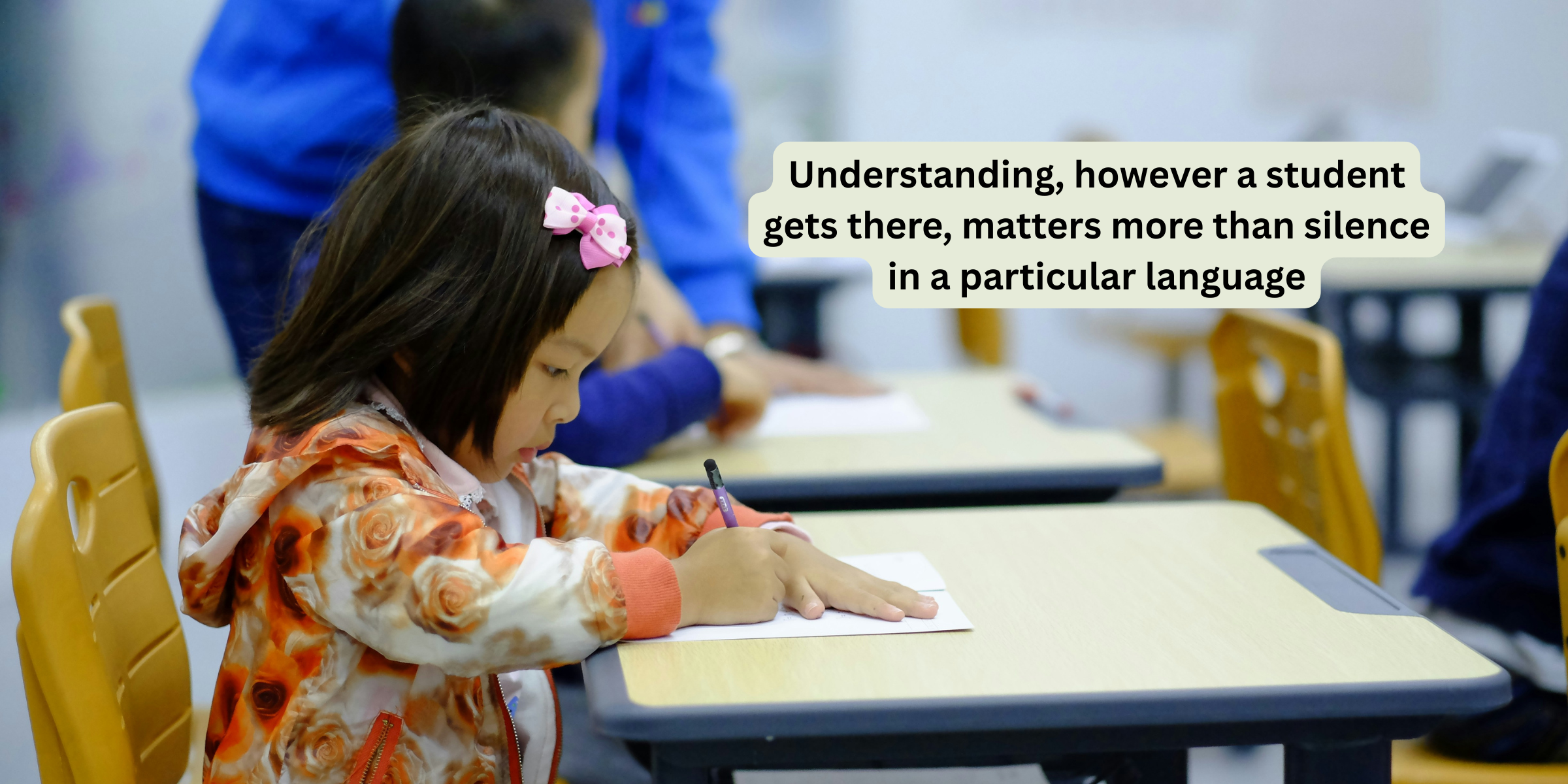
That’s what translanguaging in the classroom really asks for: a change in what gets treated as the goal. Understanding, however a student gets there, matters more than silence in one particular language.
If your school is navigating how to support multilingual learners without an EAL specialist on staff, Multi Lingua Consulting runs practical, teacher-facing workshops on exactly this.
You can book a call to talk through what your staff actually need or find out more about my work on my website, and I share regular reflections and practical insights on multilingualism on Instagram, Facebook, and LinkedIn. I’d love to have you there!
Frequently Asked Questions
What is translanguaging in the classroom?
Translanguaging is the practice of letting students use all the languages they know, not just the target language, as a resource for learning and communicating in class.
Is translanguaging the same as code-switching?
They’re closely related. Code-switching describes a student moving between languages, while translanguaging describes the deliberate classroom practice of welcoming and using that movement to support learning.
Do teachers need to speak a student’s home language to use translanguaging?
No. Techniques like pairing students who share a language, or letting students draft ideas in their home language before writing in the target one, don’t require the teacher to understand that language at all.
Does translanguaging slow down learning the target language?
Research points the other way. Students who can draw on their home language while learning a new one tend to show deeper understanding, lower anxiety, and higher participation, not slower progress.
Not Sure Where to Start?
Book a free 30-minute intro call. No preparation needed, no strings attached.
Just a conversation about where you are and how I might be able to help.
Leave a Reply