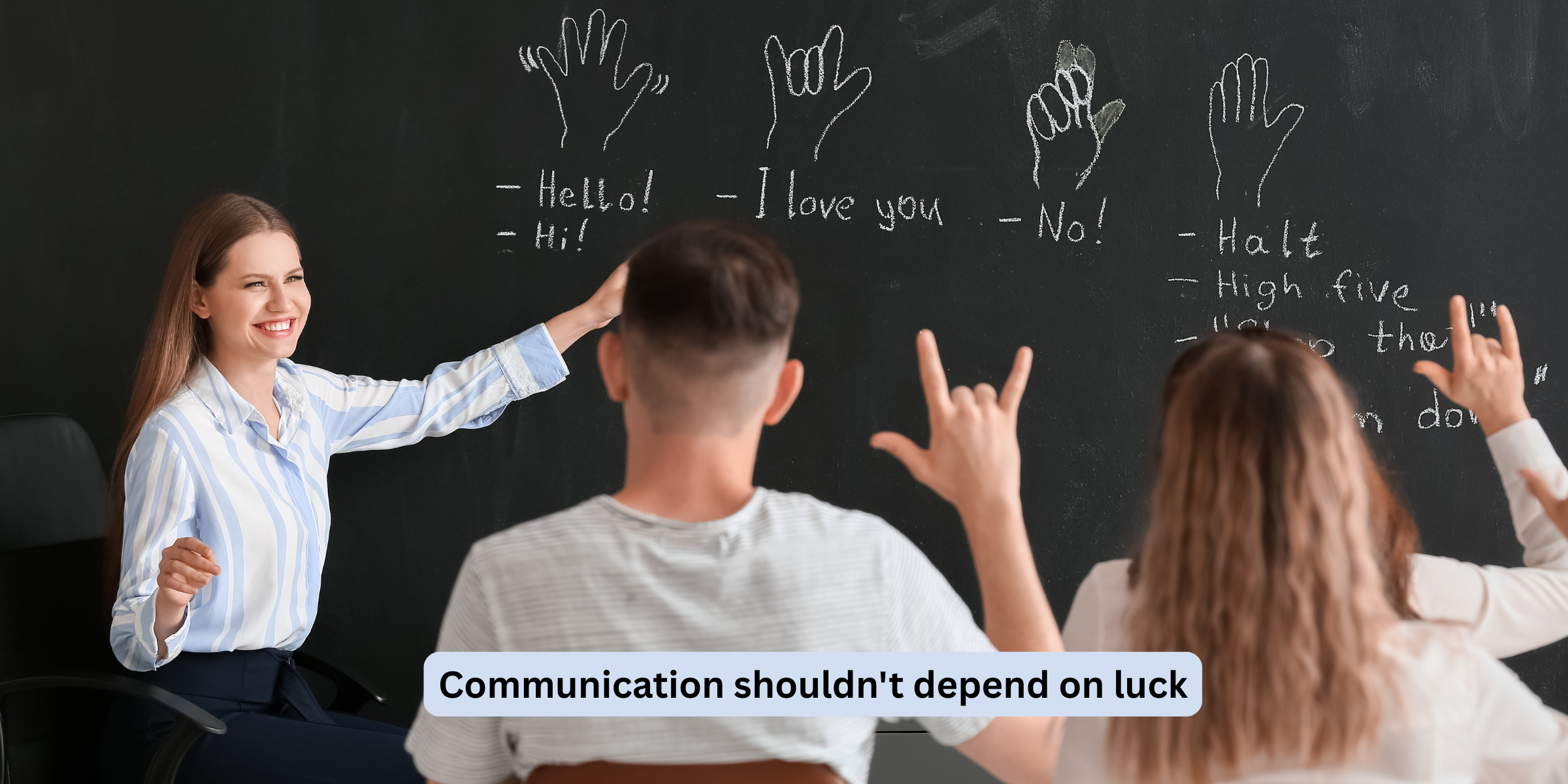
Daniel Jillings was twelve years old when he started campaigning for a British Sign Language GCSE. Five years later, the government confirmed it would happen, and last September, that promise became real: British Sign Language became a GCSE subject for the first time in the qualification’s history.
It’s a genuine milestone, and also, right now, one available in only a small number of schools and entirely optional rather than part of the National Curriculum. More than 70 million people worldwide belong to Deaf communities that communicate primarily through sign language. For almost everyone else, it remains something a lucky few stumble into rather than something any child is actually taught. The door has opened, but it hasn’t opened very wide yet.
Sign Language Isn’t One Language
Before getting into how that GCSE came to exist, it’s worth being clear about what’s actually being taught. A lot of people assume sign language works the same way everywhere, or that British Sign Language is basically English translated into hand shapes. Neither assumption holds up.
There are actually more than 300 distinct sign languages in use around the world, each with its own grammar, vocabulary, and history, entirely separate from the spoken language of the country it’s used in. British Sign Language and American Sign Language make a good example. Despite both countries speaking English, BSL and ASL aren’t mutually intelligible, and they’re not even related. ASL’s roots trace back to French Sign Language, brought to the United States in the nineteenth century, while BSL developed independently and belongs to its own family alongside Auslan in Australia and New Zealand Sign Language.
This matters for how we think about teaching it. Sign languages are complete, independent natural languages in their own right, not a hand-signed version of whatever’s spoken locally. Within Deaf culture, that’s reflected in how people describe themselves. Capital-D “Deaf” is generally used to mean a shared linguistic and cultural identity, distinct from lowercase “deaf,” which refers only to the audiological condition of hearing loss.
Treating it as a language rather than an accommodation lines up with something I see constantly in multilingual classrooms more broadly, the assumption that there’s one “normal” way to communicate and everything else is a special case, when most classrooms already hold more linguistic diversity than adults tend to give them credit for. That’s the language a GCSE has just started to recognise, after very nearly losing it altogether.
A Historic First for Sign Language in Schools
British Sign Language was only recognised in law as an official language of Great Britain in 2022. The GCSE that followed took over a decade of campaigning to arrive. From September 2025, students in a small selection of English schools can now study BSL as a two-year course, learning somewhere between 750 and 1,000 signs alongside the history of the language and the culture behind it.
It’s worth saying plainly why a GCSE means older students specifically. GCSEs sit at the end of compulsory secondary education, taken at fourteen to sixteen, and that’s true of every subject, not a deliberate decision to leave younger children out of sign language specifically. Nothing stops a primary school from teaching BSL if it wants to, there’s just no equivalent qualification at that age for any subject. Some schools are already doing exactly that. Signature, the same organisation behind the GCSE, runs a free programme called The School of Signs that brings BSL into primary classrooms alongside teaching about Deaf culture and identity, entirely separate from the exam route.
That younger-age push matters more than it might first appear, given the history. Sign language was actually banned from deaf education in 1880, when delegates at the International Congress on Education of the Deaf met in Milan and voted to replace it with oral-only teaching. Deaf teachers lost their jobs, children were punished for signing, and the ban held for well over a century before deaf education bodies formally apologised for it in 2010. The GCSE and programmes like The School of Signs are a fairly recent reversal of that, not a given.
Language suppression like this rarely stays confined to one community, or one kind of language. Spain banned Catalan, Basque, and Galician from schools and public life for the entire length of Franco’s dictatorship, from 1939 until his death in 1975. France did something similar decades earlier: the Jules Ferry laws of the 1880s made French the only language allowed in state schools, and children caught speaking Occitan, Breton, or Basque were shamed and punished for it, a policy Occitan speakers still call la vergonha, the shame. Versions of the same pattern show up across the world, in Indigenous boarding schools, in colonial classrooms, wherever a state decided one language should carry the nation’s identity and pushed everything else out of the room first.
Families kept the suppressed languages alive anyway, in kitchens and clandestine classes, much the way sign language survived in Deaf clubs and Deaf-run churches while it was banned from British and American classrooms. I’ve written before about what that looks like a few generations on, when a language survives the ban itself but still quietly disappears anyway. All of these bans were framed at the time as unifying, and all of them left a gap that took decades to close, some of which are still closing. A single GCSE won’t undo a century of that on its own, but it’s the kind of repair that has to start somewhere.
Scotland has taken a different route. Rather than adding BSL as one optional exam subject, the British Sign Language (Scotland) Act 2015 recognised BSL as an official language of Scotland outright, a full decade before England’s GCSE arrived. In 2025, the Scottish Parliament went further, unanimously passing the Education (Scotland) Act with amendments that give BSL users statutory rights of access across the whole education system, not just in one classroom subject. Campaigners pushed for those amendments after an earlier reading of the Bill recognised Gaelic but not BSL, and they made their case with a stark statistic: Deaf learners in Scotland are currently nearly three times more likely to leave school without qualifications than their hearing peers.
England hasn’t gone that far, and it’s worth being honest about what that gap looks like in practice. The GCSE is real progress, and it deserves to be recognised as such, but BSL still isn’t part of the National Curriculum, so most schools have no obligation to offer it at all, and plenty simply don’t have a trained teacher available even if they wanted to. A live petition is already calling for BSL to be added to the National Curriculum outright, rather than left as an optional GCSE in a handful of schools, which tells you the demand for something closer to Scotland’s approach exists well beyond the schools currently offering it. For most children in England, and for children everywhere else, sign language remains something they might stumble across by chance rather than something they’re ever actually taught.
What Gets Lost When It’s Optional
The case for teaching sign language more widely isn’t only about giving hearing children an interesting new skill, though it’s that, too. There’s a real cost to leaving it as a niche option that most schools never offer.
Deaf and hard-of-hearing children who are mainstreamed into hearing schools face a measurably higher risk of peer rejection, fewer close friendships, and bullying than their hearing classmates. The research on this is fairly consistent, and it points to communication access as the driver, not anything inherent about the children themselves. A classroom where a handful of hearing pupils know basic sign language looks different for a Deaf child than one where they’re the only person who can. I’ve written before about what these children need most from the adults teaching them, and training, not willingness, is usually the actual bottleneck. Schools that treat sign language as a genuine second medium of instruction, not just a fallback for the one Deaf pupil in the building, consistently show better outcomes on exactly this measure. It doesn’t need to be complicated. It just needs to stop being optional.
Widening sign language teaching would change more than classrooms, too. Right now, the fallback when a hearing person and a Deaf person don’t share a language is usually a phone passed back and forth, typing out what won’t come across any other way. It works, more or less, but it’s slow, it flattens a conversation down to whatever fits in a text box, and it puts the entire burden of adapting on the Deaf person. A shop assistant or a colleague who knows even basic BSL changes that exchange from something typed out to something actually signed.
A GCSE available in a handful of schools doesn’t move that needle much. A basic grounding taught widely, the way children currently get a taste of French or Spanish whether or not they ever become fluent, would.
I picked up a handful of signs myself in preschool, because there was a deaf girl in my class, though I don’t remember much of it now beyond the fact that a five-year-old managed it without much effort. That’s roughly where it stayed until I met two of my husband’s relatives in Turkey, who communicate through Turkish Sign Language, a language isolate all its own, unconnected to spoken Turkish or to any other country’s sign language, used by roughly 250,000 people. I’ve decided I want to learn some basics myself, though I’m still working out which sign language actually makes sense to start with, there’s no single “closest one” to reach for the way there might be with a spoken language. If anyone reading this has tips, I’d genuinely love to hear them.
You Don’t Need a GCSE to Start
None of this requires waiting for policy to catch up. Learning enough sign language to hold a basic conversation is genuinely more achievable than most people assume. Research on BSL specifically suggests a beginner can reach conversational basics in around 15 to 20 hours of focused study, while a full accredited Level 1 qualification runs to roughly 64 guided hours, usually taught across a single school term. That’s a realistic weekend-course-and-practice commitment, not a multi-year undertaking.
Next week marks International Week of the Deaf, running into International Day of Sign Languages on the 23rd. It’s as good a moment as any to actually start. Most areas have local BSL taster sessions or beginner courses through community colleges or Deaf charities, and a quick search for “BSL beginner course” plus your town or city usually turns up more options than people expect, often through the same institutions that already run evening classes in French or Italian. If a structured course isn’t practical right now, there’s a genuinely good selection of free beginner sign language channels on YouTube, too. Neither route requires your school, or your child’s school, to have a policy in place first.
Ready to Bring Sign Language Into Your School’s Culture?
What changes when a school treats sign language as a normal part of language learning, rather than a rare specialist option, is the message it sends before a single sign is even taught. It tells every child that communication comes in more than one form, and it tells any Deaf child in the building that they aren’t the exception the rest of the class has to work around.
If you’re thinking about how to bring more genuine language inclusion into your school, whether that’s exploring sign language provision, rethinking how communication access works day to day, or simply wanting to know where to start, this is exactly what my workshops for schools are built around.
You can book a free 30-minute call or find more information about my work and current offers on my website. I also share ongoing insights and resources on Instagram, Facebook, and LinkedIn. I’d love to have you there!
Not Sure Where to Start?
Book a free 30-minute intro call. No preparation needed, no strings attached.
Just a conversation about where you are and how I might be able to help.
Frequently Asked Questions
Is British Sign Language a GCSE subject in England?
Yes, since September 2025. It’s a genuine GCSE, but currently only offered in a small number of schools, and it isn’t part of the National Curriculum.
Why isn’t BSL taught in every school?
BSL isn’t a compulsory National Curriculum subject, so schools have no obligation to offer it, and many don’t have a trained BSL teacher available even if they wanted to.
How long does it take to learn basic British Sign Language?
Research on BSL suggests a beginner can reach conversational basics in around 15 to 20 hours of focused study, with a full Level 1 qualification taking roughly 64 guided hours.
Is British Sign Language the same as American Sign Language?
No. BSL and ASL aren’t mutually intelligible and aren’t even related. ASL developed from French Sign Language, while BSL belongs to its own family alongside Auslan and New Zealand Sign Language.
Why was sign language banned in schools historically?
In 1880, delegates at the International Congress on Education of the Deaf voted to replace sign language with oral-only teaching. The ban held for well over a century before deaf education bodies formally apologised for it in 2010.
Leave a Reply