
What’s Really Going On When Motivation Goes Missing
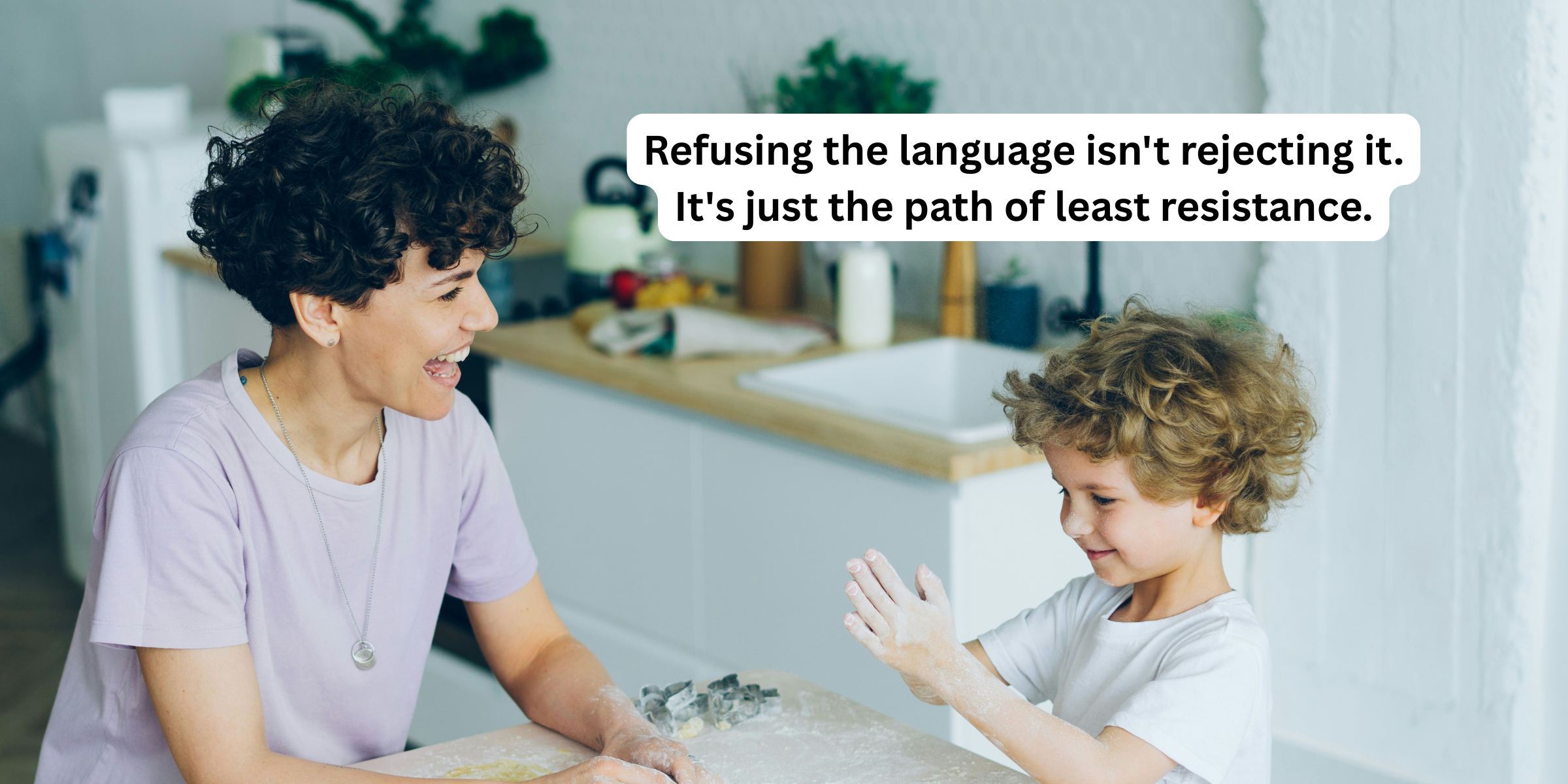
When I was about four years old, living in England, my mum would speak to me in Spanish at the breakfast table and I’d answer in English. Every time. She’d try again in Spanish. I’d answer in English again, and eventually I’d tell her, with the casual cruelty only a child can deploy, to please just talk normally. By ‘normally’ I meant in English. In the street where we lived, in my school, in every shop and playground I moved through, Spanish had no function at all. Nobody else spoke it. Nothing around me required it. And so, to my four-year-old brain, it simply didn’t make sense.
My mum kept going. She didn’t make a drama of it, didn’t push back in a way that created a battleground, just kept speaking to me in Spanish with the patience of someone who understood something I didn’t yet: that the need would eventually come. And she was right.
I share this story because it’s one I hear echoed in different forms from almost every multilingual family I work with. The child who answers in the majority language even when addressed in the minority one. The child who groans when a grandparent calls and the call will be in a language they’d rather avoid. The child who seems to have understood everything for years and then, almost overnight, acts as though the heritage language is an imposition.
Parents often interpret this as rejection — of the language, of the culture, sometimes even of the parent who speaks it. Understandably so. But what’s actually happening is almost always more straightforward, and far less personal.
Why Children Refuse Minority Languages
Language use in children is governed almost entirely by need and environment. Children are, above all, pragmatists. They speak the language that works in the moment, the language that connects them to the people around them, the language that earns them full membership in their social world. When a minority language offers none of those things — because it’s spoken only at home, only with one parent, or only on occasional visits to family abroad — children stop reaching for it, not because they’ve lost it or abandoned it, but because they haven’t yet found a reason to use it.
This is compounded by the simple economics of cognitive effort. Speaking a weaker language takes more concentration than speaking the dominant one. Children who are tired, busy, distracted, or socially self-conscious will always default to their strongest language. This is entirely normal and says nothing about the long-term prospects for the minority language.
In families where one parent speaks the heritage language and the other doesn’t, the child quickly learns that switching to the majority language loses nothing. The parent who speaks the heritage language almost certainly understands the majority language, too, so the child gets their point across either way. Why do the harder thing?
What Actually Helps
The most effective shift is environmental, not motivational. Motivation follows opportunity and need — it rarely precedes them. When children encounter genuine reasons to use the minority language, something clicks. A holiday where the heritage language is the only way to get an ice cream. A grandparent who genuinely doesn’t speak the majority language. A WhatsApp group with cousins. A favourite film that only exists in the heritage language. These are the levers, and they’re more powerful than any amount of encouragement or insistence at home.
One family I work with has a child growing up in Germany with a heritage language spoken by only one parent. The environmental pressure toward German is intense — school, friendships, screen time, the whole social world is in German. Rather than fighting this directly, we worked on creating small but consistent moments where the heritage language was the natural choice: a weekly video call with extended family, a bedtime story only available in the heritage language, cooking sessions where one parent stuck entirely to it. The goal wasn’t immersion; it was sufficiency — enough regular contact to keep the language alive and associated with warmth rather than obligation.
What tends not to work is making the minority language a source of tension. Children who associate a language with conflict, pressure, or parental disappointment build a resistance to it that can outlast childhood. The emotional texture around a language matters as much as the linguistic input.
A Few Practical Anchors
For families navigating this, a few principles tend to hold across different situations. Consistency matters more than volume — a small daily interaction in the minority language is more valuable than an occasional intense effort. The parent who speaks the heritage language keeps speaking it even when the child responds in the other language; this keeps the input steady without turning every conversation into a negotiation. Finding a genuine community — even a small one, even online — of other children who speak the heritage language shifts it from a private family thing into a real-world social tool. And, whenever possible, visiting places where the heritage language is the majority language does more in two weeks than months of at-home effort.
None of this is quick and none of it is linear. There will be periods of apparent regression, phases where the minority language almost disappears from active use, and then surprising recoveries. Children who seemed entirely uninterested at ten are often the ones holding fluent conversations at sixteen. The language accumulates quietly even when it’s not being performed.
If you’re wondering whether your approach is working or whether there’s something specific holding your child back, that’s exactly the kind of question worth exploring together. I offer a free 30-minute introductory call where we can look at your specific situation together and work out where to start.
You can find out more about my work on my website, and I share regular reflections and practical insights on multilingualism on Instagram, Facebook, and LinkedIn. I’d love to have you there!
Not Sure Where to Start?
Book a free 30-minute intro call. No preparation needed, no strings attached.
Just a conversation about where you are and how I might be able to help.
Read More on the Blog
- Why My Brain Kept Switching Languages in Gibraltar
- What Three Languages Taught Us About Building a Wedding Ceremony for Everyone, and No One, at Once
- The Real Cost of Treating Bilingual Employees as Your Backup Translators
- England Just Made Sign Language a GCSE. Here’s Why Every Child Should Get the Chance
- Learning to Read in Two Languages Isn’t Reading Twice
Leave a Reply