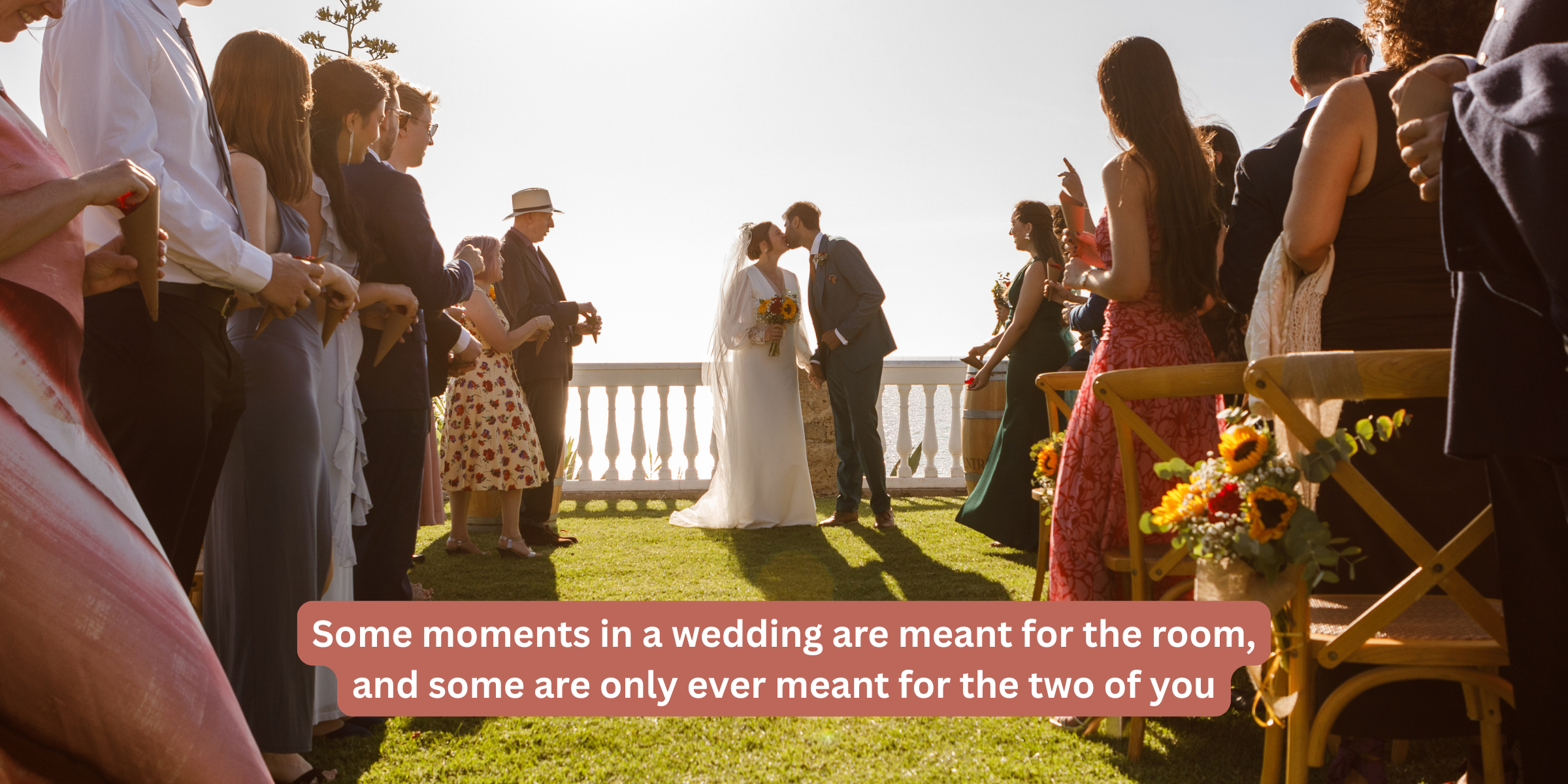
Three people led our wedding ceremony, and none of them was a professional officiant. My uncle led one part, in Spanish. Our closest German friend led another, in German. My childhood best friend from Spain took on the English part, a language that wasn’t the obvious choice for her at all, and she agreed anyway and did it beautifully. When it came to my vows to my husband, I spoke them in German only, which meant not everyone in the room understood them in the moment.
None of that happened by accident. Every one of those choices was made on purpose, well before the day itself, and it’s worth talking through properly, because most multilingual couples eventually face some version of the same question. Which languages go where, and why.
Why We Decided the Languages in Advance
I’ve written before about the logistics of planning our wedding across eight countries and five languages, choosing a venue, coordinating officiants, working out who needed what translated in advance. That post was about the planning itself. This one is about something narrower and, in some ways, harder, the actual language choices inside the ceremony once the logistics were sorted.
It would’ve been simpler to pick one shared language and run the whole thing through it, with everything else offered as a translated handout. Plenty of multilingual couples do exactly that, and there’s nothing wrong with it. We didn’t, because a wedding ceremony is one of the few moments where language carries almost as much meaning as the words themselves. Researchers who study family language policy in multilingual households have found something similar, that the language choices a couple makes early on tend to shape identity and belonging within the family for years afterwards, not just communication in the moment. The language something is said in shapes how it lands, for the person saying it and for the person hearing it. Deciding this in advance, deliberately, felt like part of building the ceremony rather than a detail to sort out afterwards.
We also wanted the choice to reflect the people involved, not just the two of us. A wedding brings together family members and friends who might otherwise never share a room, let alone a language, and the ceremony is one of the few moments where that mix is fully on display. Treating the language choices as part of the design, rather than an afterthought squeezed in once everything else was booked, meant we could actually plan for that mix instead of hoping it would sort itself out.
Spanish, English, German: Where Each Language Went
We didn’t bring in an outside officiant at all. The ceremony was led entirely by my uncle and two close friends, each taking on a different part in a different language, which meant every language in the room was represented by someone we actually loved rather than by a stranger reading a script. My uncle led the Spanish part. Our German friend led the German part. The English part, the language most guests in the room actually shared, went to my childhood best friend from Spain, not the language anyone would have guessed for her, and she took it on anyway and did an outstanding job.
The vows were different. We chose German for them specifically, because it’s the language that carries the most private, unguarded version of how we speak to each other day to day. That decision meant some people in the room followed every word, and others followed none of it and simply watched. We knew that going in, and we were at peace with it. A wedding ceremony doesn’t have to be fully legible to every guest to be meaningful. It has to be true to the couple making the promises.
This isn’t unusual for multilingual couples generally. I’ve written before about how language shapes intimacy in multilingual relationships, and the same pattern shows up again and again, that couples often gravitate towards one particular language for the most personal, unguarded conversations, regardless of which language they use for everyday practical life. Vows are simply that pattern showing up on the one day everyone’s watching.
Which Parts Are for the Room, and Which Are Just for You
Looking back, the clearest way to describe what we did is that we sorted the ceremony into two categories early on, the parts that were genuinely for the room, and the parts that were only ever for the two of us. The three parts led by my uncle and our friends, and the welcome and pronouncement around them, all of that was for the room, and we planned the languages there with every guest in mind. The vows sat in the other category. They were the one part of the day that didn’t need an audience to understand them to work.
Which moments in a wedding are actually meant for the guests, and which ones are only ever meant for the two people making the promise? It’s a question worth sitting with properly, because the answer is rarely obvious until you’re planning the actual script and have to choose. Getting clear on that distinction early made every other language decision easier, because we weren’t trying to make one moment do two jobs at once.
A Few Starting Points for Planning Your Own Multilingual Ceremony
If you’re somewhere in the middle of planning a multilingual or multicultural ceremony of your own, a few starting points tend to make the process considerably less overwhelming.
Start by mapping out who’s actually in the room and what language matters to each of them, rather than defaulting to whichever language is most commonly spoken among your combined guest list. A grandparent who speaks no English but sits in the front row deserves more consideration than a rough headcount would suggest. From there, decide deliberately which parts of the ceremony are shared, public moments and which are private ones between the two of you. That distinction does most of the heavy lifting once you’re ready to assign specific languages to specific parts.
For the shared parts, give thought to who leads what, and consider asking family members and close friends to lead in their own languages rather than translating everything into one. It tends to mean more to them and lands better with anyone listening, even without full comprehension. For the private parts, you don’t owe anyone a live translation. A simple printed programme note explaining what’s being said, or a friend quietly narrating the gist afterwards over drinks, includes guests without turning an intimate moment into a performance.
It also helps to talk to your officiant early about how flexible the format actually is. Some registrars and celebrants are used to switching languages mid-ceremony and will offer suggestions of their own, while others default to a single-language script unless asked. Raising it as a specific request, rather than a vague wish, tends to get a much better result. If your ceremony includes a legal declaration that has to be spoken in a specific language for the marriage to be valid where you’re marrying, confirm that early, too, so the legal requirement and the personal choices around it don’t end up in tension on the day itself.
Finally, involve the people you’re asking to lead a part or speak before the day arrives, not just to confirm they’re willing, but to talk through what the moment will actually feel like for them. Standing up in front of a room to lead part of your ceremony, especially in a language that isn’t the obvious one for you, is a different kind of pressure to reading a translated script someone handed you. A short conversation beforehand, about pace, about what the words mean to you, about how much rehearsal they’d like, tends to turn a favour into something they remember fondly rather than something they were relieved to get through.
Ready to Plan a Ceremony That Feels Entirely Yours?
Getting these decisions right changes the whole shape of the day. It means every language choice in your ceremony reflects something true about your relationship and your families, rather than being smoothed over for convenience or left to chance until the week before.
If you’re navigating questions, challenges, or goals around multilingualism, whether that’s planning a wedding across several languages, raising a family across them, or simply working out what feels right for your own relationship, this is exactly the kind of thing a one-to-one consultation can help you think through properly, well before the pressure of a final week of planning sets in.
You can book a free 30-minute call or find more information about my work and current offers on my website. I also share ongoing insights and resources on Instagram, Facebook, and LinkedIn. I’d love to have you there!
Frequently Asked Questions
How many languages should a multilingual wedding ceremony include?
There’s no fixed number. Include the languages that genuinely matter to the people involved, whether that’s two or five, and resist the urge to add a language just because a small number of guests speak it.
Should wedding vows be translated for guests who don’t understand them?
Not necessarily. Vows are one of the few parts of a ceremony that can stay private between the couple, understood fully by them alone, while the rest of the ceremony remains inclusive of everyone present.
What’s the best way to include family members who speak different languages in a wedding ceremony?
Give them a specific part of the ceremony to lead in their own language, rather than asking them to perform in a language that isn’t theirs. It tends to mean more to them and to the guests listening.
Do vows have to be understood by every guest to be meaningful?
No. A vow’s meaning comes from its truth to the couple saying it, not from how many people in the room can follow along in real time.
Not Sure Where to Start?
Book a free 30-minute intro call. No preparation needed, no strings attached.
Just a conversation about where you are and how I might be able to help.
Leave a Reply