On code-switching, Llanito, and the freedom of not having to choose
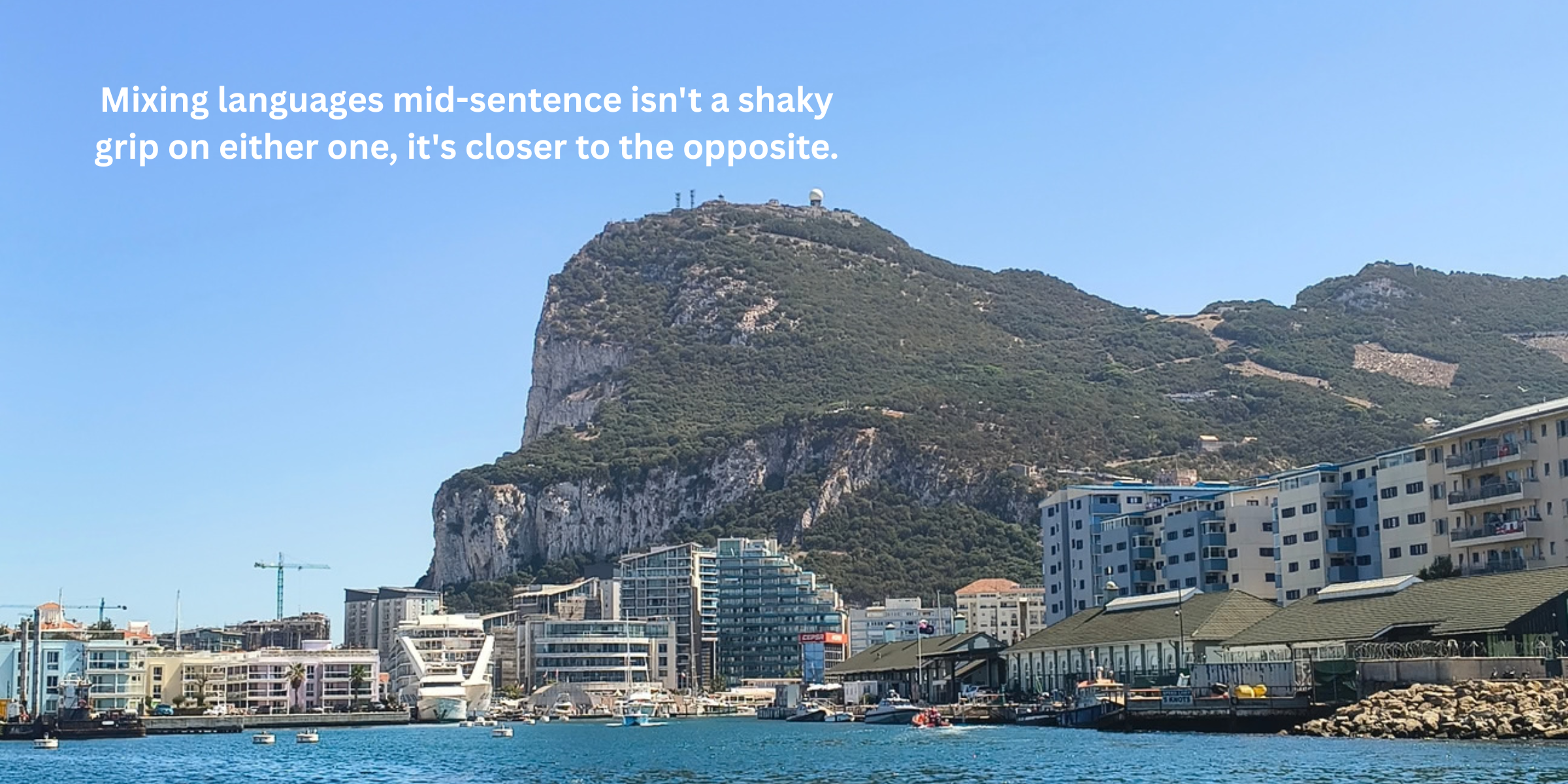
I was in a small shop in Gibraltar, halfway through a day-trip with my sister and a friend, when the cashier asked me something in Spanish, paused, switched to English mid-sentence, then dropped back into Spanish for the total. I hadn’t said a word yet. I still hadn’t worked out which language to use with her, and she’d already used both, comfortably, in the same breath. It happened again five minutes later in the next shop. And again on the street, in a restaurant, in half the conversations I overheard that day. Not occasionally, constantly.
What struck me wasn’t that people in Gibraltar speak two languages. Plenty of places do that. It was that they don’t seem to experience Spanish and English as two separate boxes to choose between. The two run together, sometimes within a single sentence, and nobody appears to find that remarkable except the visitor standing at the till trying to work out which language she’s supposed to be having this conversation in.
That visitor confusion is, itself, kind of interesting. So I want to unpack what’s actually happening when people do this, called code-switching, why it feels different from simply knowing two languages, and what Gibraltar’s own version of it, known locally as Llanito, can tell us about how deep this goes when an entire community grows up doing it.
What Code-Switching Actually Is
Code-switching is the practice of moving between two or more languages within a conversation, sometimes between sentences, sometimes within a single sentence, sometimes for a single word. It’s not a sign that someone doesn’t fully know either language. If anything, the research points the other way.
A 2023 study in Frontiers in Psychology, working with French-Canadian bilinguals, found that people who habitually code-switch showed measurable advantages in inhibitory control, the mental skill involved in filtering out irrelevant information and staying on task. The researchers describe frequent, deliberate code-switchers as needing to constantly monitor two active language systems and choose the relevant one in real time, and that ongoing exercise appears to sharpen the same cognitive machinery used for filtering distractions in general. It’s less like forgetting which language you’re in and more like a mental muscle that gets stronger through regular use.
This is worth sitting with, because it runs against a fairly old and stubborn assumption that mixing languages mid-sentence signals a shaky grip on either one. It’s closer to the opposite. Deciding, often unconsciously, which language best fits a given word, mood, or social moment, and switching to it seamlessly, takes more linguistic control than staying in one language throughout, not less. It’s a genuinely different skill from simply being bilingual, which is why two people can both speak two languages fluently and yet code-switch at very different rates depending on their environment and habits. I’ve written before about why learning a language as an adult feels so hard, and code-switching sits at the opposite end of that spectrum entirely. It’s not effortful in the way early learning is. For someone who’s grown up doing it, it’s closer to breathing.
Llanito: Gibraltar’s Everyday Third Language
What I saw in that shop has a name. Gibraltarians call it Llanito, sometimes spelt Yanito, and it deserves proper attention rather than a passing mention, because it’s a genuinely fascinating case study in what happens when code-switching becomes woven into an entire community’s daily life rather than an individual habit.
Llanito is built on Andalusian Spanish, heavily layered with English, and it carries traces of Genoese, Hebrew, Maltese, and Portuguese, too, a direct reflection of Gibraltar’s mixed history. The territory has been home to waves of Genoese labourers, Sephardic Jewish families with roots in North Africa, Maltese settlers, and British administrators and military families, all living alongside a Spanish-speaking Andalusian population, for the better part of three centuries. Llanito is what that mixture sounds like when it settles into everyday speech. Even its name is disputed. One theory traces “Llanito” to the Spanish word for flatland, a nod to the local terrain. Another points to Genoese slang, where “Gianito” was a diminutive of the name Giovanni, “little Johnny”, reportedly common enough among Gibraltar’s large Genoese community in the late 1700s that it became attached to the local population generally.
Linguists who study Llanito closely tend to describe it less as a fixed dialect with its own grammar and more as a set of code-switching habits and borrowed vocabulary layered onto Andalusian Spanish. Some argue it isn’t really a separate linguistic system at all, just what intense, constant code-switching looks like when an entire bilingual community does it together for generations, complete with its own in-jokes, calques, and Anglicised pronunciations. Either way, it’s real enough that Gibraltar has produced actual dictionaries of it, and it’s distinct enough that a Gibraltarian moving to inland Spain or England will find themselves subtly, sometimes very unsubtly, out of step with how people speak in either place.
The Sheer Frequency of It
What I couldn’t have appreciated before visiting is quite how relentless the switching is. It’s genuinely documented, not just something a visitor imagines. Researchers who’ve recorded and transcribed everyday Gibraltarian speech have logged code-switches within single sentences as an ordinary, unremarkable feature of conversation, not an occasional flourish. One frequently cited example, drawn from real recorded speech, has a speaker saying “te llamo p’atrá anyway”, Spanish grammar and vocabulary carrying an English word dropped in without a second thought, meaning simply “I’ll call you back anyway”. Nobody in that conversation would have registered it as unusual. It’s just how the sentence came out.
That’s the part that’s hard to grasp until you’ve stood in the middle of it. It isn’t that Gibraltarians occasionally reach for an English word when the Spanish one slips their mind, or vice versa. The switching itself is the register. Two languages functioning as one continuously available toolkit, drawn from word by word, clause by clause, according to whatever fits best in the moment.
What Felt Freeing, What Felt Confusing
Standing in that shop, not knowing which language to default to was genuinely disorientating, at least at first. I speak Spanish and English natively myself, so it wasn’t a comprehension problem. It was something closer to not knowing which social rule I was supposed to be following. In most bilingual settings I’ve been in, there’s an implicit understanding of which language a given interaction happens in, and you find it within the first exchange or two. In Gibraltar, that rule simply doesn’t apply in the way I expected it to, because the two languages aren’t taking turns. They’re overlapping.
Once I stopped trying to work out which language I was “supposed” to be speaking, something shifted, and it became genuinely freeing rather than confusing. Nobody in Gibraltar was making a decision about the one correct language for our interaction, and neither did I have to. I could reach for whichever word arrived first, in whichever language it arrived in, and be understood completely. That’s not something most bilingual environments actually offer. Usually, there’s a language of the room, and mixing feels like a lapse. In Gibraltar, for the day, it felt more like having a wider vocabulary than either language alone could give me, available all at once rather than sorted into two separate drawers.
I’ve written elsewhere about how couples navigate which language carries which parts of a relationship, often without ever discussing it directly, and Gibraltar does something similar at the scale of an entire population. Nobody sat down and decided the rules. The two languages simply found their own equilibrium, generation after generation, and everybody inside it moves through that equilibrium without appearing to notice it’s there at all.
That’s the piece I keep coming back to since coming home. I’d always thought of my own bilingualism as two languages I happened to keep in reasonably good working order, switched on and off depending on the room. Gibraltar showed me a version where the switch itself has disappeared, where two languages just sit there together as one shared resource. I don’t think I’ll experience my own English and Spanish quite the same way again, and that shift, from managing two languages to simply having them, feels like the real souvenir from that trip.
Ready to Make Sense of Your Own Multilingual Mix?
Whether you’re a family finding its own version of this, moving between languages depending on who’s in the room, or an individual trying to work out why switching mid-sentence sometimes feels natural and sometimes feels like slipping, code-switching is worth understanding properly rather than treating as a quirk to iron out. It isn’t a sign that anything’s gone wrong with your language skills. Often, it’s the opposite.
If you’re navigating questions about your own multilingual life, whether that’s understanding your own code-switching habits, supporting a partner or child who moves between languages differently to you, or simply wanting to make more sense of how your languages actually work together, this is exactly the kind of thing a one-to-one consultation can help you think through.
You can book a free 30-minute call or find more information about my work and current offers on my website. I also share ongoing insights and resources on Instagram, Facebook, and LinkedIn. I’d love to have you there!
Frequently Asked Questions
Is code-switching a sign of not knowing a language well?
No, generally the opposite. Research links habitual code-switching to stronger cognitive control, the mental skill of managing two active systems and choosing the right one in the moment, rather than to weaker knowledge of either language.
What’s the difference between code-switching and just being bilingual?
Being bilingual means knowing two languages. Code-switching is an active, often unconscious habit of moving between them within a conversation, sometimes within a single sentence. Two equally fluent bilinguals can code-switch at very different rates depending on their environment.
Is Llanito its own language?
Linguists are divided. Many describe it less as a separate language with fixed rules and more as intense, community-wide code-switching between Andalusian Spanish and English, layered with borrowed vocabulary from Genoese, Hebrew, Maltese, and Portuguese, built up over generations of Gibraltar’s mixed history.
Why does hearing constant code-switching feel disorientating to an outsider?
Most bilingual settings have an implicit “language of the room” that becomes clear within the first exchange. In places like Gibraltar, the two languages overlap rather than take turns, so that expectation doesn’t apply, which can feel confusing at first and freeing once you stop looking for a single correct language to default to.
Not Sure Where to Start?
Book a free 30-minute intro call. No preparation needed, no strings attached.
Just a conversation about where you are and how I might be able to help.
Leave a Reply